
Help ?

IGMIN: We're glad you're here. Please click 'create a new query' if you are a new visitor to our website and need further information from us.

If you are already a member of our network and need to keep track of any developments regarding a question you have already submitted, click 'take me to my Query.'

Search

Organised by  IgMin Fevicon

Regional sites

Browse by Subjects

Welcome to IgMin Research – an Open Access journal uniting Biology, Medicine, and Engineering. We’re dedicated to advancing global knowledge and fostering collaboration across scientific fields.

Browse by Sections

At IgMin Research, we bridge the frontiers of Biology, Medicine, and Engineering to foster interdisciplinary innovation. Our expanded scope now embraces a wide spectrum of scientific disciplines, empowering global researchers to explore, contribute, and collaborate through open access.

Special Issues

We support fostering a collaborative environment where interdisciplinary knowledge is exchanged freely.

Members

We support fostering a collaborative environment where interdisciplinary knowledge is exchanged freely.

Articles

We support fostering a collaborative environment where interdisciplinary knowledge is exchanged freely.

Explore Content

We support fostering a collaborative environment where interdisciplinary knowledge is exchanged freely.

Identify Us

We support fostering a collaborative environment where interdisciplinary knowledge is exchanged freely.

IgMin Corporation

Welcome to IgMin, a leading platform dedicated to enhancing knowledge dissemination and professional growth across multiple fields of science, technology, and the humanities. We believe in the power of open access, collaboration, and innovation. Our goal is to provide individuals and organizations with the tools they need to succeed in the global knowledge economy.

Publications Support
[email protected]
E-Books Support
[email protected]
Webinars & Conferences Support
[email protected]
Content Writing Support
[email protected]
IT Support
[email protected]

Search

Select Language

Explore Section

Content for the explore section slider goes here.

Abstract

Abstract at IgMin Research

We support fostering a collaborative environment where interdisciplinary knowledge is exchanged freely.

Engineering Group Research Article Article ID: igmin367

Integrated Health Data System (IHDS): An Evidence-informed Reference Architecture for Interoperable Learning Health Systems

Artificial Intelligence DOI10.61927/igmin367 Affiliation

Affiliation

    Department of Public Health, North South University, Dhaka, Bangladesh

28
VIEWS
16
DOWNLOADS
125
Connect with Us

Abstract

Background: Health systems increasingly rely on digital records, information exchanges, and specialized service platforms, but technical connectivity alone does not ensure coordinated, equitable, and accountable care. This paper proposes the Integrated Health Data System (IHDS), an evidence-informed conceptual reference architecture intended for adaptation across health-system settings. A concentric geometric model is used as a visual language for organizing interdependent capabilities, not as evidence of technical performance.
Methods: A design-science and conceptual framework approach informed a purposive review of WHO and WHO-ITU guidance, OpenHIE and HL7 interoperability specifications, learning-health-system theory, systems thinking, governance scholarship, and emerging-technology evidence. The July 2026 evidence scan was documented by source type, search concepts, selection criteria, and a description of how the evidence informed domain selection. Functions and safeguards were mapped to an exchange-centred design and examined through an internal standards comparison, a hypothetical referral-pathway walkthrough, and explicit appraisal of assumptions and limitations. No prototype or implementation evaluation was undertaken.
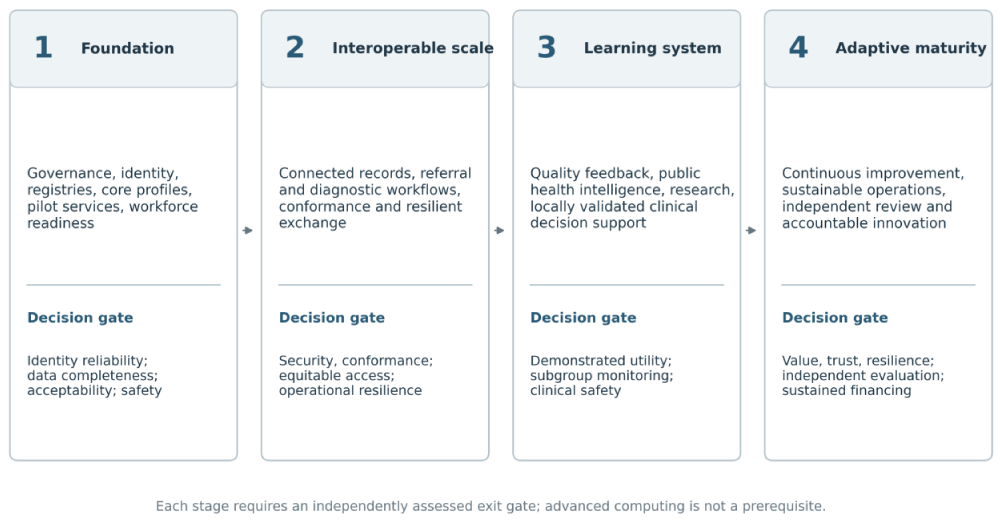
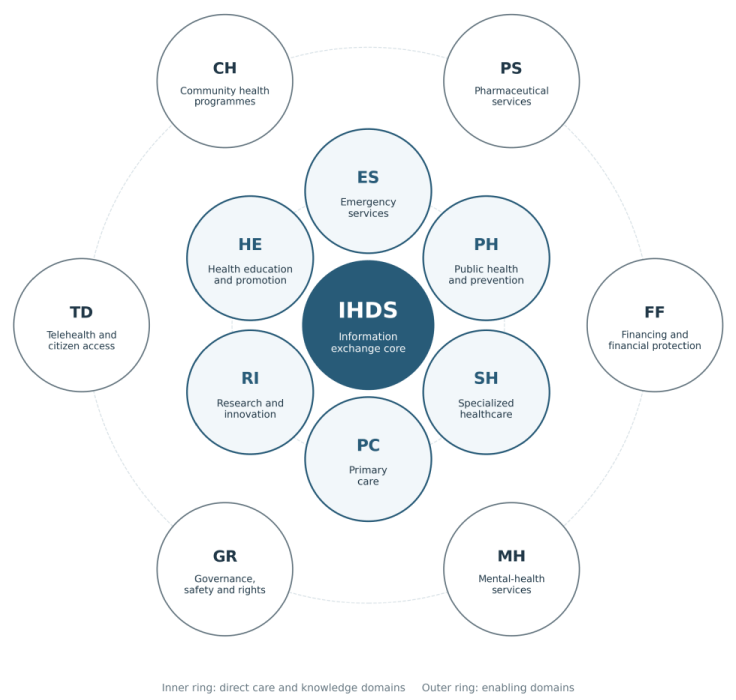
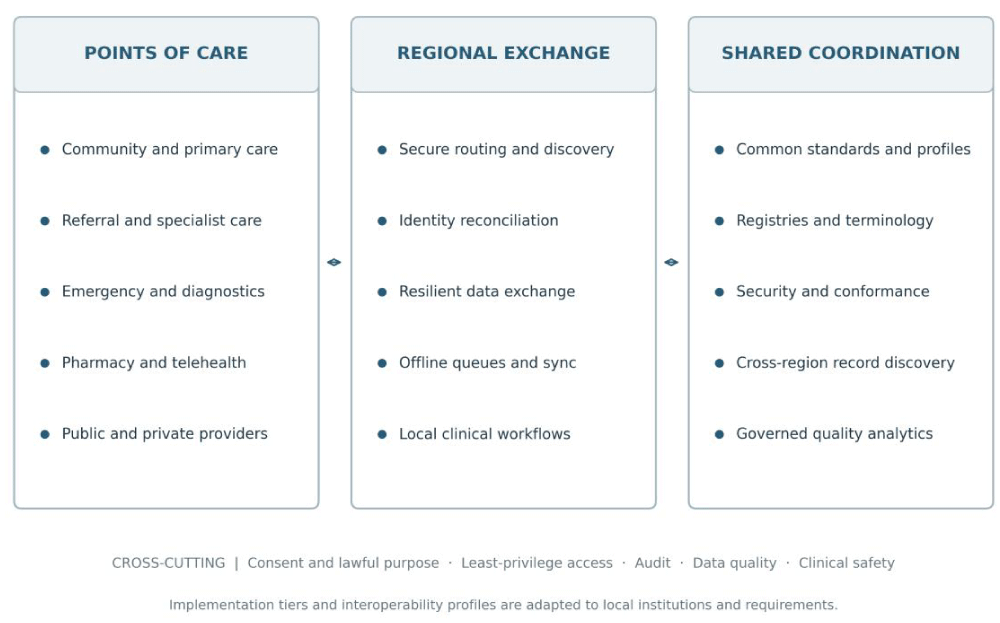
Results: IHDS specifies a longitudinal information-exchange core, six direct care and knowledge domains, six enabling domains, including a Pharmaceutical and Life Sciences Ecosystem, five complementary architecture views, cross-cutting interoperability and governance capabilities, an adaptable local-regional-shared-service topology, and a four-stage capability-maturity pathway. Eight testable propositions describe prospective evaluation targets. 
Conclusion: IHDS offers a proposed organizing architecture for interoperable and potentially learning-oriented health systems. Its technical and organizational value remains a hypothesis requiring independent expert assessment, jurisdiction-specific standards mapping, participatory design, and pilot testing before feasibility or outcome claims are warranted.
Figures

References

    1. World Health Organization. Global strategy on digital health 2020-2025. 2021b. https://www.who.int/publications/i/item/9789240020924
    2. de Savigny D, Adam T. (Eds.). Systems thinking for health systems strengthening. Alliance for Health Policy and Systems Research, World Health Organization. 2009; https://ahpsr.who.int/publications/i/item/2009-11-13-systems-thinking-for-health-systems-strengthening
    3. International Telecommunication Union, & World Health Organization. Digital health platform handbook: Building a digital information infrastructure (infostructure) for health. 2020; https://www.itu.int/dms_pub/itu-d/opb/str/D-STR-DIGITAL.HEALTH-2020-PDF-E.pdf
    4. OpenHIE Community. (n.d.). OpenHIE architecture specification. Retrieved July 31, 2026, from https://guides.ohie.org/arch-spec/
    5. Health Level Seven International. FHIR release 5 (v5.0.0): 2023; https://hl7.org/fhir/overview.html
    6. Li, E, Clarke J, Ashrafian H, Darzi A, Neves AL. The impact of electronic health record interoperability on safety and quality of care in high-income countries: Systematic review. 2022; Journal of Medical Internet Research, 24(9), e38144. https://doi.org/10.2196/38144
    7. Torab-Miandoab A, Samad-Soltani T, Jodati A, Rezaei-Hachesu P. Interoperability of heterogeneous health information systems: A systematic literature review. BMC Medical Informatics and Decision Making. 2023; 23, 18. https://doi.org/10.1186/s12911-023-02115-5
    8. Hancock T. The mandala of health: A model of the human ecosystem. Family & Community Health. 1985; 8(3), 1-10. https://doi.org/10.1097/00003727-198511000-00002
    9. Hancock T. Health, human development and the community ecosystem: Three ecological models. Health Promotion International. 1993; 8(1), 41-47. https://doi.org/10.1093/heapro/8.1.41
    10. Lockton D, Singh D, Sabnis S, Chou M, Foley S, Pantoja A. New metaphors: A workshop method for generating ideas and reframing problems in design and beyond. In Proceedings of the 2019 Conference on Creativity and Cognition (pp. 319-332). Association for Computing Machinery. https://doi.org/10.1145/3325480.3326570
    11. Hevner AR, March ST, Park J, Ram S. Design science in information systems research. MIS Quarterly. 2004; 28(1), 75-105. https://doi.org/10.2307/25148625
    12. Peffers K, Tuunanen T, Rothenberger MA, Chatterjee S. A design science research methodology for information systems research. Journal of Management Information Systems. 2007; 24(3), 45-77. https://doi.org/10.2753/MIS0742-1222240302
    13. Jabareen Y. Building a conceptual framework: Philosophy, definitions, and procedure. International Journal of Qualitative Methods. 2009; 8(4), 49-62. https://doi.org/10.1177/160940690900800406
    14. World Health Organization. WHO guideline: Recommendations on digital interventions for health system strengthening. 2019; https://www.who.int/publications/i/item/9789241550505
    15. World Health Organization. Classification of digital interventions, services and applications in health: A shared language to describe the uses of digital technology for health (2nd ed.) 2023a. https://www.who.int/publications/i/item/9789240081949
    16. World Health Organization. Ethics and governance of artificial intelligence for health: Guidance on large multi-modal models. 2025. https://www.who.int/publications/i/item/9789240084759
    17. Mehl G, Tunçalp Ö, Ratanaprayul N, Tamrat T, Barreix M, Lowrance D, Bartolomeos K, Say L, Kostanjsek N, Jakob R, Grove J, Mariano B, Jr, Swaminathan S. WHO SMART guidelines: Optimising country-level use of guideline recommendations in the digital age. The Lancet Digital Health. 2021. 3(4), e213-e216. https://doi.org/10.1016/S2589-7500(21)00038-8
    18. World Health Organization, & International Telecommunication Union. Reference architecture for national digital health transformation (Version 0.1.0) [Draft]. 2025. https://smart.who.int/ra/
    19. World Health Organization. Ethics and governance of artificial intelligence for health: WHO guidance. 2021a. https://www.who.int/publications/i/item/9789240029200
    20. World Health Organization. Regulatory considerations on artificial intelligence for health. 2023b. https://www.who.int/publications/i/item/9789240078871
    21. Mackey TK, Kuo TT, Gummadi B, Clauson KA, Church G, Grishin D, Obbad K, Barkovich R, Palombini M. Fit-for-purpose?' Challenges and opportunities for applications of blockchain technology in the future of healthcare. BMC Medicine. 2019; 17, 68. https://doi.org/10.1186/s12916-019-1296-7
    22. Sabiri K, Sousa F, Rocha T. A systematic review of privacy-preserving blockchain applications in healthcare. Multimedia Tools and Applications. 2025; 84(32): 39925-39980. https://doi.org/10.1007/s11042-024-20541-z
    23. Gupta RS, Wood CE, Engstrom T, Pole JD, Shrapnel S. A systematic review of quantum machine learning for digital health. npj Digital Medicine. 2025; 8: 237. https://doi.org/10.1038/s41746-025-01597-z
    24. World Health Organization, United Nations Children's Fund, United Nations Population Fund, & PATH. Digital implementation investment guide: Integrating digital interventions into health programmes. 2020; https://www.who.int/publications/i/item/9789240010567
    25. Braa J, Sahay S, Monteiro E. Design theory for societal digital transformation: The case of digital global health. Journal of the Association for Information Systems. 2023. 24(6): 1645-1669. https://doi.org/10.17705/1jais.00816
    26. Mantri M, Sunder G, Kadam S, Abhyankar A. A perspective on digital health platform design and its implementation at national level. Frontiers in Digital Health. 2024; 6, 1260855. https://doi.org/10.3389/fdgth.2024.1260855
    27. Institute of Medicine. The learning healthcare system: Workshop summary. National Academies Press. 2007’ https://doi.org/10.17226/11903
    28. National Academy of Medicine. Artificial intelligence in health care: The hope, the hype, the promise, the peril. National Academies Press. 2022; https://doi.org/10.17226/27111
    29. World Health Organization. Monitoring and evaluating digital health interventions: A practical guide to conducting research and assessment. 2016; https://www.who.int/publications/i/item/9789241511766

Why publish with us?

  • Global Visibility – Indexed in major databases

  • Fast Peer Review – Decision within 14–21 days

  • Open Access – Maximize readership and citation

  • Multidisciplinary Scope – Biology, Medicine and Engineering

  • Editorial Board Excellence – Global experts involved

  • University Library Indexing – Via OCLC

  • Permanent Archiving – CrossRef DOI

  • APC – Affordable APCs with discounts

  • Citation – High Citation Potential

Submit Your Article

Advertisement