IGMIN: We're glad you're here. Please click 'create a new query' if you are a new visitor to our website and need further information from us.
If you are already a member of our network and need to keep track of any developments regarding a question you have already submitted, click 'take me to my Query.'
Welcome to IgMin Research – an Open Access journal uniting Biology, Medicine, and Engineering. We’re dedicated to advancing global knowledge and fostering collaboration across scientific fields.
At IgMin Research, we bridge the frontiers of Biology, Medicine, and Engineering to foster interdisciplinary innovation. Our expanded scope now embraces a wide spectrum of scientific disciplines, empowering global researchers to explore, contribute, and collaborate through open access.
Welcome to IgMin, a leading platform dedicated to enhancing knowledge dissemination and professional growth across multiple fields of science, technology, and the humanities. We believe in the power of open access, collaboration, and innovation. Our goal is to provide individuals and organizations with the tools they need to succeed in the global knowledge economy.
IgMin Publications Inc., Suite 102, West Hartford, CT - 06110, USA
Although assessing fish stocks is essential for sustainable management, quantitative, multi-species evaluations that integrate fishing effort and biological production are scarce in Tunisian reservoirs. This study provides the first comprehensive, standardised assessment of six key species (Cyprinus carpio, Chelon ramada, Luciobarbus callensis, Sander lucioperca, Scardinius erythrophthalmus, and Rutilus rubilio) across eight major reservoirs. It combines multi-mesh gillnet sampling (2013-2016) with yield-per-recruit (Y/R) modelling using VIT software and cohort analysis using FISAT II.
The results reveal a general state of under-exploitation, yet highlight significant differences between species and between reservoirs. Exploitation rates (E) ranged from severe under-exploitation of mullets (E = 0.09) to near-optimal levels of carp in Sidi Saad (E = 0.48). Although fishing mortality exceeded 60% of total mortality for barbel and pikeperch, Y/R analysis confirmed their under-exploited status. This is supported by high biomass per recruit (up to 2,769 g for barbel in Sidi Barrak) and rapid stock renewal rates (over 79% for pikeperch). Notably, estimated surplus production indicates that current landings could be substantially increased without compromising stock sustainability.
We conclude that Tunisian reservoirs have significant untapped fishery potential. However, rather than increasing effort uniformly, we recommend making targeted, site- and species-specific adjustments, coupled with reinforced monitoring of population structure and exploitation rates, in order to prevent any shift towards overfishing. This integrated diagnostic approach provides a replicable scientific baseline for the future adaptive management of North African inland fisheries.
The sustainable management of Tunisian reservoir fisheries is crucial for rural development and food security [11Losse GF, Nau W, Winter M. Le développement de la pêche en eau douce dans le nord de la Tunisie. Étude effectuée dans le cadre de la coopération technique Tuniso‑Allemande. Eschborn: GTZ Gmbh; 1992. 418 p.-33Hajlaoui W, Fatnassi M, Mili S, Ben Salem S, Troudi D, Missaoui H. Characterization of socio‑economic fishing activity in Tunisian reservoir: Sidi Saad (centre of Tunisia), a case study. J Aquac Mar Biol. 2022;11(3):93‑8. doi:10.15406/jamb.2022.11.00342.]. This requires precise, quantitative assessments of stock status and production potential [44Bruslé J, Quignard JP. Biologie des poissons d’eau douce européens. Collection aquaculture‑pisciculture. Paris: Lavoisier; 2001. 625 p.-66King M. Fisheries biology, assessment, and management. 2nd ed. Oxford: Wiley‑Blackwell; 2007.]. However, evaluations in this area are fragmented and often limited to descriptive population studies that do not consider fishing effort or yield per recruit (Y/R) analyses at a multi-species, multi-reservoir scale [77Djemali I, Toujani R, Guillard J. Hydroacoustic fish biomass assessment in man‑made lakes in Tunisia: horizontal beaming importance and diel effect. Aquat Ecol. 2009;43:1121‑31.,88Mili S, Ennouri R, Laouar H, Khedhri I, Zarrouk H, Chargui T, Romdhane N. Freshwater fish farming and fishery management in Tunisian reservoirs: limitations and opportunities. In: Khebour Allouche F, Abu‑hashim M, Negm AM, editors. Agriculture productivity in Tunisia under stressed environment. Cham: Springer; 2021. p.309‑34. doi:10.1007/978‑3‑030‑74660‑5_14.]. To address this knowledge gap, the present study aims to conduct an integrated assessment of the exploitation status and biomass of the six main freshwater fish species (pikeperch, carp, mullet, barbel, roach, and rudd) across a representative sample of eight Tunisian reservoirs (Siliana, Bir Mcherga, Sidi Saad, Lahjar, Kasseb, Sidi Barrak, Sidi Salem, and Mellegue). Specifically, we will combine standardised multi-mesh gillnet surveys [99Comité européen de normalisation (CEN). Water quality – Sampling of fish with multi‑mesh gillnets. Norme NF EN 14757. Brussels: CEN; 2015.,1010Rousseau B, Nelva A, Persat H, Chessel D. Constitution d’une base de données ichtyologique par l’échantillonnage ponctuel d’abondance: application aux peuplements du Haut‑Rhône français. Cybium. 1985;9(Z):157‑73.] with cohort analysis (Powell-Wetherall) and Y/R modelling [1111Beverton RJH, Holt SJ. On the dynamics of exploited fish populations. London: Ministry of Agriculture, Fisheries and Food; 1957. Fish Invest Ser II, Vol.9. 533 p.] to estimate growth, mortality, and exploitation rates, and biomass per recruit. This will provide a replicable scientific baseline for the adaptive management of inland fisheries in North Africa.
Tunisia is located in a climatic transition zone with marked rainfall irregularity. It has constructed numerous retention infrastructures, including 29 large dams and over 200 hill dams, with a total capacity of over 2.9 billion m3. These were initially intended for irrigation and drinking water, but they have also created artificial aquatic ecosystems with significant fishery potential [11Losse GF, Nau W, Winter M. Le développement de la pêche en eau douce dans le nord de la Tunisie. Étude effectuée dans le cadre de la coopération technique Tuniso‑Allemande. Eschborn: GTZ Gmbh; 1992. 418 p.,12-1512-15Large dams in Tunisia (Database). Tunis: Ministry of Agriculture and Water Resources, Directorate General of Dams and Major Water Works; 2006.]. Since the late 1980s, fisheries exploitation has been organised through the Tunisian-German cooperation project at Sidi Salem [11Losse GF, Nau W, Winter M. Le développement de la pêche en eau douce dans le nord de la Tunisie. Étude effectuée dans le cadre de la coopération technique Tuniso‑Allemande. Eschborn: GTZ Gmbh; 1992. 418 p.,1616Kraïem MM. Les poissons d’eau douce de Tunisie: peuplement, répartition et écologie. Bull Inst Natl Sci Tech Océanogr Pêche Salammbô. 1998;25:111‑34.]. This has emerged as a strategic alternative to stagnant marine catches of around 100,000 tonnes per year [1717Directorate General of Fisheries and Aquaculture (DGPA). Directory of fisheries and aquaculture statistics in Tunisia. Tunis: Ministry of Agriculture, Water Resources, and Fisheries; 2023. 145 p.]. The fish assemblages comprise both native species, such as Luciobarbus callensis, Mugil cephalus, and Chelon ramada, and introduced species, including Cyprinus carpio, Sander lucioperca, Rutilus rutilus, and Scardinius erythrophthalmus. Productivity is largely sustained by the Technical Aquaculture Centre's annual stocking programmes, particularly for species that are unable to complete their life cycle in closed freshwater systems [11Losse GF, Nau W, Winter M. Le développement de la pêche en eau douce dans le nord de la Tunisie. Étude effectuée dans le cadre de la coopération technique Tuniso‑Allemande. Eschborn: GTZ Gmbh; 1992. 418 p.,88Mili S, Ennouri R, Laouar H, Khedhri I, Zarrouk H, Chargui T, Romdhane N. Freshwater fish farming and fishery management in Tunisian reservoirs: limitations and opportunities. In: Khebour Allouche F, Abu‑hashim M, Negm AM, editors. Agriculture productivity in Tunisia under stressed environment. Cham: Springer; 2021. p.309‑34. doi:10.1007/978‑3‑030‑74660‑5_14.,1818Mili S, Ennouri R, Laouar H, Missaoui H. Fisheries in the Tunisian dams: diagnosis of the current situation and development opportunities. In: FAO Fisheries and Aquaculture Proceedings No.39. Rome: FAO; 2015. p.95‑106.,1919Laouar H. Assessment of fishery resources in dam reservoirs in Tunisia: intercalibration of acoustic and gillnet sampling [doctoral thesis]. Tunis: National Agronomic Institute of Tunisia; 2019. 133 p.].
Despite this potential, official statistics reveal a worrying decline in catch, from 998 tonnes in 2013 to 693 tonnes in 2023 [1717Directorate General of Fisheries and Aquaculture (DGPA). Directory of fisheries and aquaculture statistics in Tunisia. Tunis: Ministry of Agriculture, Water Resources, and Fisheries; 2023. 145 p.]. This raises concerns about the health of the fish stocks and the intensity of fishing efforts [2020Mili S, Hajlaoui W, Ennouri R, Fatnassi M, Laouar H. Rapport technique sur l’échantillonnage des peuplements piscicoles au niveau des retenues de barrage en Tunisie moyennant des filets multimailles. Tunis: Ministère de l’Agriculture, des Ressources Hydrauliques et de la Pêche; 2022. 217 p.,2121Mili S, Ennouri R, Fatnassi M, Agrebi S, Chargui T, Laouar H. The use of geographic information system (GIS) data to assess and rebuild stocks in Tunisia’s largest freshwater reservoirs. In: Khebour Allouche F, editor. Environmental remote sensing and GIS in the MENA region. Cham: Springer; 2026. p.41‑54. doi:10.1007/978‑3‑031‑86574‑9_4.]. Effective sustainable management, therefore, depends on accurate population assessments based on analyses of growth, mortality, and exploitation rates [2222Pauly D. Fish population dynamics in tropical waters: a manual for use with programmable calculators. Manila: ICLARM; 1984. ICLARM Stud Rev.,2323Sparre P, Venema SC. Introduction to tropical fish stock assessment. Part 1: Manual. FAO Fish Tech Pap. 1998;306.1 Rev.2.].
To diagnose the status of exploitation, we apply an analytical framework that uses length-frequency data to estimate growth parameters [2424von Bertalanffy L. A quantitative theory of organic growth (inquiries on growth laws II). Hum Biol. 1938;10(2):181‑213.], natural mortality [2525Pauly D. A selection of simple methods for assessment of tropical fish stocks. FAO Fish Circ. 1980;729:1‑54.-2727Then AY, Hoenig JM, Hall NG, Hewitt DA. Evaluating the predictive performance of empirical estimators of natural mortality rate for fishes. ICES J Mar Sci. 2015;72(1):82‑92. doi:10.1093/icesjms/fsu136.], and fishing mortality [2828Gulland JA. Fish stock assessment: a manual of basic methods. FAO/Wiley Ser Food Agric. Chichester: Wiley; 1983.,2929Hewitt DA, Lambert DM, Hoenig JM, Lipcius RN, Bunnell DB, Miller TJ. Direct and indirect estimates of natural mortality for Chesapeake Bay blue crab. Trans Am Fish Soc. 2007;136:1030‑40.]. We interpret stock status via Y/R analysis [1111Beverton RJH, Holt SJ. On the dynamics of exploited fish populations. London: Ministry of Agriculture, Fisheries and Food; 1957. Fish Invest Ser II, Vol.9. 533 p.,3030Lieonart J, Salat J. VIT: Programa d’analisis de pesquerias. Informes Técnicos de Scientia Marina. 1992;116 p.], comparing exploitation rates (E = F/Z) to conventional reference points (E < 0.5: under-exploitation; E = 0.5: optimal; E > 0.5: over-exploitation) [55Cadima EL. Manuel d’évaluation des ressources halieutiques. FAO Document technique sur les pêches. Rome: FAO; 2002. No.393. 160 p.,66King M. Fisheries biology, assessment, and management. 2nd ed. Oxford: Wiley‑Blackwell; 2007.]. This integrated approach is being applied for the first time across such a wide spatial and taxonomic range in Tunisia. It provides the solid scientific basis needed to formulate management recommendations that aim to optimise yields while ensuring the long-term sustainability of these inland fishery resources [3131Poulet N, Seon‑Massin N, Basilico L. Biodiversité aquatique: du diagnostic à la restauration. Synthèse du séminaire. Paris: Ministère de l’Environnement; 2012. 46 p.-3333Guillard J. Étude des stocks piscicoles lacustres par écho‑intégration: problèmes méthodologiques [doctoral thesis]. Lyon: Univ Lyon I; 1991. 148 p.].
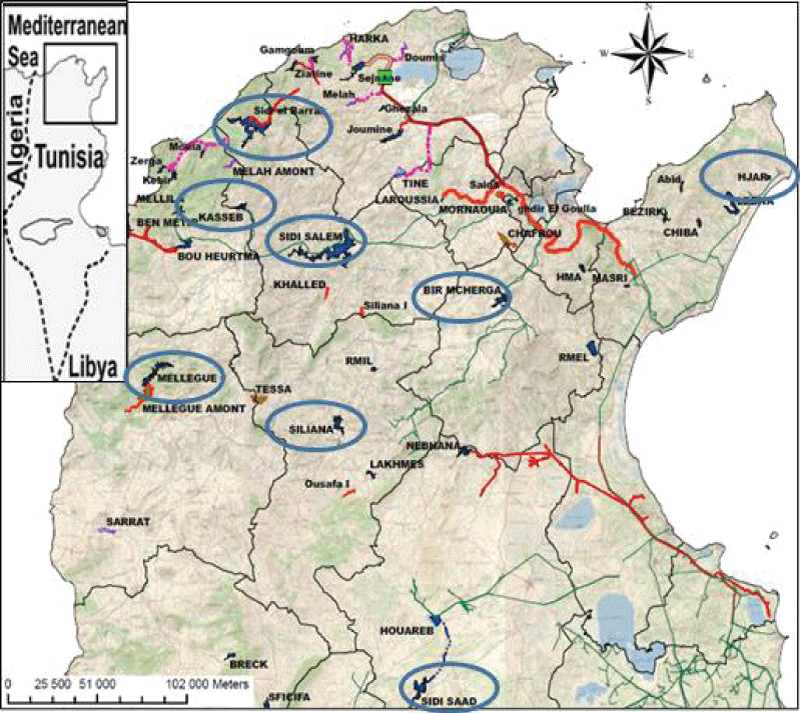
The study was conducted in eight Tunisian reservoirs that are representative of the country's main artificial lakes: Lahjar, Bir Mcherga, Sidi Salem, Sidi Barrak, Kasseb, Siliana, Sidi Saad, and Mellegue (Figure 1) [1212Large dams in Tunisia (Database). Tunis: Ministry of Agriculture and Water Resources, Directorate General of Dams and Major Water Works; 2006.]. Sampling surveys were carried out over three years (2013-2016), covering the spring and autumn seasons at each site to account for seasonal variations in fish assemblages [1010Rousseau B, Nelva A, Persat H, Chessel D. Constitution d’une base de données ichtyologique par l’échantillonnage ponctuel d’abondance: application aux peuplements du Haut‑Rhône français. Cybium. 1985;9(Z):157‑73.,1919Laouar H. Assessment of fishery resources in dam reservoirs in Tunisia: intercalibration of acoustic and gillnet sampling [doctoral thesis]. Tunis: National Agronomic Institute of Tunisia; 2019. 133 p.,3131Poulet N, Seon‑Massin N, Basilico L. Biodiversité aquatique: du diagnostic à la restauration. Synthèse du séminaire. Paris: Ministère de l’Environnement; 2012. 46 p.].
Figure 1: Geographical map of the main dam reservoirs in Tunisia, highlighting the eight study sites.
Ichthyological sampling
A fish community assessment was performed using multi-mesh gillnets, which is a standardised, passive method of quantitatively sampling freshwater fish [99Comité européen de normalisation (CEN). Water quality – Sampling of fish with multi‑mesh gillnets. Norme NF EN 14757. Brussels: CEN; 2015.,3434Appelberg M, Berger HM, Hesthagen T, et al. Development and intercalibration of methods in Nordic freshwater fish monitoring. Water Air Soil Pollut. 1995;85:401‑6. doi:10.1007/BF00476862.]. This sampling strategy was adapted from protocols employed in Scandinavia and by the CEN in lentic ecosystems in North Africa [77Djemali I, Toujani R, Guillard J. Hydroacoustic fish biomass assessment in man‑made lakes in Tunisia: horizontal beaming importance and diel effect. Aquat Ecol. 2009;43:1121‑31.,1010Rousseau B, Nelva A, Persat H, Chessel D. Constitution d’une base de données ichtyologique par l’échantillonnage ponctuel d’abondance: application aux peuplements du Haut‑Rhône français. Cybium. 1985;9(Z):157‑73.,3333Guillard J. Étude des stocks piscicoles lacustres par écho‑intégration: problèmes méthodologiques [doctoral thesis]. Lyon: Univ Lyon I; 1991. 148 p.,3535Mili S, Ennouri R, Dhib A, Laouar H, Missaoui H, Aleya L. Characterization of fish assemblages and population structure of freshwater fish in two Tunisian reservoirs: implications for fishery management. Environ Monit Assess. 2016;188(364):1‑11.]. To ensure methodological reproducibility and inter-site comparability, the following standardisation procedures were strictly adhered to: gear, temporal, and spatial standardisation.
Two types of nets were used: Benthic gillnets with panels measuring 20 metres in length and 1.5 metres in height, composed of eight contiguous panels with stretched mesh sizes of 18, 24, 28, 35, 40, 55, 70, and 80 mm. These nets are accompanied by pelagic gillnets. These were used in the water column to target pelagic species and had a height of 6 metres with the same mesh size ranges [3535Mili S, Ennouri R, Dhib A, Laouar H, Missaoui H, Aleya L. Characterization of fish assemblages and population structure of freshwater fish in two Tunisian reservoirs: implications for fishery management. Environ Monit Assess. 2016;188(364):1‑11.].
For each site and survey, the nets were set in series at dusk and retrieved at dawn after approximately 12 hours to capture the nycthemeral activity peaks of different species. All sampling was conducted during the same seasonal windows (spring and autumn) across all years and sites [2121Mili S, Ennouri R, Fatnassi M, Agrebi S, Chargui T, Laouar H. The use of geographic information system (GIS) data to assess and rebuild stocks in Tunisia’s largest freshwater reservoirs. In: Khebour Allouche F, editor. Environmental remote sensing and GIS in the MENA region. Cham: Springer; 2026. p.41‑54. doi:10.1007/978‑3‑031‑86574‑9_4.].
Nets were positioned in a stratified manner to sample different habitats (littoral, pelagic, and profundal zones) and depth strata, ensuring representative coverage of the fish community in each reservoir [3636Mili S, Ennouri R, Fatnassi M, Agrebi S, Louiz I, Khattab Y, Hedfi A, Ben Ali M, Laouar H. Investigating freshwater mullet fisheries in Tunisian reservoirs: future development prospects. Water. 2023;15(14):2554. doi:10.3390/w15142554.].
Catch processing: The following parameters were identified and measured for each captured fish: Species, Total length (Lt) to the nearest millimetre; Total weight (W) to the nearest 0.1 g; sex; and gonadal maturity stage. Individuals were identified using Kraïem's [1616Kraïem MM. Les poissons d’eau douce de Tunisie: peuplement, répartition et écologie. Bull Inst Natl Sci Tech Océanogr Pêche Salammbô. 1998;25:111‑34.] identification keys.
Population parameter analysis
Length-frequency data, derived directly from the standardised gillnet catches described above, formed the basis for all population dynamics analyses. These analyses were performed using FISAT II (FAO-ICLARM Stock Assessment Tools II), version 1.2.2 [3737Gayanilo FC, Sparre P, Pauly D. FAO‑ICLARM Outils d’évaluation des stocks II (FiSAT II). Version révisée. Guide d’utilisation. Rome: FAO; 2005. 190 p.,3838Série informatique Pêche: guide d’utilisation de FISAT II. Rome: FAO; 2005.], a widely used software package specifically designed for length-based stock assessment in data-limited fisheries.
Growth: Individual growth was modelled using the von Bertalanffy (1938) [2424von Bertalanffy L. A quantitative theory of organic growth (inquiries on growth laws II). Hum Biol. 1938;10(2):181‑213.] growth equation:
Lt = L∞ [1 - e(-K(t - t₀))]
where: Lt is the length at age t; L∞ is the theoretical asymptotic length. K is the growth coefficient (year-1). T0 is the theoretical age at zero length.
The growth parameters L∞ and K were estimated using a two-step approach. Firstly, the Wetherall plot [3939Wetherall JA. A new method for estimating growth and mortality parameters from length‑frequency data. ICLARM Fishbyte. 1986;4(1):12‑4.] was used to provide robust initial estimates by converting the von Bertalanffy equation from length-frequency data into a linear form. These initial estimates were then refined using the ELEFAN I (Electronic Length Frequency Analysis) algorithm integrated into FISAT II [3838Série informatique Pêche: guide d’utilisation de FISAT II. Rome: FAO; 2005.]. ELEFAN I was chosen because it is specifically designed for tropical and subtropical fish populations, in which seasonal growth oscillations are common. Furthermore, it does not require the reading of the age from hard structures, which is particularly advantageous when otoliths or scales are unavailable or difficult to interpret for certain species [2222Pauly D. Fish population dynamics in tropical waters: a manual for use with programmable calculators. Manila: ICLARM; 1984. ICLARM Stud Rev.,2323Sparre P, Venema SC. Introduction to tropical fish stock assessment. Part 1: Manual. FAO Fish Tech Pap. 1998;306.1 Rev.2.].
Length-weight relationship: The relationship between length (L in cm) and weight (W in g) was established for each species and site using the equation [3232Nelson JS. Fishes of the world. 3rd ed. New York: Wiley; 1994. 600 p.]:
W = aLb
The coefficients a (condition factor) and b (allometric growth exponent) were estimated using linear regression on logarithmically transformed data (log W = log a + b log L).
Mortality: Total mortality (Z) was estimated using the linearised catch curve method [2222Pauly D. Fish population dynamics in tropical waters: a manual for use with programmable calculators. Manila: ICLARM; 1984. ICLARM Stud Rev.], which is based on length frequencies that have been converted into relative ages [2929Hewitt DA, Lambert DM, Hoenig JM, Lipcius RN, Bunnell DB, Miller TJ. Direct and indirect estimates of natural mortality for Chesapeake Bay blue crab. Trans Am Fish Soc. 2007;136:1030‑40.]. Natural mortality (M) was estimated using three complementary approaches to reduce the uncertainty inherent in any single estimator, and to account for environmental and life-history variability.
The first was the empirical equation of Pauly [4040Pauly D. On the interrelationships between natural mortality, growth parameters, and mean environmental temperature in 175 fish stocks. ICES J Mar Sci. 1980;39(2):175‑92.]: log10(M) = -0.0066 - 0.279 log10(L∞) + 0.6543 log10(K) + 0.4634 log10(T), where T is the mean annual water temperature (°C). This method was chosen because it explicitly incorporates temperature, which is a key environmental driver of ectothermic fish metabolism in Mediterranean reservoirs.
The formula of Taylor [2626Taylor CC. Temperature and growth: the Pacific razor clam. ICES J Mar Sci. 1959;25(1):93‑101. doi:10.1093/icesjms/25.1.93.], which is based on growth parameters (K and L∞) and provides a purely biological estimate, is independent of temperature and complementary to Pauly's approach.
The formula of Then, et al. [2727Then AY, Hoenig JM, Hall NG, Hewitt DA. Evaluating the predictive performance of empirical estimators of natural mortality rate for fishes. ICES J Mar Sci. 2015;72(1):82‑92. doi:10.1093/icesjms/fsu136.]: M = 4.899 tmax-0.916, where tmax is the maximum observed age for the species. This recent method was selected for its demonstrated predictive performance across a wide range of fish species, as well as for being independent of growth parameters. This offers an additional, validated perspective.
The final M value retained for each species and site was the arithmetic mean of the estimates derived from these three methods. This averaging procedure is a well-established practice in stock assessment when empirical estimators yield divergent results, as it balances the biases and assumptions of each method [2929Hewitt DA, Lambert DM, Hoenig JM, Lipcius RN, Bunnell DB, Miller TJ. Direct and indirect estimates of natural mortality for Chesapeake Bay blue crab. Trans Am Fish Soc. 2007;136:1030‑40.,66King M. Fisheries biology, assessment, and management. 2nd ed. Oxford: Wiley‑Blackwell; 2007.]. Finally, fishing mortality (F) was derived by difference: F = Z - M [2929Hewitt DA, Lambert DM, Hoenig JM, Lipcius RN, Bunnell DB, Miller TJ. Direct and indirect estimates of natural mortality for Chesapeake Bay blue crab. Trans Am Fish Soc. 2007;136:1030‑40.].
Stock assessment
The exploitation status of the stocks was assessed using the yield per recruit analytical model [1111Beverton RJH, Holt SJ. On the dynamics of exploited fish populations. London: Ministry of Agriculture, Fisheries and Food; 1957. Fish Invest Ser II, Vol.9. 533 p.], implemented via the VIT software (version 1.1, IEO-CSIC) [55Cadima EL. Manuel d’évaluation des ressources halieutiques. FAO Document technique sur les pêches. Rome: FAO; 2002. No.393. 160 p.,3030Lieonart J, Salat J. VIT: Programa d’analisis de pesquerias. Informes Técnicos de Scientia Marina. 1992;116 p.]. VIT was specifically chosen because it is tailored to data-limited situations common in inland fisheries, allows for straightforward sensitivity analyses, and has been extensively validated for Mediterranean and North African fisheries.
The following parameters were used as inputs: growth parameters (L∞, K, t0), natural mortality (M), mean length at first capture (Lc), and mean length at recruitment (Lr) [5959Chargui T, Fatnassi M, Ennouri R, Zarrouk H, Laouar H, Romdhane N, Mili S. Exploring freshwater fish assemblages and population structure in three Tunisian reservoirs for better fishery management. Biodivers Int J. 2021;5(2):37‑45. doi:10.15406/bij.2021.05.00196.,3232Nelson JS. Fishes of the world. 3rd ed. New York: Wiley; 1994. 600 p.]. The model allows the calculation of Yield per recruit (Y/R), biomass per recruit (B/R), and exploitation rate (E = F/Z). Stock status was interpreted by comparing the current exploitation rate (E) to conventional reference points.
E < 0.5: under-exploitation (stock not fully using its productive potential).
E = 0.5: optimal exploitation (corresponding to Emax, Maximum Sustainable Yield (MSY), where Yield per recruit reaches its maximum).
E > 0.5: over-exploitation (fishing pressure exceeds the level that maximises yield per recruit).
These reference points are standard in fisheries science and are based on the equilibrium Y/R theory [55Cadima EL. Manuel d’évaluation des ressources halieutiques. FAO Document technique sur les pêches. Rome: FAO; 2002. No.393. 160 p.,66King M. Fisheries biology, assessment, and management. 2nd ed. Oxford: Wiley‑Blackwell; 2007.,1111Beverton RJH, Holt SJ. On the dynamics of exploited fish populations. London: Ministry of Agriculture, Fisheries and Food; 1957. Fish Invest Ser II, Vol.9. 533 p.].
Data analysis
Statistical analyses and restructuring of length-frequency distributions were performed using FISAT II [3838Série informatique Pêche: guide d’utilisation de FISAT II. Rome: FAO; 2005.] and R software (version 4.0.2). Results are presented as mean ± standard deviation. All length-frequency data were log-transformed before regression analysis for the length-weight relationship. Nonlinear growth parameter fitting was performed using the ELEFAN I routine, with goodness-of-fit assessed by the Rn index. All statistical tests were considered significant at p < 0.05.
I. Population dynamics and stock assessment of common carp (C. carpio) in Sidi Saad and Bir Mcherga reservoirs
1. Growth and mortality parameters
The biological parameters of C. carpio in the Sidi Saad and Bir Mcherga reservoirs are presented in Table 1. The asymptotic length (L∞) was estimated to be 60.05 cm in both reservoirs, with growth coefficients (K) of 0.158 yr-1 and t0 values of -0.920. The length-weight relationship was identical between sites (a = 0.0173; b = 2.873). Natural mortality (M) estimates varied by method: Taylor [2626Taylor CC. Temperature and growth: the Pacific razor clam. ICES J Mar Sci. 1959;25(1):93‑101. doi:10.1093/icesjms/25.1.93.] provided values of 0.17 yr-1 for both sites, whereas Pauly [2525Pauly D. A selection of simple methods for assessment of tropical fish stocks. FAO Fish Circ. 1980;729:1‑54.] provided values of 0.36 and 0.34 yr-1, respectively. The mean retained values were 0.26 and 0.25 yr-1 for Sidi Saad and Bir Mcherga, respectively (Table 1).
Table 1: Biological parameters of the six target fish species across the eight study reservoirs. (Values are presented as mean estimates; M = arithmetic mean of [2525Pauly D. A selection of simple methods for assessment of tropical fish stocks. FAO Fish Circ. 1980;729:1‑54.-2727Then AY, Hoenig JM, Hall NG, Hewitt DA. Evaluating the predictive performance of empirical estimators of natural mortality rate for fishes. ICES J Mar Sci. 2015;72(1):82‑92. doi:10.1093/icesjms/fsu136.]).
2. Stock abundance and biomass
The estimated population size was 7,806 individuals (mean biomass: 238.99 tonnes) in Sidi Saad and 1,118 individuals (mean biomass: 42.08 tonnes) in Bir Mcherga (Table 2). The respective spawning stock biomass (SSB) was estimated at 208.78 and 38.64 tonnes. The critical lengths for the maximum cohort biomass were 30 cm and 32 cm for Sidi Saad and Bir Mcherga, respectively, corresponding to ages of 3.47 and 3.90 years, respectively. In the absence of fishing, these critical values would be identical at 37 cm and 5.15 years for both reservoirs.
Table 2: Key stock indicators for the six target species across all study reservoirs. (Diagnosis follows Beverton & Holt (1957): E < 0.5 = under‑exploitation; E = 0.5: optimal; E > 0.5: over‑exploitation. However, when E > 0.5 but Y/R is on the ascending phase, N = estimated population size, B = mean biomass; F = fishing mortality; M = natural mortality; E = exploitation rate; Y/R = yield per recruit; B/R = biomass per recruit.
3. Mortality, exploitation rates, and yield per recruit
Fishing mortality (F) was estimated at 0.27 per year in Sidi Saad and 0.23 per year in Bir Mcherga. Natural mortality (M) was 0.26 and 0.25 yr-1 in Sidi Saad and Bir Mcherga, respectively. Consequently, the exploitation rates (E = F/Z) were 0.48 in Sidi Saad and 0.30 in Bir Mcherga (Table 2). Gain composition analysis revealed that growth accounted for 90.33% of biomass gains in Sidi Saad and 91.84% in Bir Mcherga, while recruitment contributed only 9.67% and 8.16%, respectively. In Sidi Saad, losses were partitioned as 51.51% natural mortality and 48.49% fishing mortality, whereas in Bir Mcherga, they were 70.01% natural and 29.99% fishing. Yield per recruit (Y/R) was 109.36 g in Sidi Saad and 113.94 g in Bir Mcherga. Biomass per recruit (B/R) was 439.27 g and 614.66 g, respectively (Table 2).
II. Population dynamics and stock assessment of thin-lipped grey mullet (C. ramada) in Sidi Saad and Siliana reservoirs
1. Growth and mortality parameters
The biBiological parameters of C. ramada are presented in Table 1. Asymptotic length (L∞) and growth coefficient (K) were identical in both reservoirs (L∞ = 39.7 cm; K = 0.164 yr-1; t0 = -1.513), indicating similar growth patterns. However, the length-weight relationship differed between sites: the condition factor (a) was 0.0169 in Sidi Saad and 0.0053 in Siliana, while the allometric exponent (b) was 2.777 and 3.189, respectively (Table 1). Natural mortality (M) estimates varied by method. Taylor (1959) gave 0.179 yr-1 for both sites, while Pauly (1980) gave 0.390 yr-1 (Sidi Saad) and 0.400 yr-1 (Siliana). The mean retained values were 0.28 yr-1 for Sidi Saad and 0.29 yr-1 for Siliana (Table 1).
2. Stock abundance and biomass
The estimated population size was 118,997 individuals (mean biomass: 199.03 t) in Sidi Saad, and 585,646 individuals (mean biomass: 469.96 t) in Siliana (Table 2). Gain composition showed that individual growth contributed 99.5% of biomass gains in Sidi Saad and 71.82% in Siliana, with recruitment (stocking) contributing the remaining 0.5% and 28.18%, respectively. Losses were partitioned as 91.22% natural mortality and 8.78% fishing mortality in Sidi Saad, and 90.75% natural versus 9.25% fishing mortality in Siliana. Annual biomass renewal rates were 30.7% and 31.96%, respectively.
3. Mortality, exploitation rates, and yield-per-recruit
Fishing mortality (F) was 0.09 yr-1 in Sidi Saad and 0.10 yr-1 in Siliana. Natural mortality (M) was 0.28 and 0.29 yr-1, respectively. Consequently, the exploitation rates (E = F/Z) were 0.09 in Sidi Saad and 0.10 in Siliana (Table 2). Yield per recruit (Y/R) was 6.27 g in Sidi Saad and 17.53 g in Siliana. Biomass per recruit (B/R) was 232.39 g and 592.62 g, respectively (Table 2). In both reservoirs, the current Y/R values lie on the ascending phase of the yield-per-recruit curve, and the spawning biomass per recruit (SSB/R) was lower than the total biomass per recruit (B/R), consistent with the absence of natural in-situ reproduction for this species.
III. Population dynamics and stock assessment of barbel (L. callensis) in Sidi Barrak, Kasseb, and Bir Mcherga reservoirs
1. Growth and mortality parameters
The biological parameters of L. callensis are presented in Table 1. Sidi Barrak and Kasseb reservoirs exhibited identical growth parameters (L∞ = 68.25 cm; K = 0.076 yr-1; t0 = 1.858), indicating comparable growth conditions at these two sites. Bir Mcherga showed slightly distinct values (L∞ = 71.01 cm; K = 0.077 yr-1; t0 = 2.075). The length-weight relationship also differed: Sidi Barrak and Kasseb shared identical values (a = 0.0227; b = 2.984), while Bir Mcherga showed lower values (a = 0.0196; b = 2.816). Natural mortality (M) estimates varied by method. Taylor (1959) gave 0.073 yr-1 for all sites. Pauly (1980) gave 0.21 yr-1 for Sidi Barrak and Kasseb, and 0.224 yr-1 for Bir Mcherga. The mean retained values were 0.14 yr-1 for Sidi Barrak and Kasseb, and 0.15 yr-1 for Bir Mcherga (Table 1).
2. Stock abundance and biomass
The estimated population size was 177,452 individuals (mean biomass: 51.29 t) in Sidi Barrak, 191,360 individuals (mean biomass: 14.99 t) in Kasseb, and 848,683 individuals (mean biomass: 21.01 t) in Bir Mcherga (Table 2). Mean age at capture was 10.55 years in Sidi Barrak. The composition varied substantially between reservoirs. Growth contributed 58.75% of biomass gains in Sidi Barrak, while recruitment contributed the remaining 41.25%. In Kasseb, recruitment predominantly contributed (59.63%), with growth contributing 40.37%. In Bir Mcherga, growth contributed 82.62% of gains, with recruitment contributing 17.38%. Losses were partitioned as follows: Sidi Barrak, fishing mortality 57.76% and natural mortality 42.24%; Kasseb, fishing mortality 70.09% and natural mortality 29.91%; Bir Mcherga, fishing mortality 66.3% and natural mortality 33.7%.
3. Mortality, exploitation rates, and yield-per-recruit
Fishing mortality (F) was 0.19 yr-1 in Sidi Barrak, 0.33 yr-1 in Kasseb, and 0.29 yr-1 in Bir Mcherga. Natural mortality (M) was 0.14, 0.14, and 0.15 yr-1, respectively. Consequently, the exploitation rates (E = F/Z) were 0.58 in Sidi Barrak, 0.70 in Kasseb, and 0.66 in Bir Mcherga (Table 2). Yield per recruit (Y/R) was 530.27 g in Sidi Barrak, 179.69 g in Kasseb, and 81.78 g in Bir Mcherga. Biomass per recruit (B/R) was 2,769.49 g, 547.75 g, and 277.12 g, respectively (Table 2). In all three reservoirs, the current Y/R values lie on the ascending phase of the yield-per-recruit curve.
IV. Population dynamics and stock assessment of pikeperch (S. lucioperca) in Siliana reservoir
1. Growth and mortality parameters
The biological parameters of S. lucioperca in the Siliana Reservoir are presented in Table 1. Growth characteristics included an asymptotic length (L∞) of 102.2 cm, a growth coefficient (K) of 0.23 per year, and t0 = -0.055. The length-weight relationship parameters were a = 0.0106 and b = 2.937 (Table 1). Estimates of natural mortality (M) varied by method. Taylor (1959) provided a value of 0.231 yr-1, whereas Pauly (1980) provided a value of 0.391 yr-1. The mean retained value was 0.31 yr-1 (Table 1).
2. Stock abundance and biomass
The estimated population size was 1,630 individuals, with a mean biomass of 21.53 tonnes. Spawning stock biomass (SSB) was estimated at 14.22 tonnes. The population was characterised by a young structure, with a mean length of 25.86 cm and a mean age of 1.27 years. The critical length and age corresponding to maximum cohort biomass were estimated at 44 cm and 2.39 years, respectively (Table 2). Gain composition showed that individual growth contributed 98.22% of biomass gains, with natural recruitment contributing only 1.78%. Losses were partitioned as 60.66% fishing mortality and 39.34% natural mortality. The annual biomass renewal rate was 79.08% (Table 2).
3. Mortality, exploitation rates, and yield-per-recruit
Fishing mortality (F) was 0.48 yr-1, and natural mortality (M) was 0.31 yr-1. Consequently, the exploitation rate (E = F/Z) was 0.61 (Table 2). Yield per recruit (Y/R) was 162.47 g. Biomass per recruit (B/R) was 338.70 g, and spawning biomass per recruit (SSB/R) was 223.77 g (Table 2). The current Y/R value lies on the ascending phase of the yield-per-recruit curve.
V. Population dynamics and stock assessment of rudd (S. erythrophthalmus) in Sidi Salem and Siliana reservoirs
1. Growth and mortality parameters
The biological parameters of S. erythrophthalmus, derived from Djemali and Mili, et al. [4141Djemali I. Évaluation de la biomasse piscicole dans les plans d’eau douces tunisiens: approche analytique et acoustique [doctoral thesis]. Tunis: National Institute of Agronomy of Tunisia; 2005. 250 p.,4242Mili S, Ennouri R, Laouar H, Aleya L. Optimization of fishing for stock enhancement of Rutilus rutilus and Scardinius erythropththalmus in forage fish‑deficient Tunisian reservoirs. Environ Monit Assess. 2017;189(610):1‑12.], are presented in Table 1. Growth characteristics included an asymptotic length (L∞) of 31.51 cm, a growth coefficient (K) of 0.379 yr-1, and t0 = 0.377. The length-weight relationship parameters were a = 0.0107 and b = 3.068 (Table 1). Natural mortality (M) estimates varied by method. Roff [4343Roff DA. The evaluation of life history in teleosts. Can J Fish Aquat Sci. 1984;41:989‑1000.] gave 0.25 yr-1, while Taylor (1959) gave 0.36 yr-1. The mean retained value was 0.30 yr-1 (Table 1).
2. Stock abundance and biomass
The estimated population size was 20,039 individuals (mean biomass: 101.49 t) in Sidi Salem and 1,608,516 individuals (mean biomass: 24.74 t) in Siliana (Table 2). Gain composition showed that individual growth contributed 98.37% of biomass gains in Sidi Salem and 97.62% in Siliana, with natural recruitment contributing the remaining 1.63% and 2.38%, respectively. Losses were partitioned as follows: Sidi Salem, fishing mortality 62.17% and natural mortality 37.83%; Siliana, fishing mortality 46.66% and natural mortality 53.34%. Annual biomass renewal rates were 79.31% in Sidi Salem and 56.24% in Siliana (Table 2).
3. Mortality, exploitation rates, and yield-per-recruit
Fishing mortality (F) was 0.49 yr-1 in Sidi Salem and 0.27 yr-1 in Siliana. Natural mortality (M) was 0.30 yr-1 at both sites. Consequently, the exploitation rates (E = F/Z) were 0.62 in Sidi Salem and 0.47 in Siliana (Table 2). Yield per recruit (Y/R) was 28.68 g in Sidi Salem and 51.20 g in Siliana. Biomass per recruit (B/R) was 58.16 g and 195.13 g, respectively (Table 2). In both reservoirs, the current Y/R values lie on the ascending phase of the yield-per-recruit curve.
VI. Population dynamics and stock assessment of roach (R. rubilio) in Sidi Salem, Mellegue, and Lahjar reservoirs
1. Growth and mortality parameters
The biological parameters of R. rubilio, derived from Djemali and Mili, et al. [4141Djemali I. Évaluation de la biomasse piscicole dans les plans d’eau douces tunisiens: approche analytique et acoustique [doctoral thesis]. Tunis: National Institute of Agronomy of Tunisia; 2005. 250 p.,4242Mili S, Ennouri R, Laouar H, Aleya L. Optimization of fishing for stock enhancement of Rutilus rutilus and Scardinius erythropththalmus in forage fish‑deficient Tunisian reservoirs. Environ Monit Assess. 2017;189(610):1‑12.], are presented in Table 1. Growth characteristics included an asymptotic length (L∞) of 32.24 cm, a growth coefficient (K) of 0.383 yr-1, and t0 = 0.088. The length-weight relationship parameters were a = 0.0066 and b = 3.188 (Table 1). Natural mortality (M) estimates varied by method. Roff [4343Roff DA. The evaluation of life history in teleosts. Can J Fish Aquat Sci. 1984;41:989‑1000.] gave 0.25 yr-1, while Taylor (1959) gave 0.38 yr-1. The mean retained value was 0.31 yr-1 (Table 1).
2. Stock abundance and biomass
The estimated population size was 10,321,598 individuals (mean biomass: 147.53 t) in Sidi Salem, 28,900 individuals (mean biomass: 5.65 t) in Mellegue, and 7,857 individuals (mean biomass: 1.87 t) in Lahjar (Table 2). Gain composition showed that individual growth contributed 92.71% of biomass gains in Sidi Salem, 88.45% in Mellegue, and 61.88% in Lahjar. Recruitment contributed the remaining 7.29%, 11.55%, and 38.12%, respectively. Losses were partitioned as follows: Sidi Salem, fishing mortality 52.25% and natural mortality 47.75%; Mellegue, fishing mortality 49.24% and natural mortality 50.76%; Lahjar, fishing mortality 54.72% and natural mortality 45.28%. Annual biomass renewal rates were 64.92% in Sidi Salem, 61.07% in Mellegue, and 68.46% in Lahjar (Table 2).
3. Mortality, exploitation rates, and yield-per-recruit
Fishing mortality (F) was 0.34 yr-1 in Sidi Salem, 0.30 yr-1 in Mellegue, and 0.38 yr-1 in Lahjar. Natural mortality (M) was 0.31 yr-1 at all three sites. Consequently, the exploitation rates (E = F/Z) were 0.52 in Sidi Salem, 0.49 in Mellegue, and 0.55 in Lahjar (Table 2). Yield per recruit (Y/R) was 52.07 g in Sidi Salem, 58.77 g in Mellegue, and 79.25 g in Lahjar. Biomass per recruit (B/R) was 153.51 g, 195.43 g, and 211.56 g, respectively (Table 2). In all three reservoirs, the current Y/R values lie on the ascending phase of the yield-per-recruit curve.
This study is the most comprehensive assessment to date of the status of the primary fish species in Tunisian reservoirs. It covers six key species across eight distinct reservoirs. Our results reveal a complex situation in which widespread under-exploitation coexists with specific management challenges, necessitating a differentiated and adaptive approach. Our methodological approach, based on standardised protocols [99Comité européen de normalisation (CEN). Water quality – Sampling of fish with multi‑mesh gillnets. Norme NF EN 14757. Brussels: CEN; 2015.], combines assessment techniques such as cohort analysis and production modelling to provide a significant improvement on previous studies. The consistency of our results with those of Djemali , Laouar and Mili, et al. [1919Laouar H. Assessment of fishery resources in dam reservoirs in Tunisia: intercalibration of acoustic and gillnet sampling [doctoral thesis]. Tunis: National Agronomic Institute of Tunisia; 2019. 133 p.,3535Mili S, Ennouri R, Dhib A, Laouar H, Missaoui H, Aleya L. Characterization of fish assemblages and population structure of freshwater fish in two Tunisian reservoirs: implications for fishery management. Environ Monit Assess. 2016;188(364):1‑11.,4141Djemali I. Évaluation de la biomasse piscicole dans les plans d’eau douces tunisiens: approche analytique et acoustique [doctoral thesis]. Tunis: National Institute of Agronomy of Tunisia; 2005. 250 p.] validates the robustness of our estimates and provides essential, updated data.
Combining multiple natural mortality estimation methods [2626Taylor CC. Temperature and growth: the Pacific razor clam. ICES J Mar Sci. 1959;25(1):93‑101. doi:10.1093/icesjms/25.1.93.,4040Pauly D. On the interrelationships between natural mortality, growth parameters, and mean environmental temperature in 175 fish stocks. ICES J Mar Sci. 1980;39(2):175‑92.,4343Roff DA. The evaluation of life history in teleosts. Can J Fish Aquat Sci. 1984;41:989‑1000.] helps reduce the inherent uncertainties of each approach. The values obtained (0.25-0.31 yr-1) are consistent with those in the international literature [4444Mehner T, Diekmann M, Brämick U, Lemcke R. Composition of fish communities in German lakes as related to lake morphology, trophic state, shore structure, and human‑use intensity. Freshw Biol. 2005;50:70‑85.-4747Lorenzoni M, Dörr AJM, Erra R, Giovinazzo G, Mearelli M, Selvi S. Growth and reproduction of largemouth bass (Micropterus salmoides) in Lake Trasimeno (Umbria, Italy). Fish Res. 2002;56:89‑95.], as well as with studies specific to the Tunisian context [2020Mili S, Hajlaoui W, Ennouri R, Fatnassi M, Laouar H. Rapport technique sur l’échantillonnage des peuplements piscicoles au niveau des retenues de barrage en Tunisie moyennant des filets multimailles. Tunis: Ministère de l’Agriculture, des Ressources Hydrauliques et de la Pêche; 2022. 217 p.,3636Mili S, Ennouri R, Fatnassi M, Agrebi S, Louiz I, Khattab Y, Hedfi A, Ben Ali M, Laouar H. Investigating freshwater mullet fisheries in Tunisian reservoirs: future development prospects. Water. 2023;15(14):2554. doi:10.3390/w15142554.,4141Djemali I. Évaluation de la biomasse piscicole dans les plans d’eau douces tunisiens: approche analytique et acoustique [doctoral thesis]. Tunis: National Institute of Agronomy of Tunisia; 2005. 250 p.,4848Toujani R. Le sandre (Stizostedion lucioperca) de la retenue de Sidi‑Salem (Tunisie): biologie et dynamique de population [doctoral thesis]. Lyon: Univ Claude Bernard Lyon I; 1998. 176 p.,4949Kraiem M. Systématique, biogéographie et bio‑écologie de Barbus callensis Valenciennes, 1842 (poisson, Cyprinidae) de Tunisie [doctoral thesis]. Tunis: Univ Tunis; 1994. 227 p.].
The interspecific and inter-site variability observed in our study emphasises the significance of abiotic and biotic factors in shaping fish communities. As Djemali, et al., Guillard, and Ben Rejeb-Jenhani, et al. [3333Guillard J. Étude des stocks piscicoles lacustres par écho‑intégration: problèmes méthodologiques [doctoral thesis]. Lyon: Univ Lyon I; 1991. 148 p.,5050Djemali I, Laouar H, Toujani R. Distribution patterns of fish biomass by acoustic survey in three Tunisian man‑made lakes. J Appl Ichthyol. 2010;26:390‑6.,5151Ben Rejeb‑Jenhani A, Fathalli A, Djemali I, Changeux T, Romdhane MS. Tunisian reservoirs: diagnosis and biological potentialities. Aquat Living Resour. 2019;32:17. doi:10.1051/alr/2019014.] have noted, reservoir morphometry, trophic productivity, and hydrological connectivity play a key role in determining carrying capacity and stock productivity. For native species such as the barbel, population structure reflects the characteristics and connectivity of the watershed and tributary streams. Our results corroborate the observations of Kraiem and Mili, et al. [1818Mili S, Ennouri R, Laouar H, Missaoui H. Fisheries in the Tunisian dams: diagnosis of the current situation and development opportunities. In: FAO Fisheries and Aquaculture Proceedings No.39. Rome: FAO; 2015. p.95‑106.,4949Kraiem M. Systématique, biogéographie et bio‑écologie de Barbus callensis Valenciennes, 1842 (poisson, Cyprinidae) de Tunisie [doctoral thesis]. Tunis: Univ Tunis; 1994. 227 p.] regarding the importance of river inputs in maintaining native cyprinid populations. In contrast, the successful acclimatisation of introduced species such as the common carp and pikeperch depends on how well their ecological requirements match the conditions in each reservoir [1919Laouar H. Assessment of fishery resources in dam reservoirs in Tunisia: intercalibration of acoustic and gillnet sampling [doctoral thesis]. Tunis: National Agronomic Institute of Tunisia; 2019. 133 p.,5252M’Hetli M. Le sandre Stizostedion lucioperca (Linnaeus, 1758), poisson allochtone: étude biologique et essai d’optimisation des critères de l’élevage [doctoral thesis]. Tunis: Univ Tunis; 2001.]. The remarkable performance of pikeperch in Siliana confirms the observations of Toujani, M'Hetli [4848Toujani R. Le sandre (Stizostedion lucioperca) de la retenue de Sidi‑Salem (Tunisie): biologie et dynamique de population [doctoral thesis]. Lyon: Univ Claude Bernard Lyon I; 1998. 176 p.,5252M’Hetli M. Le sandre Stizostedion lucioperca (Linnaeus, 1758), poisson allochtone: étude biologique et essai d’optimisation des critères de l’élevage [doctoral thesis]. Tunis: Univ Tunis; 2001.], and Laouar, et al. [5353Laouar H, Marzouki M, Briki H, Mili S. Note technique sur la reproduction contrôlée du sandre, Sander lucioperca, en cages dans les retenues des barrages tunisiennes. Bull CTA Échos Aquac. 2016;5:10‑3.] regarding this species' potential in large Tunisian reservoirs.
The under-exploitation of these high-value species represents a significant economic opportunity, but a cautious approach is required [4646Lammens EHRR. Consequences of biomanipulation for fish and fisheries. FAO Fish Circ. 2001.]. As recommended by Mili, et al., Laouar, and Mili, et al. [88Mili S, Ennouri R, Laouar H, Khedhri I, Zarrouk H, Chargui T, Romdhane N. Freshwater fish farming and fishery management in Tunisian reservoirs: limitations and opportunities. In: Khebour Allouche F, Abu‑hashim M, Negm AM, editors. Agriculture productivity in Tunisia under stressed environment. Cham: Springer; 2021. p.309‑34. doi:10.1007/978‑3‑030‑74660‑5_14.,1919Laouar H. Assessment of fishery resources in dam reservoirs in Tunisia: intercalibration of acoustic and gillnet sampling [doctoral thesis]. Tunis: National Agronomic Institute of Tunisia; 2019. 133 p.,5454Mili S, Ennouri R, Laouar H, Missaoui H. Étude de l’âge et de la croissance chez deux espèces de Mugilidae (Mugil cephalus et Liza ramada) dans trois retenues de barrages en Tunisie. Bull Soc Zool Fr. 2015;140(3):181‑97.], any development of exploitation must be accompanied by enhanced monitoring measures, including tracking population structure and exploitation rates. The discrepancy between the success of stocking operations [3636Mili S, Ennouri R, Fatnassi M, Agrebi S, Louiz I, Khattab Y, Hedfi A, Ben Ali M, Laouar H. Investigating freshwater mullet fisheries in Tunisian reservoirs: future development prospects. Water. 2023;15(14):2554. doi:10.3390/w15142554.,5555Mili S, Bouriga N, Ennouri R, Laouar H, Missaoui H. Identification, répartition spatio‑temporelle et caractérisation génétique des alevins de Muges ensemencés dans les retenues de barrages tunisiennes. Cybium. 2013;37(1‑2):67‑73.,5656Romdhane MS, Fassatoui C, Shaiek M, Ben Rejeb Jenhani A, Changeux T. Mugilid fisheries of Tunisian coasts and lagoons. Aquat Living Resour. 2019;32(6). doi:10.1051/alr/2019005.] and the under-exploitation of stocks highlights a worrying disparity between production efforts and utilisation. As emphasised by Mili, et al. [3636Mili S, Ennouri R, Fatnassi M, Agrebi S, Louiz I, Khattab Y, Hedfi A, Ben Ali M, Laouar H. Investigating freshwater mullet fisheries in Tunisian reservoirs: future development prospects. Water. 2023;15(14):2554. doi:10.3390/w15142554.], better coordination between the Technical Aquaculture Centre (CTA) and professional fishermen is essential to optimise return on investment. The under-exploited potential of forage species such as rudd and roach, which are traditionally considered secondary, offers interesting opportunities for diversifying catches. Their high productivity [4242Mili S, Ennouri R, Laouar H, Aleya L. Optimization of fishing for stock enhancement of Rutilus rutilus and Scardinius erythropththalmus in forage fish‑deficient Tunisian reservoirs. Environ Monit Assess. 2017;189(610):1‑12.] makes them ideal candidates for developing sustainable fisheries, provided that appropriate management measures are implemented [66King M. Fisheries biology, assessment, and management. 2nd ed. Oxford: Wiley‑Blackwell; 2007.,3131Poulet N, Seon‑Massin N, Basilico L. Biodiversité aquatique: du diagnostic à la restauration. Synthèse du séminaire. Paris: Ministère de l’Environnement; 2012. 46 p.].
The common carp stocks exhibited different levels of exploitation. In Sidi Saad, the exploitation rate (E = 0.48) was close to the optimal threshold (E = 0.5), consistent with the findings of Mili, et al. [2020Mili S, Hajlaoui W, Ennouri R, Fatnassi M, Laouar H. Rapport technique sur l’échantillonnage des peuplements piscicoles au niveau des retenues de barrage en Tunisie moyennant des filets multimailles. Tunis: Ministère de l’Agriculture, des Ressources Hydrauliques et de la Pêche; 2022. 217 p.]. In contrast, the lower exploitation rate (E = 0.30) in Bir Mcherga indicates significant under-exploitation. The predominance of natural mortality (70%) over fishing mortality suggests a waste of productive potential, possibly due to restricted fishing access or low interest among fishermen. This contrast highlights the need for site-specific management rather than uniform effort policies. The fivefold difference in population size (7,806 to 1,118 individuals) indicates differences in recruitment success and stocking history.
The thin-lipped grey mullet stocks in both Sidi Saad and Siliana reservoirs exhibited a state of marked under-exploitation (E = 0.09 and 0.10, respectively), with fishing mortality accounting for less than 10% of total mortality. This indicates that the vast majority of the biomass produced through costly stocking programmes is lost to natural mortality rather than being harvested, representing a significant waste of zootechnical resources and a missed socio-economic opportunity [11Losse GF, Nau W, Winter M. Le développement de la pêche en eau douce dans le nord de la Tunisie. Étude effectuée dans le cadre de la coopération technique Tuniso‑Allemande. Eschborn: GTZ Gmbh; 1992. 418 p.-33Hajlaoui W, Fatnassi M, Mili S, Ben Salem S, Troudi D, Missaoui H. Characterization of socio‑economic fishing activity in Tunisian reservoir: Sidi Saad (centre of Tunisia), a case study. J Aquac Mar Biol. 2022;11(3):93‑8. doi:10.15406/jamb.2022.11.00342.]. The differences in the length-weight relationship between sites may reflect variations in food availability, competition, and environmental conditions [3232Nelson JS. Fishes of the world. 3rd ed. New York: Wiley; 1994. 600 p.,3636Mili S, Ennouri R, Fatnassi M, Agrebi S, Louiz I, Khattab Y, Hedfi A, Ben Ali M, Laouar H. Investigating freshwater mullet fisheries in Tunisian reservoirs: future development prospects. Water. 2023;15(14):2554. doi:10.3390/w15142554.,5454Mili S, Ennouri R, Laouar H, Missaoui H. Étude de l’âge et de la croissance chez deux espèces de Mugilidae (Mugil cephalus et Liza ramada) dans trois retenues de barrages en Tunisie. Bull Soc Zool Fr. 2015;140(3):181‑97.]. Unlike most freshwater fish, C. ramada does not complete its reproductive cycle in closed freshwater reservoirs [5555Mili S, Bouriga N, Ennouri R, Laouar H, Missaoui H. Identification, répartition spatio‑temporelle et caractérisation génétique des alevins de Muges ensemencés dans les retenues de barrages tunisiennes. Cybium. 2013;37(1‑2):67‑73.,5656Romdhane MS, Fassatoui C, Shaiek M, Ben Rejeb Jenhani A, Changeux T. Mugilid fisheries of Tunisian coasts and lagoons. Aquat Living Resour. 2019;32(6). doi:10.1051/alr/2019005.]. Recruitment is entirely dependent on annual stocking operations, which are independent of local spawning stock biomass (SSB). Consequently, the risk of recruitment overfishing is negligible provided stocking continues. From a management perspective, a reasoned and controlled increase in fishing effort specifically targeting mullet would enable the exploitation rate (E) to approach 0.5 and thus substantially increase yields without endangering stock sustainability. However, any increase in fishing pressure must be carefully coordinated with the Technical Aquaculture Centre (CTA) to ensure that harvesting does not outpace production capacity [88Mili S, Ennouri R, Laouar H, Khedhri I, Zarrouk H, Chargui T, Romdhane N. Freshwater fish farming and fishery management in Tunisian reservoirs: limitations and opportunities. In: Khebour Allouche F, Abu‑hashim M, Negm AM, editors. Agriculture productivity in Tunisia under stressed environment. Cham: Springer; 2021. p.309‑34. doi:10.1007/978‑3‑030‑74660‑5_14.,5757Chargui T, Ennouri R, Rjeibi M, Fatnassi M, Laouar H, Romdhane N, Mili S. What can fisheries managers learn]. Improved coordination between the CTA and professional fishermen is essential to optimise the return on investment [33Hajlaoui W, Fatnassi M, Mili S, Ben Salem S, Troudi D, Missaoui H. Characterization of socio‑economic fishing activity in Tunisian reservoir: Sidi Saad (centre of Tunisia), a case study. J Aquac Mar Biol. 2022;11(3):93‑8. doi:10.15406/jamb.2022.11.00342.,3636Mili S, Ennouri R, Fatnassi M, Agrebi S, Louiz I, Khattab Y, Hedfi A, Ben Ali M, Laouar H. Investigating freshwater mullet fisheries in Tunisian reservoirs: future development prospects. Water. 2023;15(14):2554. doi:10.3390/w15142554.].
The three barbel stocks exhibited a paradoxical situation: despite exploitation rates exceeding the conventional optimal threshold (E = 0.58-0.70), all were diagnosed as under-exploited. This apparent contradiction is explained by the exceptionally high biomass per recruit (B/R) observed, particularly in Sidi Barrak (2,769.49 g), which indicates a robust stock with substantial productive capacity [55Cadima EL. Manuel d’évaluation des ressources halieutiques. FAO Document technique sur les pêches. Rome: FAO; 2002. No.393. 160 p.,1111Beverton RJH, Holt SJ. On the dynamics of exploited fish populations. London: Ministry of Agriculture, Fisheries and Food; 1957. Fish Invest Ser II, Vol.9. 533 p.]. However, the high exploitation rates in Kasseb (E = 0.70) and Bir Mcherga (E = 0.66) are of particular concern given the species' life-history traits. As a slow-growing species (K = 0.076 yr-1) with a high lifespan, L. callensis is inherently vulnerable to overfishing [66King M. Fisheries biology, assessment, and management. 2nd ed. Oxford: Wiley‑Blackwell; 2007.,4949Kraiem M. Systématique, biogéographie et bio‑écologie de Barbus callensis Valenciennes, 1842 (poisson, Cyprinidae) de Tunisie [doctoral thesis]. Tunis: Univ Tunis; 1994. 227 p.,5858Mili S, Ennouri R, Agrebi S, Fatnassi M, Chargui T, Hedfi A, Ben Ali M, Boufahja F, Laouar H. Under threat in North African reservoirs: the decline of the Algerian barb, Luciobarbus callensis (Actinopterygii, Cypriniformes, Cyprinidae), in Tunisia as a case study. Acta Ichthyol Piscat. 2026;56:41‑54. doi:10.3897/aiep.56.157532.]. Unlike the fast-growing pikeperch or rudd, the barbel cannot sustain high fishing mortality without risking long-term depletion of the spawning stock. The contrasts between reservoirs provide important management insights. As observed by Kraiem, and Mili, et al. [4949Kraiem M. Systématique, biogéographie et bio‑écologie de Barbus callensis Valenciennes, 1842 (poisson, Cyprinidae) de Tunisie [doctoral thesis]. Tunis: Univ Tunis; 1994. 227 p.,5858Mili S, Ennouri R, Agrebi S, Fatnassi M, Chargui T, Hedfi A, Ben Ali M, Boufahja F, Laouar H. Under threat in North African reservoirs: the decline of the Algerian barb, Luciobarbus callensis (Actinopterygii, Cypriniformes, Cyprinidae), in Tunisia as a case study. Acta Ichthyol Piscat. 2026;56:41‑54. doi:10.3897/aiep.56.157532.], the population structure of native cyprinids like barbel is closely linked to watershed connectivity and tributary streams. From a management perspective, while the Y/R analysis does not indicate immediate overfishing, the exploitation rates in Kasseb and Bir Mcherga are dangerously close to the threshold beyond which yield per recruit would decline (E > 0.7-0.8). For barbel, we recommend maintaining or cautiously reducing current fishing pressure, particularly in Kasseb and Bir Mcherga, to prevent a shift from under-exploitation to over-exploitation. Enhanced monitoring of population structure, particularly the proportion of large, mature individuals, is required to detect early warning signs of recruitment overfishing [66King M. Fisheries biology, assessment, and management. 2nd ed. Oxford: Wiley‑Blackwell; 2007.,3131Poulet N, Seon‑Massin N, Basilico L. Biodiversité aquatique: du diagnostic à la restauration. Synthèse du séminaire. Paris: Ministère de l’Environnement; 2012. 46 p.].
The pikeperch stock in Siliana reservoir presents a notable paradox: despite an exploitation rate (E = 0.61) exceeding the conventional optimal threshold of 0.5, the stock is diagnosed as under-exploited. This apparent contradiction is explained by the species' high productivity and rapid population renewal, consistent with observations by Toujani, M'Hetli [4848Toujani R. Le sandre (Stizostedion lucioperca) de la retenue de Sidi‑Salem (Tunisie): biologie et dynamique de population [doctoral thesis]. Lyon: Univ Claude Bernard Lyon I; 1998. 176 p.,5252M’Hetli M. Le sandre Stizostedion lucioperca (Linnaeus, 1758), poisson allochtone: étude biologique et essai d’optimisation des critères de l’élevage [doctoral thesis]. Tunis: Univ Tunis; 2001.], and Laouar, et al. [5353Laouar H, Marzouki M, Briki H, Mili S. Note technique sur la reproduction contrôlée du sandre, Sander lucioperca, en cages dans les retenues des barrages tunisiennes. Bull CTA Échos Aquac. 2016;5:10‑3.]. The quantitative justification for this interpretation lies in the combination of a high growth coefficient (K = 0.23 yr-1), early maturity, and a substantial biomass per recruit (B/R = 338.70 g). Unlike the slow-growing barbel, the pikeperch's life-history traits confer greater resilience to exploitation [66King M. Fisheries biology, assessment, and management. 2nd ed. Oxford: Wiley‑Blackwell; 2007.,4444Mehner T, Diekmann M, Brämick U, Lemcke R. Composition of fish communities in German lakes as related to lake morphology, trophic state, shore structure, and human‑use intensity. Freshw Biol. 2005;50:70‑85.]. However, while the stock is currently under-exploited in terms of production potential, the high proportion of fishing mortality (60.66% of total losses) requires particular vigilance. As noted by Poulet, et al. [3131Poulet N, Seon‑Massin N, Basilico L. Biodiversité aquatique: du diagnostic à la restauration. Synthèse du séminaire. Paris: Ministère de l’Environnement; 2012. 46 p.] and Chargui, et al. [5757Chargui T, Ennouri R, Rjeibi M, Fatnassi M, Laouar H, Romdhane N, Mili S. What can fisheries managers learn], continuous monitoring of population structure and exploitation rates is essential to detect any shift towards growth overfishing. From a management perspective, we recommend a cautious approach: a controlled and incremental increase in fishing effort could be considered, but this must be accompanied by reinforced monitoring of catch composition, size structure, and fishing mortality rates [2121Mili S, Ennouri R, Fatnassi M, Agrebi S, Chargui T, Laouar H. The use of geographic information system (GIS) data to assess and rebuild stocks in Tunisia’s largest freshwater reservoirs. In: Khebour Allouche F, editor. Environmental remote sensing and GIS in the MENA region. Cham: Springer; 2026. p.41‑54. doi:10.1007/978‑3‑031‑86574‑9_4.]. Any increase in effort should target larger size classes, and seasonal closures during spawning periods should be maintained to protect the spawning stock biomass [1919Laouar H. Assessment of fishery resources in dam reservoirs in Tunisia: intercalibration of acoustic and gillnet sampling [doctoral thesis]. Tunis: National Agronomic Institute of Tunisia; 2019. 133 p.,4848Toujani R. Le sandre (Stizostedion lucioperca) de la retenue de Sidi‑Salem (Tunisie): biologie et dynamique de population [doctoral thesis]. Lyon: Univ Claude Bernard Lyon I; 1998. 176 p.]. The high commercial value of pikeperch makes this species a priority for sustainable development, but the precautionary principle should guide management decisions [33Hajlaoui W, Fatnassi M, Mili S, Ben Salem S, Troudi D, Missaoui H. Characterization of socio‑economic fishing activity in Tunisian reservoir: Sidi Saad (centre of Tunisia), a case study. J Aquac Mar Biol. 2022;11(3):93‑8. doi:10.15406/jamb.2022.11.00342.,88Mili S, Ennouri R, Laouar H, Khedhri I, Zarrouk H, Chargui T, Romdhane N. Freshwater fish farming and fishery management in Tunisian reservoirs: limitations and opportunities. In: Khebour Allouche F, Abu‑hashim M, Negm AM, editors. Agriculture productivity in Tunisia under stressed environment. Cham: Springer; 2021. p.309‑34. doi:10.1007/978‑3‑030‑74660‑5_14.].
The rudd stocks in Sidi Salem and Siliana reservoirs exhibited contrasting population structures but a shared diagnosis of under-exploitation. Despite an exploitation rate exceeding the optimal threshold in Sidi Salem (E = 0.62), the stock remains under-exploited due to the species' high productivity, as observed by Mili, et al. [4242Mili S, Ennouri R, Laouar H, Aleya L. Optimization of fishing for stock enhancement of Rutilus rutilus and Scardinius erythropththalmus in forage fish‑deficient Tunisian reservoirs. Environ Monit Assess. 2017;189(610):1‑12.]. The two reservoirs differ markedly in their population dynamics. Sidi Salem harbours a relatively small population (20,039 individuals) with low biomass per recruit (B/R = 58.16 g), suggesting a population dominated by larger, older individuals. In contrast, Siliana supports an exceptionally large population (1,608,516 individuals) with much higher biomass per recruit (B/R = 195.13 g), indicating a population dominated by juveniles. These differences may reflect variations in trophic conditions, predation pressure, or fishing selectivity [4141Djemali I. Évaluation de la biomasse piscicole dans les plans d’eau douces tunisiens: approche analytique et acoustique [doctoral thesis]. Tunis: National Institute of Agronomy of Tunisia; 2005. 250 p.,4242Mili S, Ennouri R, Laouar H, Aleya L. Optimization of fishing for stock enhancement of Rutilus rutilus and Scardinius erythropththalmus in forage fish‑deficient Tunisian reservoirs. Environ Monit Assess. 2017;189(610):1‑12.]. From a management perspective, in Sidi Salem, the exploitation rate (E = 0.62) is approaching the range where yield per recruit could begin to decline (E > 0.6-0.7). We recommend maintaining current fishing effort in Sidi Salem, with enhanced monitoring of population size structure. In Siliana, where E = 0.47 and B/R = 195.13 g, there is scope for a moderate increase in fishing effort to approach optimal exploitation (E = 0.5), provided that fishing gear selectivity is managed to avoid excessive capture of small individuals [66King M. Fisheries biology, assessment, and management. 2nd ed. Oxford: Wiley‑Blackwell; 2007.,3131Poulet N, Seon‑Massin N, Basilico L. Biodiversité aquatique: du diagnostic à la restauration. Synthèse du séminaire. Paris: Ministère de l’Environnement; 2012. 46 p.].
The roach stocks in Sidi Salem, Mellegue, and Lahjar reservoirs exhibited a shared diagnosis of under-exploitation, despite exploitation rates (E = 0.49-0.55) close to or slightly above the optimal threshold of 0.5. This apparent paradox is explained by the species' high productivity, as observed by Mili, et al. and Djemali [4141Djemali I. Évaluation de la biomasse piscicole dans les plans d’eau douces tunisiens: approche analytique et acoustique [doctoral thesis]. Tunis: National Institute of Agronomy of Tunisia; 2005. 250 p.,4242Mili S, Ennouri R, Laouar H, Aleya L. Optimization of fishing for stock enhancement of Rutilus rutilus and Scardinius erythropththalmus in forage fish‑deficient Tunisian reservoirs. Environ Monit Assess. 2017;189(610):1‑12.]. The three reservoirs present markedly different population characteristics. Sidi Salem harbours by far the largest population (10.3 million individuals) with the lowest biomass per recruit (B/R = 153.51 g), suggesting a population dominated by smaller individuals. In contrast, Mellegue and Lahjar have much smaller populations with higher biomass per recruit (195.43 g and 211.56 g, respectively), indicating populations dominated by larger individuals. The higher relative contribution of recruitment in Lahjar (38.12%) compared to the other sites (7.29-11.55%) suggests either higher recruitment success or a younger population structure. From a management perspective, we recommend maintaining current fishing effort in Sidi Salem with enhanced monitoring of size structure, a modest increase in fishing effort in Mellegue to approach optimal exploitation, and caution in increasing effort in Lahjar with reinforced monitoring of population structure to ensure that recruitment is not compromised. These site-specific recommendations would enable sustainable optimisation of roach fisheries [66King M. Fisheries biology, assessment, and management. 2nd ed. Oxford: Wiley‑Blackwell; 2007.,4242Mili S, Ennouri R, Laouar H, Aleya L. Optimization of fishing for stock enhancement of Rutilus rutilus and Scardinius erythropththalmus in forage fish‑deficient Tunisian reservoirs. Environ Monit Assess. 2017;189(610):1‑12.].
Our results suggest that the management of Tunisian reservoirs should adopt an ecosystem approach to fisheries (EAF). This approach should integrate differentiated management plans for each reservoir, taking into account their specific characteristics, as recommended by Chargui, et al. and Poulet, et al. [3131Poulet N, Seon‑Massin N, Basilico L. Biodiversité aquatique: du diagnostic à la restauration. Synthèse du séminaire. Paris: Ministère de l’Environnement; 2012. 46 p.,5959Chargui T, Fatnassi M, Ennouri R, Zarrouk H, Laouar H, Romdhane N, Mili S. Exploring freshwater fish assemblages and population structure in three Tunisian reservoirs for better fishery management. Biodivers Int J. 2021;5(2):37‑45. doi:10.15406/bij.2021.05.00196.]. It should also involve the optimisation of fishing effort based on stock-specific reference indicators [5959Chargui T, Fatnassi M, Ennouri R, Zarrouk H, Laouar H, Romdhane N, Mili S. Exploring freshwater fish assemblages and population structure in three Tunisian reservoirs for better fishery management. Biodivers Int J. 2021;5(2):37‑45. doi:10.15406/bij.2021.05.00196.], the economic valorisation of catches through the diversification of exploited species [11Losse GF, Nau W, Winter M. Le développement de la pêche en eau douce dans le nord de la Tunisie. Étude effectuée dans le cadre de la coopération technique Tuniso‑Allemande. Eschborn: GTZ Gmbh; 1992. 418 p.-33Hajlaoui W, Fatnassi M, Mili S, Ben Salem S, Troudi D, Missaoui H. Characterization of socio‑economic fishing activity in Tunisian reservoir: Sidi Saad (centre of Tunisia), a case study. J Aquac Mar Biol. 2022;11(3):93‑8. doi:10.15406/jamb.2022.11.00342.], and the integration of conservation issues, particularly about native species such as the barbel [66King M. Fisheries biology, assessment, and management. 2nd ed. Oxford: Wiley‑Blackwell; 2007.].
Despite the advances represented by this study, several limitations must be acknowledged. The absence of long time series limits our ability to analyse interannual stock variability [3131Poulet N, Seon‑Massin N, Basilico L. Biodiversité aquatique: du diagnostic à la restauration. Synthèse du séminaire. Paris: Ministère de l’Environnement; 2012. 46 p.]. Furthermore, the assessment of trophic interactions between species requires more thorough investigation [55Cadima EL. Manuel d’évaluation des ressources halieutiques. FAO Document technique sur les pêches. Rome: FAO; 2002. No.393. 160 p.]. Interannual variability could not be quantified due to the limited time series, meaning that uncertainty metrics could not be calculated for all indicators.
Future research should include developing long-term monitoring programmes to track stock dynamics over time, conducting a comprehensive study of competitive and predatory interactions between species, carrying out a detailed economic analysis of different management options, and assessing the impact of climate change on reservoir productivity and fish community composition.
This study shows that Tunisian reservoirs have significant fishery potential that is currently being under-exploited. Realising this potential requires an approach to management that is refined and differentiated according to the specifics of each system and stock.
This study provides the first comprehensive multi-species assessment of fishery potential in Tunisian reservoirs. It reveals widespread under-exploitation (E = 0.09-0.70), but with strong contrasts between species and reservoirs. Key contributions include robust biological parameters and stock indicators for six species. These demonstrate that fast-growing species (pikeperch, rudd, and roach) can withstand high fishing pressure due to their rapid renewal rates (56-79%), whereas slow-growing species such as barbel require more caution. Furthermore, mullet stocks are severely underutilised (F <10% of mortality).
However, data limitations, particularly the lack of long-term time series and uncertainty metrics, constrain interannual variability analysis and trophic interaction assessments. Future work should prioritise long-term monitoring, trophic studies, economic analyses, and climate change impact assessments.
Realising this potential demands differentiated, site-specific management. Priority recommendations include increasing the effort for under-exploited stocks (mullet and roach), establishing permanent monitoring systems, providing sustainable fishing training, and integrating local and scientific knowledge. These actions will enhance rural socio-economic development while ensuring the long-term sustainability of resources.
We thank the AMBISEPT project collaborators (Technical Center of Aquaculture, Higher Institute of Marine Sciences of Bizerte, and General Directorate of Fisheries and Aquaculture, Tunisia) for their support, and the ISSMB and FSB students for their valuable assistance in the experimental work.
Losse GF, Nau W, Winter M. Le développement de la pêche en eau douce dans le nord de la Tunisie. Étude effectuée dans le cadre de la coopération technique Tuniso‑Allemande. Eschborn: GTZ Gmbh; 1992. 418 p.
Mtimet N. Analyse socioéconomique de la filière de la pisciculture continentale au nord‑ouest de la Tunisie. Projet de sauvegarde et de valorisation socio‑économique des ressources environnementales de la région nord‑ouest de la Tunisie. Tunis: Ministère de l’Agriculture et de l’Environnement, coopération italienne; 2010. p.15‑30.
Hajlaoui W, Fatnassi M, Mili S, Ben Salem S, Troudi D, Missaoui H. Characterization of socio‑economic fishing activity in Tunisian reservoir: Sidi Saad (centre of Tunisia), a case study. J Aquac Mar Biol. 2022;11(3):93‑8. doi:10.15406/jamb.2022.11.00342.
Bruslé J, Quignard JP. Biologie des poissons d’eau douce européens. Collection aquaculture‑pisciculture. Paris: Lavoisier; 2001. 625 p.
Cadima EL. Manuel d’évaluation des ressources halieutiques. FAO Document technique sur les pêches. Rome: FAO; 2002. No.393. 160 p.
King M. Fisheries biology, assessment, and management. 2nd ed. Oxford: Wiley‑Blackwell; 2007.
Djemali I, Toujani R, Guillard J. Hydroacoustic fish biomass assessment in man‑made lakes in Tunisia: horizontal beaming importance and diel effect. Aquat Ecol. 2009;43:1121‑31.
Mili S, Ennouri R, Laouar H, Khedhri I, Zarrouk H, Chargui T, Romdhane N. Freshwater fish farming and fishery management in Tunisian reservoirs: limitations and opportunities. In: Khebour Allouche F, Abu‑hashim M, Negm AM, editors. Agriculture productivity in Tunisia under stressed environment. Cham: Springer; 2021. p.309‑34. doi:10.1007/978‑3‑030‑74660‑5_14.
Comité européen de normalisation (CEN). Water quality – Sampling of fish with multi‑mesh gillnets. Norme NF EN 14757. Brussels: CEN; 2015.
Rousseau B, Nelva A, Persat H, Chessel D. Constitution d’une base de données ichtyologique par l’échantillonnage ponctuel d’abondance: application aux peuplements du Haut‑Rhône français. Cybium. 1985;9(Z):157‑73.
Beverton RJH, Holt SJ. On the dynamics of exploited fish populations. London: Ministry of Agriculture, Fisheries and Food; 1957. Fish Invest Ser II, Vol.9. 533 p.
Large dams in Tunisia (Database). Tunis: Ministry of Agriculture and Water Resources, Directorate General of Dams and Major Water Works; 2006.
Snoussi M, Haïda S, Imassi S. Effects of the construction of dams on the water and sediment fluxes of the Moulouya and the Sebou rivers, Morocco. Reg Environ Change. 2002;3(1‑3):5‑12.
Louati MEH, Khanfir R, Alouini A, El Euchi ML, Marzouk A, Frigui L. Stratégie du secteur de l’eau en Tunisie à long terme (2030). Tunis: Ministère de l’Agriculture; 1998. 97 p.
Directorate General of Dams and Major Hydraulic Works (DGBGTH). Hydrological yearbook of Tunisia. Tunis: Ministry of Agriculture, Water Resources, and Fisheries; 2021. 123 p.
Kraïem MM. Les poissons d’eau douce de Tunisie: peuplement, répartition et écologie. Bull Inst Natl Sci Tech Océanogr Pêche Salammbô. 1998;25:111‑34.
Directorate General of Fisheries and Aquaculture (DGPA). Directory of fisheries and aquaculture statistics in Tunisia. Tunis: Ministry of Agriculture, Water Resources, and Fisheries; 2023. 145 p.
Mili S, Ennouri R, Laouar H, Missaoui H. Fisheries in the Tunisian dams: diagnosis of the current situation and development opportunities. In: FAO Fisheries and Aquaculture Proceedings No.39. Rome: FAO; 2015. p.95‑106.
Laouar H. Assessment of fishery resources in dam reservoirs in Tunisia: intercalibration of acoustic and gillnet sampling [doctoral thesis]. Tunis: National Agronomic Institute of Tunisia; 2019. 133 p.
Mili S, Hajlaoui W, Ennouri R, Fatnassi M, Laouar H. Rapport technique sur l’échantillonnage des peuplements piscicoles au niveau des retenues de barrage en Tunisie moyennant des filets multimailles. Tunis: Ministère de l’Agriculture, des Ressources Hydrauliques et de la Pêche; 2022. 217 p.
Mili S, Ennouri R, Fatnassi M, Agrebi S, Chargui T, Laouar H. The use of geographic information system (GIS) data to assess and rebuild stocks in Tunisia’s largest freshwater reservoirs. In: Khebour Allouche F, editor. Environmental remote sensing and GIS in the MENA region. Cham: Springer; 2026. p.41‑54. doi:10.1007/978‑3‑031‑86574‑9_4.
Pauly D. Fish population dynamics in tropical waters: a manual for use with programmable calculators. Manila: ICLARM; 1984. ICLARM Stud Rev.
Sparre P, Venema SC. Introduction to tropical fish stock assessment. Part 1: Manual. FAO Fish Tech Pap. 1998;306.1 Rev.2.
von Bertalanffy L. A quantitative theory of organic growth (inquiries on growth laws II). Hum Biol. 1938;10(2):181‑213.
Pauly D. A selection of simple methods for assessment of tropical fish stocks. FAO Fish Circ. 1980;729:1‑54.
Taylor CC. Temperature and growth: the Pacific razor clam. ICES J Mar Sci. 1959;25(1):93‑101. doi:10.1093/icesjms/25.1.93.
Then AY, Hoenig JM, Hall NG, Hewitt DA. Evaluating the predictive performance of empirical estimators of natural mortality rate for fishes. ICES J Mar Sci. 2015;72(1):82‑92. doi:10.1093/icesjms/fsu136.
Gulland JA. Fish stock assessment: a manual of basic methods. FAO/Wiley Ser Food Agric. Chichester: Wiley; 1983.
Hewitt DA, Lambert DM, Hoenig JM, Lipcius RN, Bunnell DB, Miller TJ. Direct and indirect estimates of natural mortality for Chesapeake Bay blue crab. Trans Am Fish Soc. 2007;136:1030‑40.
Lieonart J, Salat J. VIT: Programa d’analisis de pesquerias. Informes Técnicos de Scientia Marina. 1992;116 p.
Poulet N, Seon‑Massin N, Basilico L. Biodiversité aquatique: du diagnostic à la restauration. Synthèse du séminaire. Paris: Ministère de l’Environnement; 2012. 46 p.
Nelson JS. Fishes of the world. 3rd ed. New York: Wiley; 1994. 600 p.
Guillard J. Étude des stocks piscicoles lacustres par écho‑intégration: problèmes méthodologiques [doctoral thesis]. Lyon: Univ Lyon I; 1991. 148 p.
Appelberg M, Berger HM, Hesthagen T, et al. Development and intercalibration of methods in Nordic freshwater fish monitoring. Water Air Soil Pollut. 1995;85:401‑6. doi:10.1007/BF00476862.
Mili S, Ennouri R, Dhib A, Laouar H, Missaoui H, Aleya L. Characterization of fish assemblages and population structure of freshwater fish in two Tunisian reservoirs: implications for fishery management. Environ Monit Assess. 2016;188(364):1‑11.
Mili S, Ennouri R, Fatnassi M, Agrebi S, Louiz I, Khattab Y, Hedfi A, Ben Ali M, Laouar H. Investigating freshwater mullet fisheries in Tunisian reservoirs: future development prospects. Water. 2023;15(14):2554. doi:10.3390/w15142554.
Gayanilo FC, Sparre P, Pauly D. FAO‑ICLARM Outils d’évaluation des stocks II (FiSAT II). Version révisée. Guide d’utilisation. Rome: FAO; 2005. 190 p.
Série informatique Pêche: guide d’utilisation de FISAT II. Rome: FAO; 2005.
Wetherall JA. A new method for estimating growth and mortality parameters from length‑frequency data. ICLARM Fishbyte. 1986;4(1):12‑4.
Pauly D. On the interrelationships between natural mortality, growth parameters, and mean environmental temperature in 175 fish stocks. ICES J Mar Sci. 1980;39(2):175‑92.
Djemali I. Évaluation de la biomasse piscicole dans les plans d’eau douces tunisiens: approche analytique et acoustique [doctoral thesis]. Tunis: National Institute of Agronomy of Tunisia; 2005. 250 p.
Mili S, Ennouri R, Laouar H, Aleya L. Optimization of fishing for stock enhancement of Rutilus rutilus and Scardinius erythropththalmus in forage fish‑deficient Tunisian reservoirs. Environ Monit Assess. 2017;189(610):1‑12.
Roff DA. The evaluation of life history in teleosts. Can J Fish Aquat Sci. 1984;41:989‑1000.
Mehner T, Diekmann M, Brämick U, Lemcke R. Composition of fish communities in German lakes as related to lake morphology, trophic state, shore structure, and human‑use intensity. Freshw Biol. 2005;50:70‑85.
Boisneau P, Mennesson‑Boisneau C. Inland commercial fisheries management. Fish Manag Ecol. 2001;8:303‑10.
Lammens EHRR. Consequences of biomanipulation for fish and fisheries. FAO Fish Circ. 2001.
Lorenzoni M, Dörr AJM, Erra R, Giovinazzo G, Mearelli M, Selvi S. Growth and reproduction of largemouth bass (Micropterus salmoides) in Lake Trasimeno (Umbria, Italy). Fish Res. 2002;56:89‑95.
Toujani R. Le sandre (Stizostedion lucioperca) de la retenue de Sidi‑Salem (Tunisie): biologie et dynamique de population [doctoral thesis]. Lyon: Univ Claude Bernard Lyon I; 1998. 176 p.
Kraiem M. Systématique, biogéographie et bio‑écologie de Barbus callensis Valenciennes, 1842 (poisson, Cyprinidae) de Tunisie [doctoral thesis]. Tunis: Univ Tunis; 1994. 227 p.
Djemali I, Laouar H, Toujani R. Distribution patterns of fish biomass by acoustic survey in three Tunisian man‑made lakes. J Appl Ichthyol. 2010;26:390‑6.
Ben Rejeb‑Jenhani A, Fathalli A, Djemali I, Changeux T, Romdhane MS. Tunisian reservoirs: diagnosis and biological potentialities. Aquat Living Resour. 2019;32:17. doi:10.1051/alr/2019014.
M’Hetli M. Le sandre Stizostedion lucioperca (Linnaeus, 1758), poisson allochtone: étude biologique et essai d’optimisation des critères de l’élevage [doctoral thesis]. Tunis: Univ Tunis; 2001.
Laouar H, Marzouki M, Briki H, Mili S. Note technique sur la reproduction contrôlée du sandre, Sander lucioperca, en cages dans les retenues des barrages tunisiennes. Bull CTA Échos Aquac. 2016;5:10‑3.
Mili S, Ennouri R, Laouar H, Missaoui H. Étude de l’âge et de la croissance chez deux espèces de Mugilidae (Mugil cephalus et Liza ramada) dans trois retenues de barrages en Tunisie. Bull Soc Zool Fr. 2015;140(3):181‑97.
Mili S, Bouriga N, Ennouri R, Laouar H, Missaoui H. Identification, répartition spatio‑temporelle et caractérisation génétique des alevins de Muges ensemencés dans les retenues de barrages tunisiennes. Cybium. 2013;37(1‑2):67‑73.
Romdhane MS, Fassatoui C, Shaiek M, Ben Rejeb Jenhani A, Changeux T. Mugilid fisheries of Tunisian coasts and lagoons. Aquat Living Resour. 2019;32(6). doi:10.1051/alr/2019005.
Chargui T, Ennouri R, Rjeibi M, Fatnassi M, Laouar H, Romdhane N, Mili S. What can fisheries managers learn
Mili S, Ennouri R, Agrebi S, Fatnassi M, Chargui T, Hedfi A, Ben Ali M, Boufahja F, Laouar H. Under threat in North African reservoirs: the decline of the Algerian barb, Luciobarbus callensis (Actinopterygii, Cypriniformes, Cyprinidae), in Tunisia as a case study. Acta Ichthyol Piscat. 2026;56:41‑54. doi:10.3897/aiep.56.157532.
Chargui T, Fatnassi M, Ennouri R, Zarrouk H, Laouar H, Romdhane N, Mili S. Exploring freshwater fish assemblages and population structure in three Tunisian reservoirs for better fishery management. Biodivers Int J. 2021;5(2):37‑45. doi:10.15406/bij.2021.05.00196.
Ricker WE. Computation and interpretation of biological statistics of fish populations. Bull Fish Res Board Can. 1975;191.
Mili S, Ennouri R, Agrebi S, Chargui T, Laouar H. Towards Sustainable Fisheries Management in Tunisian Reservoirs: A Stock Assessment Approach. IgMin Res. June 30, 2026; 4(6): 230-239. IgMin ID: igmin348; DOI:10.61927/igmin348; Available at: igmin.link/p348
1University of Carthage, Faculty of Sciences of Bizerte, Zarzouna, 7021 Bizerte, Tunisia
2University of Carthage, Laboratory of Fisheries Sciences, National Institute of Marine Sciences and Technologies, 28 rue du 2 mars 1934, Salammbô 2025, Tunis, Tunisia
3Laboratory of Ecology, Biology and Physiology of Aquatic Organisms, Faculty of Sciences of Tunis, University of Tunis El Manar, Tunis, Tunisia
4University of Carthage, Higher Institute of Marine Sciences of Bizerte, Errimel, B.P. 15,7080 Bizerte, Tunisia
5University of Carthage, National Agronomic Institute of Tunis, 43, Street Charles Nicolle 1082, Mahrajène, Tunis, Tunisia
How to cite this article: Mili S, Ennouri R, Agrebi S, Chargui T, Laouar H. Towards Sustainable Fisheries Management in Tunisian Reservoirs: A Stock Assessment Approach. IgMin Res. June 30, 2026; 4(6): 230-239. IgMin ID: igmin348; DOI:10.61927/igmin348; Available at: igmin.link/p348
Figure 1: Geographical map of the main dam reservoirs in Tun...
Table 1: Biological parameters of the six target fish speci...
Table 2: Key stock indicators for the six target species ac...
Losse GF, Nau W, Winter M. Le développement de la pêche en eau douce dans le nord de la Tunisie. Étude effectuée dans le cadre de la coopération technique Tuniso‑Allemande. Eschborn: GTZ Gmbh; 1992. 418 p.
Mtimet N. Analyse socioéconomique de la filière de la pisciculture continentale au nord‑ouest de la Tunisie. Projet de sauvegarde et de valorisation socio‑économique des ressources environnementales de la région nord‑ouest de la Tunisie. Tunis: Ministère de l’Agriculture et de l’Environnement, coopération italienne; 2010. p.15‑30.
Hajlaoui W, Fatnassi M, Mili S, Ben Salem S, Troudi D, Missaoui H. Characterization of socio‑economic fishing activity in Tunisian reservoir: Sidi Saad (centre of Tunisia), a case study. J Aquac Mar Biol. 2022;11(3):93‑8. doi:10.15406/jamb.2022.11.00342.
Bruslé J, Quignard JP. Biologie des poissons d’eau douce européens. Collection aquaculture‑pisciculture. Paris: Lavoisier; 2001. 625 p.
Cadima EL. Manuel d’évaluation des ressources halieutiques. FAO Document technique sur les pêches. Rome: FAO; 2002. No.393. 160 p.
King M. Fisheries biology, assessment, and management. 2nd ed. Oxford: Wiley‑Blackwell; 2007.
Djemali I, Toujani R, Guillard J. Hydroacoustic fish biomass assessment in man‑made lakes in Tunisia: horizontal beaming importance and diel effect. Aquat Ecol. 2009;43:1121‑31.
Mili S, Ennouri R, Laouar H, Khedhri I, Zarrouk H, Chargui T, Romdhane N. Freshwater fish farming and fishery management in Tunisian reservoirs: limitations and opportunities. In: Khebour Allouche F, Abu‑hashim M, Negm AM, editors. Agriculture productivity in Tunisia under stressed environment. Cham: Springer; 2021. p.309‑34. doi:10.1007/978‑3‑030‑74660‑5_14.
Comité européen de normalisation (CEN). Water quality – Sampling of fish with multi‑mesh gillnets. Norme NF EN 14757. Brussels: CEN; 2015.
Rousseau B, Nelva A, Persat H, Chessel D. Constitution d’une base de données ichtyologique par l’échantillonnage ponctuel d’abondance: application aux peuplements du Haut‑Rhône français. Cybium. 1985;9(Z):157‑73.
Beverton RJH, Holt SJ. On the dynamics of exploited fish populations. London: Ministry of Agriculture, Fisheries and Food; 1957. Fish Invest Ser II, Vol.9. 533 p.
Large dams in Tunisia (Database). Tunis: Ministry of Agriculture and Water Resources, Directorate General of Dams and Major Water Works; 2006.
Snoussi M, Haïda S, Imassi S. Effects of the construction of dams on the water and sediment fluxes of the Moulouya and the Sebou rivers, Morocco. Reg Environ Change. 2002;3(1‑3):5‑12.
Louati MEH, Khanfir R, Alouini A, El Euchi ML, Marzouk A, Frigui L. Stratégie du secteur de l’eau en Tunisie à long terme (2030). Tunis: Ministère de l’Agriculture; 1998. 97 p.
Directorate General of Dams and Major Hydraulic Works (DGBGTH). Hydrological yearbook of Tunisia. Tunis: Ministry of Agriculture, Water Resources, and Fisheries; 2021. 123 p.
Kraïem MM. Les poissons d’eau douce de Tunisie: peuplement, répartition et écologie. Bull Inst Natl Sci Tech Océanogr Pêche Salammbô. 1998;25:111‑34.
Directorate General of Fisheries and Aquaculture (DGPA). Directory of fisheries and aquaculture statistics in Tunisia. Tunis: Ministry of Agriculture, Water Resources, and Fisheries; 2023. 145 p.
Mili S, Ennouri R, Laouar H, Missaoui H. Fisheries in the Tunisian dams: diagnosis of the current situation and development opportunities. In: FAO Fisheries and Aquaculture Proceedings No.39. Rome: FAO; 2015. p.95‑106.
Laouar H. Assessment of fishery resources in dam reservoirs in Tunisia: intercalibration of acoustic and gillnet sampling [doctoral thesis]. Tunis: National Agronomic Institute of Tunisia; 2019. 133 p.
Mili S, Hajlaoui W, Ennouri R, Fatnassi M, Laouar H. Rapport technique sur l’échantillonnage des peuplements piscicoles au niveau des retenues de barrage en Tunisie moyennant des filets multimailles. Tunis: Ministère de l’Agriculture, des Ressources Hydrauliques et de la Pêche; 2022. 217 p.
Mili S, Ennouri R, Fatnassi M, Agrebi S, Chargui T, Laouar H. The use of geographic information system (GIS) data to assess and rebuild stocks in Tunisia’s largest freshwater reservoirs. In: Khebour Allouche F, editor. Environmental remote sensing and GIS in the MENA region. Cham: Springer; 2026. p.41‑54. doi:10.1007/978‑3‑031‑86574‑9_4.
Pauly D. Fish population dynamics in tropical waters: a manual for use with programmable calculators. Manila: ICLARM; 1984. ICLARM Stud Rev.
Sparre P, Venema SC. Introduction to tropical fish stock assessment. Part 1: Manual. FAO Fish Tech Pap. 1998;306.1 Rev.2.
von Bertalanffy L. A quantitative theory of organic growth (inquiries on growth laws II). Hum Biol. 1938;10(2):181‑213.
Pauly D. A selection of simple methods for assessment of tropical fish stocks. FAO Fish Circ. 1980;729:1‑54.
Taylor CC. Temperature and growth: the Pacific razor clam. ICES J Mar Sci. 1959;25(1):93‑101. doi:10.1093/icesjms/25.1.93.
Then AY, Hoenig JM, Hall NG, Hewitt DA. Evaluating the predictive performance of empirical estimators of natural mortality rate for fishes. ICES J Mar Sci. 2015;72(1):82‑92. doi:10.1093/icesjms/fsu136.
Gulland JA. Fish stock assessment: a manual of basic methods. FAO/Wiley Ser Food Agric. Chichester: Wiley; 1983.
Hewitt DA, Lambert DM, Hoenig JM, Lipcius RN, Bunnell DB, Miller TJ. Direct and indirect estimates of natural mortality for Chesapeake Bay blue crab. Trans Am Fish Soc. 2007;136:1030‑40.
Lieonart J, Salat J. VIT: Programa d’analisis de pesquerias. Informes Técnicos de Scientia Marina. 1992;116 p.
Poulet N, Seon‑Massin N, Basilico L. Biodiversité aquatique: du diagnostic à la restauration. Synthèse du séminaire. Paris: Ministère de l’Environnement; 2012. 46 p.
Nelson JS. Fishes of the world. 3rd ed. New York: Wiley; 1994. 600 p.
Guillard J. Étude des stocks piscicoles lacustres par écho‑intégration: problèmes méthodologiques [doctoral thesis]. Lyon: Univ Lyon I; 1991. 148 p.
Appelberg M, Berger HM, Hesthagen T, et al. Development and intercalibration of methods in Nordic freshwater fish monitoring. Water Air Soil Pollut. 1995;85:401‑6. doi:10.1007/BF00476862.
Mili S, Ennouri R, Dhib A, Laouar H, Missaoui H, Aleya L. Characterization of fish assemblages and population structure of freshwater fish in two Tunisian reservoirs: implications for fishery management. Environ Monit Assess. 2016;188(364):1‑11.
Mili S, Ennouri R, Fatnassi M, Agrebi S, Louiz I, Khattab Y, Hedfi A, Ben Ali M, Laouar H. Investigating freshwater mullet fisheries in Tunisian reservoirs: future development prospects. Water. 2023;15(14):2554. doi:10.3390/w15142554.
Gayanilo FC, Sparre P, Pauly D. FAO‑ICLARM Outils d’évaluation des stocks II (FiSAT II). Version révisée. Guide d’utilisation. Rome: FAO; 2005. 190 p.
Série informatique Pêche: guide d’utilisation de FISAT II. Rome: FAO; 2005.
Wetherall JA. A new method for estimating growth and mortality parameters from length‑frequency data. ICLARM Fishbyte. 1986;4(1):12‑4.
Pauly D. On the interrelationships between natural mortality, growth parameters, and mean environmental temperature in 175 fish stocks. ICES J Mar Sci. 1980;39(2):175‑92.
Djemali I. Évaluation de la biomasse piscicole dans les plans d’eau douces tunisiens: approche analytique et acoustique [doctoral thesis]. Tunis: National Institute of Agronomy of Tunisia; 2005. 250 p.
Mili S, Ennouri R, Laouar H, Aleya L. Optimization of fishing for stock enhancement of Rutilus rutilus and Scardinius erythropththalmus in forage fish‑deficient Tunisian reservoirs. Environ Monit Assess. 2017;189(610):1‑12.
Roff DA. The evaluation of life history in teleosts. Can J Fish Aquat Sci. 1984;41:989‑1000.
Mehner T, Diekmann M, Brämick U, Lemcke R. Composition of fish communities in German lakes as related to lake morphology, trophic state, shore structure, and human‑use intensity. Freshw Biol. 2005;50:70‑85.
Boisneau P, Mennesson‑Boisneau C. Inland commercial fisheries management. Fish Manag Ecol. 2001;8:303‑10.
Lammens EHRR. Consequences of biomanipulation for fish and fisheries. FAO Fish Circ. 2001.
Lorenzoni M, Dörr AJM, Erra R, Giovinazzo G, Mearelli M, Selvi S. Growth and reproduction of largemouth bass (Micropterus salmoides) in Lake Trasimeno (Umbria, Italy). Fish Res. 2002;56:89‑95.
Toujani R. Le sandre (Stizostedion lucioperca) de la retenue de Sidi‑Salem (Tunisie): biologie et dynamique de population [doctoral thesis]. Lyon: Univ Claude Bernard Lyon I; 1998. 176 p.
Kraiem M. Systématique, biogéographie et bio‑écologie de Barbus callensis Valenciennes, 1842 (poisson, Cyprinidae) de Tunisie [doctoral thesis]. Tunis: Univ Tunis; 1994. 227 p.
Djemali I, Laouar H, Toujani R. Distribution patterns of fish biomass by acoustic survey in three Tunisian man‑made lakes. J Appl Ichthyol. 2010;26:390‑6.
Ben Rejeb‑Jenhani A, Fathalli A, Djemali I, Changeux T, Romdhane MS. Tunisian reservoirs: diagnosis and biological potentialities. Aquat Living Resour. 2019;32:17. doi:10.1051/alr/2019014.
M’Hetli M. Le sandre Stizostedion lucioperca (Linnaeus, 1758), poisson allochtone: étude biologique et essai d’optimisation des critères de l’élevage [doctoral thesis]. Tunis: Univ Tunis; 2001.
Laouar H, Marzouki M, Briki H, Mili S. Note technique sur la reproduction contrôlée du sandre, Sander lucioperca, en cages dans les retenues des barrages tunisiennes. Bull CTA Échos Aquac. 2016;5:10‑3.
Mili S, Ennouri R, Laouar H, Missaoui H. Étude de l’âge et de la croissance chez deux espèces de Mugilidae (Mugil cephalus et Liza ramada) dans trois retenues de barrages en Tunisie. Bull Soc Zool Fr. 2015;140(3):181‑97.
Mili S, Bouriga N, Ennouri R, Laouar H, Missaoui H. Identification, répartition spatio‑temporelle et caractérisation génétique des alevins de Muges ensemencés dans les retenues de barrages tunisiennes. Cybium. 2013;37(1‑2):67‑73.
Romdhane MS, Fassatoui C, Shaiek M, Ben Rejeb Jenhani A, Changeux T. Mugilid fisheries of Tunisian coasts and lagoons. Aquat Living Resour. 2019;32(6). doi:10.1051/alr/2019005.
Chargui T, Ennouri R, Rjeibi M, Fatnassi M, Laouar H, Romdhane N, Mili S. What can fisheries managers learn
Mili S, Ennouri R, Agrebi S, Fatnassi M, Chargui T, Hedfi A, Ben Ali M, Boufahja F, Laouar H. Under threat in North African reservoirs: the decline of the Algerian barb, Luciobarbus callensis (Actinopterygii, Cypriniformes, Cyprinidae), in Tunisia as a case study. Acta Ichthyol Piscat. 2026;56:41‑54. doi:10.3897/aiep.56.157532.
Chargui T, Fatnassi M, Ennouri R, Zarrouk H, Laouar H, Romdhane N, Mili S. Exploring freshwater fish assemblages and population structure in three Tunisian reservoirs for better fishery management. Biodivers Int J. 2021;5(2):37‑45. doi:10.15406/bij.2021.05.00196.
Ricker WE. Computation and interpretation of biological statistics of fish populations. Bull Fish Res Board Can. 1975;191.






 Scan and get link