IGMIN: We're glad you're here. Please click 'create a new query' if you are a new visitor to our website and need further information from us.
If you are already a member of our network and need to keep track of any developments regarding a question you have already submitted, click 'take me to my Query.'
Welcome to IgMin Research – an Open Access journal uniting Biology, Medicine, and Engineering. We’re dedicated to advancing global knowledge and fostering collaboration across scientific fields.
At IgMin Research, we bridge the frontiers of Biology, Medicine, and Engineering to foster interdisciplinary innovation. Our expanded scope now embraces a wide spectrum of scientific disciplines, empowering global researchers to explore, contribute, and collaborate through open access.
Welcome to IgMin, a leading platform dedicated to enhancing knowledge dissemination and professional growth across multiple fields of science, technology, and the humanities. We believe in the power of open access, collaboration, and innovation. Our goal is to provide individuals and organizations with the tools they need to succeed in the global knowledge economy.
IgMin Publications Inc., Suite 102, West Hartford, CT - 06110, USA
This article proposes the concept of a "quadimel," defined as a quantum-dimensional element, as a conceptual framework for describing quantum processes in both physical and biological systems. In the physical context, semiconductor quantum-dimensional nanocrystals are considered as candidate quadimels, with quantum electron transport examined using a one-dimensional Schrödinger-equation framework, transmission through a rectangular quantum well, and associated resonance and conductivity relationships. The concept is subsequently extended to biological systems, particularly DNA and RNA nucleotides, based on their molecular structure and proposed electronic properties. The manuscript further explores the possible relationship between the physical degrees of freedom of a proposed quadimel and quantum-information concepts such as qubits. The proposed biological interpretation is preliminary and speculative and should be distinguished from established research on quantum-mechanical electronic states in DNA and from established quantum-confinement physics. The article identifies potential applications in quantum information, nanoelectronics, communications, and biological research while emphasizing the need for theoretical and experimental validation of the proposed biological model.
Quantum-mechanical phenomena have become increasingly important across physics, materials science, nanoelectronics, information science, chemistry, and biology. Quantum confinement, electron transport, tunneling, and discrete energy states provide established frameworks for describing the behavior of nanoscale systems [11Ihn T. Semiconductor Nanostructures: Quantum States and Electronic Transport. Oxford University Press, 2009. DOI: 1093/acprof:oso/9780199534425.001.0001.-44Harrison P. Quantum Wells, Wires and Dots: Theoretical and Computational Physics of Semiconductor Nanostructures. Wiley.— Particularly appropriate for the manuscript's treatment of quantum confinement and low-dimensional semiconductor structures.]. At the same time, quantum-mechanical electronic and spin phenomena in biological molecules have become subjects of continuing scientific investigation [55Sponer,J, Leszczynski J, Hobza P. Electronic properties, hydrogen bonding, stacking, and cation binding of DNA and RNA bases. Biopolymers. 2001; 61: 3–31. DOI: 1002/1097-0282(2001)61:1<3::AID-BIP10048>3.0.CO;2-4.-77Scholes GD, Fleming GR. What is quantum biology? Proc Natl Acad Sci U S A. 2026 Apr 7;123(14):e2531134123. DOI: 1073/pnas.2531134123].
The present article proposes a new conceptual term, "quadimel," derived from "quantum-dimensional element," to describe an element whose physical dimensions and quantum-mechanical properties jointly determine the states and processes under consideration [11Ihn T. Semiconductor Nanostructures: Quantum States and Electronic Transport. Oxford University Press, 2009. DOI: 1093/acprof:oso/9780199534425.001.0001.,88Alivisatos AP. Semiconductor clusters, nanocrystals, and quantum dots. Science. 1996; 271: 933–937.,99Reimann SM, Manninen M. Electronic structure of quantum dots. Mod. Phys. 2002; 74. 2002; 74: 1283–1342.]. The proposed concept is intended to provide a common conceptual language for selected quantum phenomena in physical and biological systems.
The physical part of the proposal considers semiconductor quantum-dimensional nanocrystals and quantum electron transport [1-41-4Ihn T. Semiconductor Nanostructures: Quantum States and Electronic Transport. Oxford University Press, 2009. DOI: 1093/acprof:oso/9780199534425.001.0001.,9-119-11Reimann SM, Manninen M. Electronic structure of quantum dots. Mod. Phys. 2002; 74. 2002; 74: 1283–1342.]. The biological part extends the concept to nucleotides and explores whether their molecular and electronic properties could provide a basis for quantum-information processes [5–75–7Sponer,J, Leszczynski J, Hobza P. Electronic properties, hydrogen bonding, stacking, and cation binding of DNA and RNA bases. Biopolymers. 2001; 61: 3–31. DOI: 1002/1097-0282(2001)61:1<3::AID-BIP10048>3.0.CO;2-4.,12–1512–15Barton JK, Olmon ED, Sontz PA. DNA-mediated charge transport for DNA repair. Nature Chemistry. 2018; 10: 551–560.]. However, the biological extension is preliminary and should not be interpreted as establishing that DNA or nucleotides constitute experimentally demonstrated quantum computers or quantum wires.
The objective of this article is therefore to formulate the quadimel concept, describe its proposed physical interpretation, examine its possible extension to nucleotides, and identify the theoretical and experimental questions that must be addressed before the biological interpretation can be scientifically established.
The physical meaning of the innovation
The word “quantum” has become a challenge of our time – quantum computers, computer science, physics, chemistry, biology, medicine, etc. As a rule, the term “quantum” has a direct meaning – a minimal indivisible portion of some quantity, most often energy. Quantum effects manifest themselves in the physics of continuous media and electronics, biology and medicine – electron tunneling, generation and detection of light quanta, the effect of light quanta on biological media, etc. The main physical model in this case is the state and properties of electrons in an atom and a molecule, and in media based on them.
The main scientific trend in new quantum fields is the shift from effects to processes, for example, quantum electron transport in a quantum-dimensional medium. The study of such processes is based on the fundamental principles and models of quantum mechanics, and above all on uncertainty relations and solutions to the Schrödinger equation. The Schrödinger equation always has many particular solutions for the wave function Ψi, and the choice among them is determined by the boundary conditions — that is, the physical and geometric properties of the quantum-mechanical object. In this regard, it makes sense to introduce the concept of such an object that defines processes and designate it, for example, as a quadimel, from the terminology of a quantum-dimensional element.
Quadimel, therefore, brings the chaotic quantum-mechanical process of changes in the electron’s states into a certain regular order, обусловленный the selection of states due to their dimensional quantization. The key point here is determining the conditions for dimensional quantization and quantum dimensionality. To determine them, it is necessary to assume that the steady-state (stationary) process of quantum electron transport is ensured by the fact that the quantum-dimensional element must act as an electronic quantum resonator. At the same time, its influence on electronic transport must prevail over other interactions, primarily inter-electron interactions. This condition is satisfied if the electron in the element is isolated and quasi-free. To establish the quantum dimensionality, one can use dimensional relationships with the de Broglie wavelength of the electron, defined as Λ = h/p, where h is the Planck constant and p is the electron momentum.
The physical model considers a semiconductor nanocrystal as a quantum-dimensional element. The stationary one-dimensional Schrödinger equation is considered under boundary conditions corresponding to the dimensions of the nanocrystal. For an electron with energy below the potential energy of a rectangular quantum well, the transmission coefficient is considered as a measure of quantum transport through the structure [22Beenakker CWJ, van Houten H. Quantum transport in semiconductor nanostructures. Solid State Physics.1991; 44: 1–228.,1010Landauer R. Spatial variation of currents and fields due to localized scatterers in metallic conduction. IBM J Res Develop. 1957; 1: 223–231.,1111Büttiker M. Four-terminal phase-coherent conductance. Physical Review Letters. 1986; 57: 1761–1764.,1616Tsu R, Esaki L. Tunneling in a finite superlattice. Applied Physics Letters. 1973; 22: 562–564.]. The electron current is assumed to be related to the transmission coefficient, and the differential conductivity is subsequently considered to identify resonance conditions.
The transmission coefficient is expressed through the ratio of outgoing and incoming probability fluxes. The proposed relationships between differential conductivity, resonance conditions, nanocrystal dimensions, electron mass, and resonance voltage are represented by Eqs. (1) and (2) in the manuscript.
Biological conceptual model
The biological extension considers the molecular organization of nucleotides and the electronic properties associated with their phosphate-containing structure. The manuscript proposes that a charge associated with the phosphate group may be interpreted in terms of a quasi-bound electronic state. Because this interpretation represents a central assumption of the proposed biological extension, it requires explicit scientific justification and should be distinguished from the established description of charge distribution in nucleotide structures.
Quantum-information interpretation
The manuscript further considers the possible relationship between physical degrees of freedom and qubit representation. The proposed assignment of 21 qubits to a quadimel and 63 qubits to a codon is treated as a hypothesis requiring physical and mathematical validation rather than as an established property.
Important editorial qualification
This section cannot be considered complete until the author supplies the actual computational parameters, boundary conditions, nanocrystal dimensions, experimental measurement procedure, number of observations, and data-analysis procedure underlying the claimed comparison between calculations and measurements. The present Q2 only states that the model was compared with measurement results; it does not provide sufficient methodological information to reproduce that analysis.
Quadrimes in the physics of continuous media
The stationary one-dimensional Schrödinger equation is solved with respect to the wave function Ψ and its energy eigenvalues E under the boundary conditions of a nanocrystal (quadimela); the transmission coefficient D of a quantum wave through a rectangular quantum well is calculated under the condition that the electron energy E is less than the potential energy of the quantum well U — E < U. It is assumed that the electron current J through the nanocrystal is proportional to D. The differential conductivity dJ/dE is calculated, and the conditions for its maximum (resonance) are determined. The model is confirmed by comparing it with measurement results.
The theoretical treatment presented in the manuscript produces relationships between quantum transmission, differential conductivity, resonance conditions, nanocrystal dimensions, and resonance voltage, represented by Eqs. (1) and (2). The manuscript reports that the resonance and quantum-conductivity parameters vary with the dimensions of the nanocrystals and that the relevant distributions can be represented by a normal distribution.
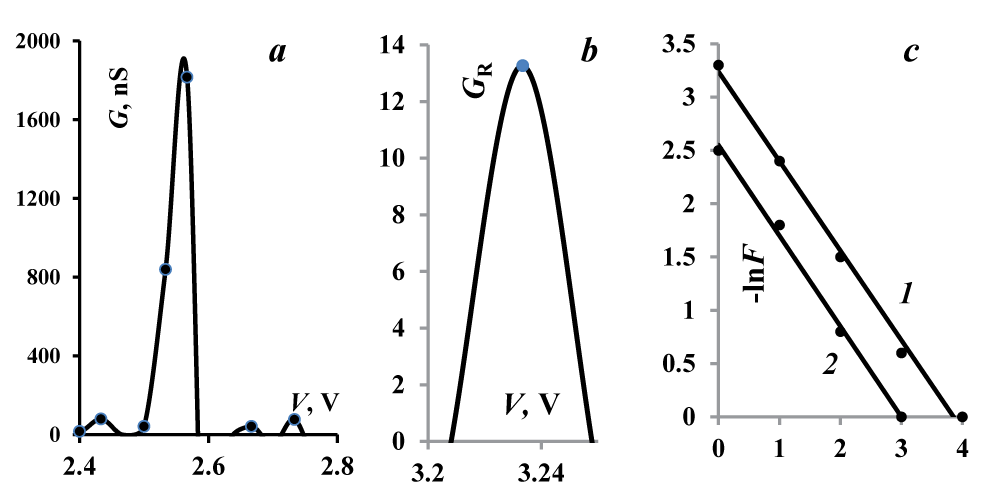
Figure 1 presents examples of quantum conductance, relative quantum conductance, and distributions relating nanocrystal dimensions to the resonance-voltage parameter. The manuscript reports that the calculated and experimental distributions exhibit comparable values of the standard deviation, which is interpreted as supporting the proposed relationships.
For the biological component, the manuscript proposes an analogy between the quantum-dimensional behavior considered for nanocrystals and electronic behavior in nucleotides. It further proposes a possible quantum-information representation of nucleotide and codon structures. These biological results are conceptual rather than experimentally established.
Critical qualification
The author must provide the actual experimental data, sample information, measurement conditions, statistical analysis, and numerical results before the above can be presented as a conventional research Results section. At present, the manuscript gives conclusions about the experimental comparison but does not provide enough information to independently evaluate them.
To calculate the transmission coefficient D, the concept of the magnitude of the probability flux density vector is used: j = iħ(2m)⁻¹(ΨΨ* - Ψ*Ψʹ). The transmission coefficient is defined as the ratio of the outgoing flux j₂ and the incoming flux j₁ through the potential barrier: D = limx→∞(ǀj₂ǀ/ǀj₁ǀ). The differential flow conductivity is determined in the variants defined by the following formulas:
G = J0dD/dV = J[1m1/2an(V1m1/2an(VIhn T. Semiconductor Nanostructures: Quantum States and Electronic Transport. Oxford University Press, 2009. DOI: 1093/acprof:oso/9780199534425.001.0001.-1/21/2Ihn T. Semiconductor Nanostructures: Quantum States and Electronic Transport. Oxford University Press, 2009. DOI: 1093/acprof:oso/9780199534425.001.0001.] , or –
GR=G/J = 1.5ћ-1m1/2an(V-E) -1/2 ≈ 6(m/m0)1/2an(V-E) -1/2, or –
(GR)-2 = (1/36) (m/m0)-1an-2(V-E) (1)
Quantum conductivity manifests as quantum resonance, determined by the condition (E→V). Taking into account the solution to the Schrödinger equation for the eigenfunction – Eq = q2h2(8man2)-1, where q is the quantum number, the following expression for the dependence on the resonance voltage point VR is obtained:
q2≈ VR h-2(8man2) ≈ 2.7VRan2 m/m0 (2)
In calculations, everywhere: energy is in volts, dimensions are in nanometers.
Figures 1a and 1b show experimental examples of quantum conductance G and relative quantum conductance GR.
The resonance and quantum conductivity parameters are determined by the variation in crystal dimensions in the direction of the applied field, following a normal distribution f(x) ~ exp[11Ihn T. Semiconductor Nanostructures: Quantum States and Electronic Transport. Oxford University Press, 2009. DOI: 1093/acprof:oso/9780199534425.001.0001.], where: μ is the mathematical expectation (median); σ is the standard deviation; σ2 is the variance of the distribution.
The proposed quadimel concept is intended as a conceptual framework linking dimensional constraints with quantum-mechanical processes. In the physical part of the manuscript, semiconductor nanocrystals provide a comparatively defined setting in which quantum confinement, electron transport, transmission, and resonance can be described using established quantum-mechanical models.
The proposed biological extension requires considerably greater caution. Electronic states and charge distributions in nucleotides and DNA are established subjects of scientific investigation, but these established phenomena should not automatically be equated with the proposed quadimel interpretation. In particular, the proposed treatment of the phosphate-associated negative charge as a quasi-bound electron requires explicit physical and chemical justification.
Similarly, the proposed designation of nucleotides as quantum wires and the assignment of 21 qubits to a nucleotide and 63 qubits to a codon should be presented as hypotheses rather than established physical properties unless a rigorous mathematical and experimental correspondence can be demonstrated.
The transition from molecular quantum phenomena to biological organization also requires further explanation. Quantum properties at the molecular level alone do not establish a direct causal connection with the organization or functioning of living organisms. Consequently, the proposed relationship between the quadimel concept and biological organization should remain clearly identified as a research hypothesis.
Future work should therefore focus on distinguishing the proposed concept from established quantum-confinement physics, establishing a scientifically defensible electronic model for nucleotides, examining experimentally addressable electronic or spin states, and determining whether a physically meaningful mapping between molecular degrees of freedom and qubit states can be established.
Figure 1, c shows calculated and experimental graphs of the logarithm of the normal probability distribution function versus the square of the deviation (x - μ) for the measured sizes of nanocrystals and the voltage values at the current resonance point on the VR current–voltage characteristic. It can be seen that the distributions are characterized by identical values of the root-mean-square deviation σ, which may be evidence of the correctness of formulas (1) and (2).
Figure 1: Quantum conductivity G of nanocrystals (a), relative quantum conductivity GR (b). c: graphs of the logarithm of the distribution function versus the square of the deviation (x – μ) for the sizes of nanocrystals (1) and the values of the VR parameter (2).
Quadrimenes in biology
“Living” matter, just like “non-living” matter, has a dimensional subdivision. The basic unit is the cell – the elementary unit of structure, function, reproduction, and development of all living organisms. Cells consist of small and large molecules that perform a wide variety of functions.
The nucleus is the most important part of the cell, containing the main part of the DNA in the form of chromosomes. The nucleus is surrounded by a double membrane, and the DNA is carefully packaged with the help of proteins into a structure called chromatin. Chromatin is a complex of DNA and proteins (primarily histones) that forms the genetic material of the cell nucleus. It ensures the packaging of DNA, regulates access to genes for transcription, and also participates in DNA replication and cell division. Deoxyribonucleic acid (DNA) is a macromolecule (one of the three main ones; the other two are RNA and proteins) that ensures the storage, transmission, and implementation of the genetic program for the development and functioning of living organisms [11Ihn T. Semiconductor Nanostructures: Quantum States and Electronic Transport. Oxford University Press, 2009. DOI: 1093/acprof:oso/9780199534425.001.0001.].
A nucleotide contains three molecular groups sequentially connected by a single electron bond. The phosphate in DNA and RNA nucleotides consists of a phosphorus atom bonded to four oxygen atoms. One of the oxygen atoms in this group has a negative charge. This charge contributes to the overall negative charge of the entire nucleotide. The negative charge of the phosphate plays an important role in the formation of the spatial structure of DNA, including in the formation of the double helix, as well as in the interactions between the strands during the complementary pairing of nitrogenous bases. Based on these three circumstances, it can be assumed that in a nucleotide, the electron of the “free” phosphate bond is a quasi-bound electron of the nucleotide, which performs cyclic rotational-translational quantized motion in it, similar to that considered in a nanocrystal.
The phosphate-containing backbone contributes substantially to the electrostatic and structural properties of nucleic acids, while electronic states and charge-transfer processes in nucleic acids have been investigated using experimental and theoretical approaches [55Sponer,J, Leszczynski J, Hobza P. Electronic properties, hydrogen bonding, stacking, and cation binding of DNA and RNA bases. Biopolymers. 2001; 61: 3–31. DOI: 1002/1097-0282(2001)61:1<3::AID-BIP10048>3.0.CO;2-4.,1313Genereux JC, Barton JK. Mechanisms for DNA charge transport. Chemical Reviews. 2010; 110: 1642–1662. DOI: 1021/cr900228f.,17–1917–19Endres RG, Cox DL, Singh RRP. The electronic structure of DNA. Reviews of Modern Physics. 2004; 76: 195–214.].
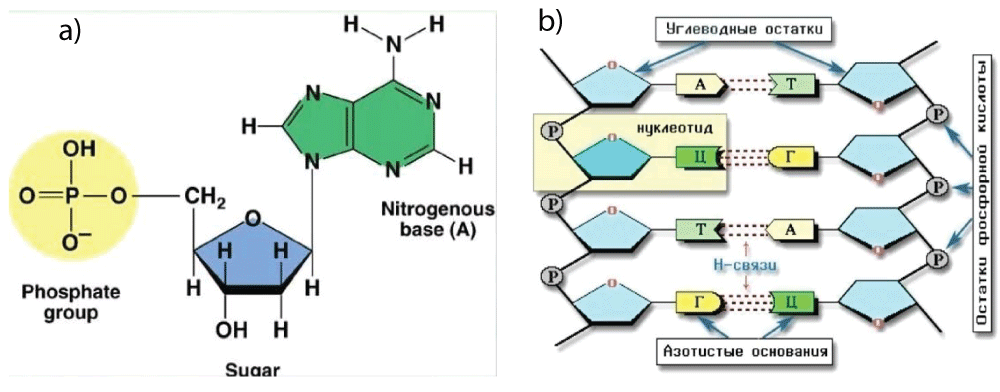
In online resources, you can find various graphical representations of a nucleotide, one of which is shown in Figure 2a, where a quasi-bound electron in the form of O– is marked in the phosphate group. Figure 2b depicts a DNA fragment illustrating the sequence of nucleotide connections of the quantum-wire type [22Beenakker CWJ, van Houten H. Quantum transport in semiconductor nanostructures. Solid State Physics.1991; 44: 1–228.].
22Beenakker CWJ, van Houten H. Quantum transport in semiconductor nanostructures. Solid State Physics.1991; 44: 1–228.]." /> Figure 2: a) Composition, structure, and electronic bonds of a nucleotide; b) the sequence of nucleotide connections of the quantum‑wire type [22Beenakker CWJ, van Houten H. Quantum transport in semiconductor nanostructures. Solid State Physics.1991; 44: 1–228.].
Scientific and practical applications – qudits and qubits
Like a bit, a qubit has two eigenstates (zero and one), denoted as ∣0⟩ and ∣1⟩, but it can also be in a superposition of these states [2020Nielsen MA, Chuang IL. Quantum Computation and Quantum Information, 10th Anniversary ed. Cambridge University Press, 2010.]. In the general case, its superposition takes the form (A∣0⟩ + B∣1⟩), where A and B are complex probability amplitudes and satisfy the condition |A*A| + |B*B| = 1.
The number of qubits is determined by combining two parameters from the total number of independent parameters – degrees of freedom. In the case of the quadimels we are considering, we can assume that its quasi-free electron, during quantum transport, may have at least 7 degrees of freedom: three in terms of coordinates, two in terms of spin, and two in terms of quantum number. This gives 21 qubits. That is, such a quadimel acts as a 21-qubit computer. Applying this to a nucleotide, we can consider it to act as a 21-qubit quantum computer, with a computational power of 221 ~ 109, i.e., ~1 QGB (qubit-gigabyte).
The key elements carrying coding information in humans are codons – blocks of three nucleotides that will have 21·3=63 qubits [22Beenakker CWJ, van Houten H. Quantum transport in semiconductor nanostructures. Solid State Physics.1991; 44: 1–228.]. This representation of the quantum-informational action of DNA elements corresponds to the coding scheme accepted in science and practice. Each of the twenty amino acids is encoded by a sequence of three nucleotides. The code cannot be monoplet, since 4 nucleotides in DNA can encode fewer than 20 amino acids. The code cannot be doublet, since 16 (42) combinations of nucleotides are also fewer than the 20 basic amino acids. The code can be minimally triplet, since 64 (43) combinations of nucleotides already encode more than 20 amino acids.
Thus, the introduction of the new term and concept of “quadimel” will make it possible to solve a number of the following scientific and applied problems.
The introduction of quadimel will unite the concepts of “living” and “non-living” matter. At the same time, the properties of the quadimels of “non-living” matter can be studied relatively easily and used to investigate the more complex quantum properties of “living” matter.
In physics, semiconductor quantum-dimensional nanocrystals have been proposed as quasidevices; they can be used as elements of nanoelectronics for quantum computing and communications based on the design and technological principles of microelectronics, in particular, to solve the fundamental problem of cryptography in stationary and, especially, mobile quantum communication systems.
Quadimeles in biology are yet to be studied theoretically and experimentally. They can be used for genetic diagnostics, radiation therapy, and protection from harmful radiation of a quantum nature.
The work presented in this article provides a detailed study of semiconductor nanocrystals as qudimes of “inanimate” matter. For “animate” matter, the study is preliminary and speculative in nature. A detailed study will be conducted in the future include the following provisions:
clear distinction between the proposed concept and the already established physics of quantum confinement;
a scientific justification of the phosphate-electron model;
a distinction between the established quantum-mechanical electronic states in DNA and the proposed interpretation;
a justified mapping between the physical degrees of freedom of a nucleotide and a fixed number of qubits;
an investigation into whether certain electronic or spin states of nucleotides can serve as experimentally addressable quantum states.
Ihn T. Semiconductor Nanostructures: Quantum States and Electronic Transport. Oxford University Press, 2009. DOI: 1093/acprof:oso/9780199534425.001.0001.
Beenakker CWJ, van Houten H. Quantum transport in semiconductor nanostructures. Solid State Physics.1991; 44: 1–228.
Platero G, Aguado R. Photon-assisted transport in semiconductor nanostructures. Physics Reports. 2004; 395: 1–157. DOI: 1016/j.physrep.2004.01.004.
Harrison P. Quantum Wells, Wires and Dots: Theoretical and Computational Physics of Semiconductor Nanostructures. Wiley.— Particularly appropriate for the manuscript's treatment of quantum confinement and low-dimensional semiconductor structures.
Sponer,J, Leszczynski J, Hobza P. Electronic properties, hydrogen bonding, stacking, and cation binding of DNA and RNA bases. Biopolymers. 2001; 61: 3–31. DOI: 1002/1097-0282(2001)61:1<3::AID-BIP10048>3.0.CO;2-4.
Middleton CT, de La Harpe K, Su C, Law YK, Crespo-Hernández CE, Kohler B. DNA excited-state dynamics: from single bases to the double helix. Annu Rev Phys Chem. 2009:60:217-39. DOI: 1146/annurev.physchem.59.032607.093719.
Scholes GD, Fleming GR. What is quantum biology? Proc Natl Acad Sci U S A. 2026 Apr 7;123(14):e2531134123. DOI: 1073/pnas.2531134123
Barton JK, Olmon ED, Sontz PA. DNA-mediated charge transport for DNA repair. Nature Chemistry. 2018; 10: 551–560.
Genereux JC, Barton JK. Mechanisms for DNA charge transport. Chemical Reviews. 2010; 110: 1642–1662. DOI: 1021/cr900228f.
Lewis FD, Wu T, Zhang Y, Letsinger RL, Greenfield SR, Wasielewski MR, et al. Distance-dependent electron transfer in DNA hairpins. Science. 1997; 277: 673–676.
Fink HW, Schönenberger C. Electrical conduction through DNA molecules. Nature. 1999; 398: 407–410.
Tsu R, Esaki L. Tunneling in a finite superlattice. Applied Physics Letters. 1973; 22: 562–564.
Endres RG, Cox DL, Singh RRP. The electronic structure of DNA. Reviews of Modern Physics. 2004; 76: 195–214.
Porath D, Bezryadin A, de Vries S, Dekker C. Direct measurement of electrical transport through DNA molecules. Nature. 2000; 403: 635–638.
Xu B, Zhang P, Li X, Tao NJ. Direct conductance measurement of single DNA molecules in aqueous solution. Nano Letters. 2004; 4: 1105–1108. DOI: 1021/nl0494295.
Nielsen MA, Chuang IL. Quantum Computation and Quantum Information, 10th Anniversary ed. Cambridge University Press, 2010.
Zhukov ND. Quadimel – A New Concept in Physics and Biology. IgMin Res. September 03, 2026; 4(9): 372-376. IgMin ID: igmin361; DOI:10.61927/igmin361; Available at: igmin.link/p361
How to cite this article: Zhukov ND. Quadimel – A New Concept in Physics and Biology. IgMin Res. September 03, 2026; 4(9): 372-376. IgMin ID: igmin361; DOI:10.61927/igmin361; Available at: igmin.link/p361
Figure 1: Quantum conductivity G of nanocrystals (a), relati...
Figure 2: a) Composition, structure, and electronic bonds of...
Ihn T. Semiconductor Nanostructures: Quantum States and Electronic Transport. Oxford University Press, 2009. DOI: 1093/acprof:oso/9780199534425.001.0001.
Beenakker CWJ, van Houten H. Quantum transport in semiconductor nanostructures. Solid State Physics.1991; 44: 1–228.
Platero G, Aguado R. Photon-assisted transport in semiconductor nanostructures. Physics Reports. 2004; 395: 1–157. DOI: 1016/j.physrep.2004.01.004.
Harrison P. Quantum Wells, Wires and Dots: Theoretical and Computational Physics of Semiconductor Nanostructures. Wiley.— Particularly appropriate for the manuscript's treatment of quantum confinement and low-dimensional semiconductor structures.
Sponer,J, Leszczynski J, Hobza P. Electronic properties, hydrogen bonding, stacking, and cation binding of DNA and RNA bases. Biopolymers. 2001; 61: 3–31. DOI: 1002/1097-0282(2001)61:1<3::AID-BIP10048>3.0.CO;2-4.
Middleton CT, de La Harpe K, Su C, Law YK, Crespo-Hernández CE, Kohler B. DNA excited-state dynamics: from single bases to the double helix. Annu Rev Phys Chem. 2009:60:217-39. DOI: 1146/annurev.physchem.59.032607.093719.
Scholes GD, Fleming GR. What is quantum biology? Proc Natl Acad Sci U S A. 2026 Apr 7;123(14):e2531134123. DOI: 1073/pnas.2531134123
Barton JK, Olmon ED, Sontz PA. DNA-mediated charge transport for DNA repair. Nature Chemistry. 2018; 10: 551–560.
Genereux JC, Barton JK. Mechanisms for DNA charge transport. Chemical Reviews. 2010; 110: 1642–1662. DOI: 1021/cr900228f.
Lewis FD, Wu T, Zhang Y, Letsinger RL, Greenfield SR, Wasielewski MR, et al. Distance-dependent electron transfer in DNA hairpins. Science. 1997; 277: 673–676.
Fink HW, Schönenberger C. Electrical conduction through DNA molecules. Nature. 1999; 398: 407–410.
Tsu R, Esaki L. Tunneling in a finite superlattice. Applied Physics Letters. 1973; 22: 562–564.
Endres RG, Cox DL, Singh RRP. The electronic structure of DNA. Reviews of Modern Physics. 2004; 76: 195–214.
Porath D, Bezryadin A, de Vries S, Dekker C. Direct measurement of electrical transport through DNA molecules. Nature. 2000; 403: 635–638.
Xu B, Zhang P, Li X, Tao NJ. Direct conductance measurement of single DNA molecules in aqueous solution. Nano Letters. 2004; 4: 1105–1108. DOI: 1021/nl0494295.
Nielsen MA, Chuang IL. Quantum Computation and Quantum Information, 10th Anniversary ed. Cambridge University Press, 2010.






 Scan and get link