IGMIN: We're glad you're here. Please click 'create a new query' if you are a new visitor to our website and need further information from us.
If you are already a member of our network and need to keep track of any developments regarding a question you have already submitted, click 'take me to my Query.'
Welcome to IgMin Research – an Open Access journal uniting Biology, Medicine, and Engineering. We’re dedicated to advancing global knowledge and fostering collaboration across scientific fields.
At IgMin Research, we bridge the frontiers of Biology, Medicine, and Engineering to foster interdisciplinary innovation. Our expanded scope now embraces a wide spectrum of scientific disciplines, empowering global researchers to explore, contribute, and collaborate through open access.
Welcome to IgMin, a leading platform dedicated to enhancing knowledge dissemination and professional growth across multiple fields of science, technology, and the humanities. We believe in the power of open access, collaboration, and innovation. Our goal is to provide individuals and organizations with the tools they need to succeed in the global knowledge economy.
IgMin Publications Inc., Suite 102, West Hartford, CT - 06110, USA
Our commitment is to bridge knowledge gaps across disciplines and propel the advancement of scientific thought.
About
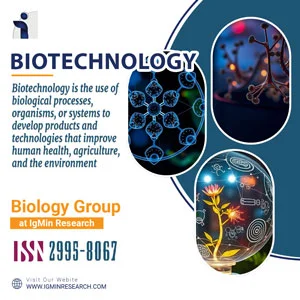
Advancing Innovation through Biotechnology Publishing
Biotechnology is transforming industries—from healthcare and agriculture to environmental sustainability. At IgMin Research, we provide a high-visibility platform for researchers and practitioners to publish their findings in our reputed biotechnology journal. With a growing biotechnology journal impact factor, our publication helps authors increase citation potential and global reach.
Whether you're working on genetic engineering, bioinformatics, or sustainable bioprocesses, our journal welcomes diverse contributions through a streamlined biotechnology journal submission process. All submissions undergo rigorous peer review to uphold the highest scientific standards.
Partner with us for impactful biotechnology research publishing that drives innovation forward.
Genetic engineering and CRISPR technology Synthetic biology and bioengineering Biopharmaceuticals and drug development Industrial biotechnology and bioprocessing Environmental biotechnology and bioremediation Agri-biotechnology and genetically modified crops Microbial biotechnology and fermentation Tissue engineering and regenerative medicine Bioinformatics and computational biotechnology Nanobiotechnology and biosensors Bioplastics and sustainable materials Metabolic engineering for biofuels Biotechnology in aquaculture Stem cell research and applications Vaccine development and delivery systems Biotechnology in diagnostics Omics technologies (genomics proteomics metabolomics) Biotechnology for personalized medicine Biotechnology in food and nutrition Ethics and biosafety in biotechnology
Open Access Policy refers to a set of principles and guidelines aimed at providing unrestricted access to scholarly research and literature. It promotes the free availability and unrestricted use of research outputs, enabling researchers, students, and the general public to access, read, download, and distribute scholarly articles without financial or legal barriers. In this response, I will provide you with an overview of the history and latest resolutions related to Open Access Policy.
Open Access Policy refers to a set of principles and guidelines aimed at providing unrestricted access to scholarly research and literature. It promotes the free availability and unrestricted use of research outputs, enabling researchers, students, and the general public to access, read, download, and distribute scholarly articles without financial or legal barriers. In this response, I will provide you with an overview of the history and latest resolutions related to Open Access Policy.
Open Access Policy refers to a set of principles and guidelines aimed at providing unrestricted access to scholarly research and literature. It promotes the free availability and unrestricted use of research outputs, enabling researchers, students, and the general public to access, read, download, and distribute scholarly articles without financial or legal barriers. In this response, I will provide you with an overview of the history and latest resolutions related to Open Access Policy.
Open Access Policy refers to a set of principles and guidelines aimed at providing unrestricted access to scholarly research and literature. It promotes the free availability and unrestricted use of research outputs, enabling researchers, students, and the general public to access, read, download, and distribute scholarly articles without financial or legal barriers. In this response, I will provide you with an overview of the history and latest resolutions related to Open Access Policy.