IGMIN: We're glad you're here. Please click 'create a new query' if you are a new visitor to our website and need further information from us.
If you are already a member of our network and need to keep track of any developments regarding a question you have already submitted, click 'take me to my Query.'
Welcome to IgMin Research – an Open Access journal uniting Biology, Medicine, and Engineering. We’re dedicated to advancing global knowledge and fostering collaboration across scientific fields.
At IgMin Research, we bridge the frontiers of Biology, Medicine, and Engineering to foster interdisciplinary innovation. Our expanded scope now embraces a wide spectrum of scientific disciplines, empowering global researchers to explore, contribute, and collaborate through open access.
Welcome to IgMin, a leading platform dedicated to enhancing knowledge dissemination and professional growth across multiple fields of science, technology, and the humanities. We believe in the power of open access, collaboration, and innovation. Our goal is to provide individuals and organizations with the tools they need to succeed in the global knowledge economy.
IgMin Publications Inc., Suite 102, West Hartford, CT - 06110, USA
Introduction: Gastroenteritis remains a major public health concern in low-income countries. Human adenoviruses (HAdVs), particularly types 40 and 41, and human astroviruses (HAstVs) are among the principal viral agents associated with diarrheal diseases, especially in children. This study aimed to determine the prevalence of adenoviruses and astroviruses among patients and selected marine animals in the Republic of Guinea.
Methods: A total of 290 samples were analyzed, including 250 stool samples from patients presenting with diarrhea at Kindia Regional Hospital and Guéckédou Prefectural Hospital, and 40 samples from marine animals collected in Conakry (fish, crabs, and mollusks). Viral detection was performed using real-time PCR for adenoviruses and RT-PCR for astroviruses. Results were analyzed according to age, sex, season, clinical presentation, and socio-professional category using descriptive statistics and 95% confidence intervals.
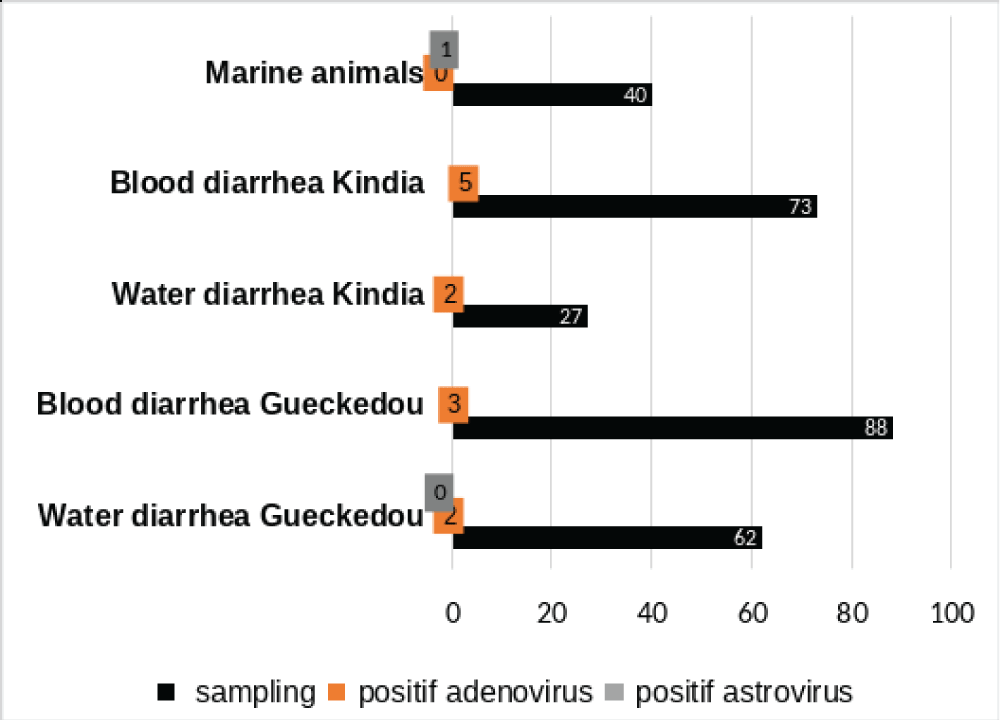
Results: Among human samples, 12 out of 250 were positive for adenovirus, corresponding to an overall prevalence of 4.8%. Higher positivity rates were observed among children aged 0–15 years (8.19%) and during the rainy season. No statistically significant differences were observed according to sex or socio-professional category. Astrovirus was detected in one marine animal sample (1/40 (2.5%)), while no positive cases were identified in fish or crabs.
Conclusion: Human adenoviruses circulate among patients with gastroenteritis in Guinea, particularly among children and during the rainy season. The detection of astrovirus in a marine organism suggests a low but potential environmental or foodborne transmission risk, supporting the relevance of an integrated One Health approach.
Acute gastroenteritis remains a major public health concern, particularly in developing countries. Human adenoviruses (HAdVs) and astroviruses (HAstVs) are responsible for a substantial proportion of cases, primarily affecting children under five years of age [11Hartman RM, Collaborators CA. Risk factors for mortality among children younger than age 5 years with severe diarrhea in low- and middle-income countries: Global Rotavirus and Pediatric Diarrhea Surveillance Networks. Lancet Glob Health. 2023;3:e1047–e1053. Available from: https://doi.org/10.1016/S2214-109X(23)00376-0]. Adenoviruses are double-stranded DNA viruses, with serotypes 40 and 41 specifically associated with diarrheal diseases in humans [22Ghebremedhin B. Human adenovirus: viral pathogen with increasing importance. Eur J Microbiol Immunol (Bp). 2014;4(1):26–33. doi:10.1556/EuJMI.4.2014.1.2.]. Globally, an estimated 1.7 billion cases of childhood diarrhea occur annually, resulting in approximately 525,000 deaths among children under five years old [33World Health Organization. Scope of diarrheal disease. 2023 May 16. Available from: https://www.who.int/newsroom/factsheets/detail/diarrhealdisease], particularly in sub-Saharan Africa and South Asia [44Dadonaite B, Roser H. Diarrheal diseases. Our World in Data. 2023 May 16. Available from: https://ourworldindata.org/diarrheal-diseases]. Enteric viruses such as HAdVs and HAstVs are thought to cause over 200,000 human deaths annually [55Stuempfig ND, Seroy J. Diarrhea. Treasure Island (FL): StatPearls Publishing; 2023 Jun 21. doi:books/NBK518995]. Astroviruses, which are single-stranded RNA viruses, are also a major cause of diarrhea, particularly among young children and immunocompromised individuals [66Dennehy PH, Nelson SM, Spangenberger S, Noel JS, Monroe SS, Glass RI. A prospective case-control study of the role of astrovirus in acute diarrhea among hospitalized young children. J Infect Dis. 2001 Jul 1;184(1):10-5. doi: 10.1086/321007. Epub 2001 May 31. PMID: 11398103.,77Troeger C, Blacker BF. Estimates of the global, regional, and national morbidity, mortality, and aetiologies of diarrhea in 195 countries: a systematic analysis for the Global Burden of Disease Study 2016. Lancet Infect Dis. 2018;18:1211–1228. Available from: https://doi.org/10.1016/S1473-3099(18)30362-1]. These pathogens are frequently implicated in both outbreaks and sporadic cases. In Guinea, specific detection of HAdVs and HAstVs is crucial for improving patient management and guiding epidemiological investigations. Nevertheless, despite advanced diagnostic techniques, a significant proportion of gastroenteritis cases remain unexplained [88Guo X, Li D, Lu W, Piao X, Chen X. Screening of Bacillus strains as potential probiotics and subsequent confirmation of the in vivo effectiveness of Bacillus subtilis MA139 in pigs. Antonie Van Leeuwenhoek. 2006 Aug;90(2):139-46. doi: 10.1007/s10482-006-9067-9. Epub 2006 Jul 4. PMID: 16820971.,99Yinda CK, Vanhulle E, Conceição-Neto N, Beller L, Deboutte W, Shi C, Ghogomu SM, Maes P, Van Ranst M, Matthijnssens J. Gut Virome Analysis of Cameroonians Reveals High Diversity of Enteric Viruses, Including Potential Interspecies Transmitted Viruses. mSphere. 2019 Jan 23;4(1):e00585-18. doi: 10.1128/mSphere.00585-18. PMID: 30674646; PMCID: PMC6344602.]. This study aims to evaluate the prevalence of human adenoviruses and astroviruses in patients presenting with diarrhea and vomiting, as well as in marine animals. Polymerase chain reaction (PCR) and reverse transcription PCR (RT-PCR) techniques were employed to detect astroviruses. The study seeks to enhance local epidemiological understanding and inform strategies to combat diarrheal diseases in the hospitals of Gueckedou, Kindia, and the marine environment of Conakry, and more broadly throughout Guinea [1010Lamberti LM, Fischer Walker CL, Black RE. Systematic review of diarrhea duration and severity in children and adults in low- and middle-income countries. BMC Public Health. 2012 Apr 6;12:276. doi: 10.1186/1471-2458-12-276. Erratum in: BMC Public Health. 2012;12:832. PMID: 22480268; PMCID: PMC3364857.-1212Santosham M, Chandran A, Fitzwater S, Fischer-Walker C, Baqui AH, Black R. Progress and barriers for the control of diarrhoeal disease. Lancet. 2010 Jul 3;376(9734):63-7. doi: 10.1016/S0140-6736(10)60356-X. PMID: 20609988.].
Conakry, the capital city of the Republic of Guinea in West Africa, is located on the Kaloum Peninsula and bordered by the Atlantic Ocean and surrounding islands. The city features diverse topography, including coastal plains and hills, and is predominantly covered by mangrove vegetation.
Its tropical climate is characterised by average temperatures ranging from 24.6 °C to 37.5 °C, with heavy rainfall, particularly during July and August. Covering an area of 450 km², Conakry had a population of over 1.66 million in 2014, composed mainly of young people from the Soussou ethnic group, known for its rich cultural traditions and folklore. The city is administratively divided into 13 autonomous municipalities governed by a central governorate [1313Ministry of Territorial Administration and Decentralization (MATD). National administrative data. Guinea; 2024. Available from: https://matd.gov.gn/].
Kindia, holds a strategic geographic position and benefits from significant natural resources. Spanning 500 km², it is surrounded by plateaus averaging 400 m in elevation, with peaks reaching up to 1,117 m. The region is well-irrigated, with an extensive hydrographic network. Its humid tropical climate alternates between dry and rainy seasons, with temperatures ranging from 15 °C to 38 °C. In 2018, Kindia had an estimated population of around 296,000, composed primarily of youth and women from diverse ethnic backgrounds. The local economy is primarily based on agriculture and livestock farming [1414National Institute of Statistics Guinea. Third General Population and Housing Census (RGPH-3). Guinea; 2014. Available from: https://www.stat-guinee.org/].
Lastly, the prefecture of Gueckedou, located in the forested region of Guinea, spans a vast area of 4,400 km². As of 2016, its population was estimated at approximately 610,000, predominantly from the Kissi ethnic group. The region is intersected by numerous watercourses and features a savannah climate, with an annual average temperature of 26.4 °C and significant summer rainfall.
Rich in biodiversity and natural resources, Gueckedou serves as an important commercial hub, notably for rice, coffee, and palm-derived products [1515Köppen climate classification. Guinea: Prefecture of Guéckédou.].
Sample collection
A total of 290 samples were collected between July and December 2022. These included 250 stool samples from patients aged 0–65 years presenting with diarrhea at Kindia Regional Hospital (n = 100) and Guéckédou Prefectural Hospital (n = 150), and 40 samples from marine animals collected in Conakry, comprising fish, crabs, and molluscs. Marine species were selected based on their abundance and importance in the local diet, as well as their potential role in environmental contamination and foodborne transmission [1616Chén OY, Bodelet JS, Saraiva RG, Phan H, Di J, Nagels G, Schwantje T, Cao H, Gou J, Reinen JM, Xiong B, Zhi B, Wang X, de Vos M. The roles, challenges, and merits of the p value. Patterns (N Y). 2023 Dec 8;4(12):100878. doi: 10.1016/j.patter.2023.100878. PMID: 38106615; PMCID: PMC10724370.-1818Hoffmann De. Gastroenteritis viruses and their impact on global public health. (E. I. Diseases, E´d.). 2018; 2:15-230.].
Transport and storage
Samples were stored in 1.5-mL Eppendorf tubes and kept in cool boxes containing dry ice. They were transported within 72 hours to the Guinean-Russian Laboratory at the Institute of Applied Biology Research of Guinea (IRBAG), where the analyses were conducted.
DNA and RNA extraction
Viral nucleic acids were extracted using the Ribo-Sorb AmpliSens® kit, following the manufacturer’s instructions. Positive and negative controls were included in each extraction batch. Extracted nucleic acids were used immediately for amplification or stored at −20 °C.
Molecular detection
Real-time PCR was used for the detection of human adenoviruses, while RT-PCR was employed for astrovirus detection. Amplification reactions were performed using AmpliSens® kits, incorporating hot-start polymerase and fluorescent probes for real-time monitoring. The analytical sensitivity of the assay was approximately 1 × 10⁴ copies per reaction.
Data analysis
Data were analysed using descriptive statistical methods. Prevalence rates were calculated, and 95% confidence intervals were used to assess variability. Results were stratified according to age group, sex, season, clinical presentation, and socio-professional category.
This study provides evidence for the circulation of human adenoviruses among patients presenting with gastroenteritis in Guinea, with variations observed according to age, season, and study site. An overall adenovirus positivity rate of 4.8% was recorded among human samples, which is comparable with rates reported in other low- and middle-income countries. The higher detection rate among children aged 0–15 years confirms their increased vulnerability, likely due to immature immunity and greater exposure to enteric pathogens. Seasonal analysis revealed higher positivity during the rainy season compared with the dry season, suggesting that increased rainfall, environmental contamination, and sanitation challenges could facilitate viral transmission [1919Griffiths L. Animal reservoirs and the transmission of gastroenteritis viruses. Zoonoses Public Health. 2013;60(7):456–471. Available from: https://doi.org/10.1111/zph.12048].
Geographical differences were also observed, with higher positivity rates in Kindia compared with Guéckédou, particularly among patients presenting with liquid diarrhea. These findings may reflect local differences in hygiene practices, water quality, population density, or healthcare access. Although males showed slightly higher positivity rates than females, no statistically significant difference was observed, indicating that sex does not appear to be a determining factor in adenovirus infection in this setting. Similarly, while positive cases were identified across several socio-professional categories, no significant association was found, suggesting that exposure risk is widespread and not confined to specific occupational groups. Regarding marine animals, astrovirus was detected in a single mollusc sample, while no positive cases were identified in fish or crabs. Although the overall positivity rate in marine animals was low (2.5%), this finding suggests a potential environmental reservoir and suggests that enteric viruses may persist in aquatic ecosystems. While the risk of foodborne or interspecies transmission appears limited, it cannot be completely excluded. Collectively, these results underscore the influence of environmental and seasonal factors on viral gastroenteritis and support the importance of integrated human–animal surveillance within a One Health framework.
Human adenoviruses are circulating among patients with gastroenteritis in Guinea, particularly among children and during the rainy season. Although astrovirus detection was rare, its presence in a marine organism highlights a potential environmental reservoir. These findings underscore the need for strengthened virological surveillance, improved hygiene and sanitation measures, and integrated human–animal health monitoring.
Funding
This study was supported by the Ministry of Higher Education, Scientific Research and Innovation, Republic of Guinea and the Directorate General of the Institute of Applied Biology Research of Guinea (IRBAG).
Ethical statement
This study was conducted in accordance with national research ethics guidelines in the Republic of Guinea. Approval was obtained from the relevant hospitals and authorities, and informed consent was obtained from all participants or their legal guardians.
Author contributions
André Saa TOGBODOUNO: Sample collection, transportation from Gueckedou to the laboratory, and manuscript writing.
Lansana II SOUMAH and Laurent Gbagbo ONIVOGUI: Development of the research protocol.
Aboubacar Sidy Sily BAH: Revision and validation of the research protocol.
Emmanuel Saa MILLIMOUNO, Tamba Ren´e Tolno, and Moussa KOLIE´: First round of manuscript revision.
Mohamed Sahar TRAORE: Critical review and final editing of the manuscript. Ibrahima Sory SOW: Statistical data analysis.
Roland TENKIANO: Sample collection in Kindia and Conakry.
Jacqueline Sia Mara: Sample preprocessing.
Ramatoulaye BALDE and Sanaba Boumbaly: Molecular analysis of samples.
Hartman RM, Collaborators CA. Risk factors for mortality among children younger than age 5 years with severe diarrhea in low- and middle-income countries: Global Rotavirus and Pediatric Diarrhea Surveillance Networks. Lancet Glob Health. 2023;3:e1047–e1053. Available from: https://doi.org/10.1016/S2214-109X(23)00376-0
Ghebremedhin B. Human adenovirus: viral pathogen with increasing importance. Eur J Microbiol Immunol (Bp). 2014;4(1):26–33. doi:10.1556/EuJMI.4.2014.1.2.
World Health Organization. Scope of diarrheal disease. 2023 May 16. Available from: https://www.who.int/newsroom/factsheets/detail/diarrhealdisease
Dadonaite B, Roser H. Diarrheal diseases. Our World in Data. 2023 May 16. Available from: https://ourworldindata.org/diarrheal-diseases
Stuempfig ND, Seroy J. Diarrhea. Treasure Island (FL): StatPearls Publishing; 2023 Jun 21. doi:books/NBK518995
Dennehy PH, Nelson SM, Spangenberger S, Noel JS, Monroe SS, Glass RI. A prospective case-control study of the role of astrovirus in acute diarrhea among hospitalized young children. J Infect Dis. 2001 Jul 1;184(1):10-5. doi: 10.1086/321007. Epub 2001 May 31. PMID: 11398103.
Troeger C, Blacker BF. Estimates of the global, regional, and national morbidity, mortality, and aetiologies of diarrhea in 195 countries: a systematic analysis for the Global Burden of Disease Study 2016. Lancet Infect Dis. 2018;18:1211–1228. Available from: https://doi.org/10.1016/S1473-3099(18)30362-1
Guo X, Li D, Lu W, Piao X, Chen X. Screening of Bacillus strains as potential probiotics and subsequent confirmation of the in vivo effectiveness of Bacillus subtilis MA139 in pigs. Antonie Van Leeuwenhoek. 2006 Aug;90(2):139-46. doi: 10.1007/s10482-006-9067-9. Epub 2006 Jul 4. PMID: 16820971.
Yinda CK, Vanhulle E, Conceição-Neto N, Beller L, Deboutte W, Shi C, Ghogomu SM, Maes P, Van Ranst M, Matthijnssens J. Gut Virome Analysis of Cameroonians Reveals High Diversity of Enteric Viruses, Including Potential Interspecies Transmitted Viruses. mSphere. 2019 Jan 23;4(1):e00585-18. doi: 10.1128/mSphere.00585-18. PMID: 30674646; PMCID: PMC6344602.
Lamberti LM, Fischer Walker CL, Black RE. Systematic review of diarrhea duration and severity in children and adults in low- and middle-income countries. BMC Public Health. 2012 Apr 6;12:276. doi: 10.1186/1471-2458-12-276. Erratum in: BMC Public Health. 2012;12:832. PMID: 22480268; PMCID: PMC3364857.
Mousavi Nasab SD, Zali F, Kaghazian H, Aghasadeghi MR, Mardani R, Gachkar L, Ahmadi Vasmehjani A, Ahmadi N, Ghasemzadeh A. Prevalence of astrovirus, adenovirus, and sapovirus infections among Iranian children with acute gastroenteritis. Gastroenterol Hepatol Bed Bench. 2020 Winter;13(Suppl1):S122-S127. PMID: 33585013; PMCID: PMC7881414.
Santosham M, Chandran A, Fitzwater S, Fischer-Walker C, Baqui AH, Black R. Progress and barriers for the control of diarrhoeal disease. Lancet. 2010 Jul 3;376(9734):63-7. doi: 10.1016/S0140-6736(10)60356-X. PMID: 20609988.
Ministry of Territorial Administration and Decentralization (MATD). National administrative data. Guinea; 2024. Available from: https://matd.gov.gn/
National Institute of Statistics Guinea. Third General Population and Housing Census (RGPH-3). Guinea; 2014. Available from: https://www.stat-guinee.org/
Köppen climate classification. Guinea: Prefecture of Guéckédou.
Chén OY, Bodelet JS, Saraiva RG, Phan H, Di J, Nagels G, Schwantje T, Cao H, Gou J, Reinen JM, Xiong B, Zhi B, Wang X, de Vos M. The roles, challenges, and merits of the p value. Patterns (N Y). 2023 Dec 8;4(12):100878. doi: 10.1016/j.patter.2023.100878. PMID: 38106615; PMCID: PMC10724370.
Tang X, Hu Y, Zhong X, Xu H. Molecular Epidemiology of Human Adenovirus, Astrovirus, and Sapovirus Among Outpatient Children With Acute Diarrhea in Chongqing, China, 2017-2019. Front Pediatr. 2022 Mar 3;10:826600. doi: 10.3389/fped.2022.826600. PMID: 35311045; PMCID: PMC8929441.
Hoffmann De. Gastroenteritis viruses and their impact on global public health. (E. I. Diseases, E´d.). 2018; 2:15-230.
Griffiths L. Animal reservoirs and the transmission of gastroenteritis viruses. Zoonoses Public Health. 2013;60(7):456–471. Available from: https://doi.org/10.1111/zph.12048
Togbodouno AS, Tenkiano T, Millimono ES, Tolno TR, Mara JS, Balde R, Soumah L, Kolie M, Onivogui LG, Boumbaly S, Bah BSS, Traore MS. Detection of Adenoviruses and Astroviruses in Patients and Marine Animals in the Republic of Guinea. IgMin Res. January 09, 2026; 4(1): 016-019. IgMin ID: igmin328; DOI:10.61927/igmin328; Available at: igmin.link/p328
1Guinea Institute for Research in Applied Biology, Republic of Guinea
2Regional Hospital of Kindia, Republic of Guinea
3Prefectural Hospital of Gueck´edou, Republic of Guinea
4Virology Research Centre, Republic of Guinea
5University of Kindia, Republic of Guinea
Address Correspondence: Andre Saa Togbodouno, Guinea Institute for Research in Applied Biology, Republic of Guinea, Email: [email protected]
How to cite this article: Togbodouno AS, Tenkiano T, Millimono ES, Tolno TR, Mara JS, Balde R, Soumah L, Kolie M, Onivogui LG, Boumbaly S, Bah BSS, Traore MS. Detection of Adenoviruses and Astroviruses in Patients and Marine Animals in the Republic of Guinea. IgMin Res. January 09, 2026; 4(1): 016-019. IgMin ID: igmin328; DOI:10.61927/igmin328; Available at: igmin.link/p328
Figure 1: Characterisation and Origin of the Samples....
Table 1: Distribution of samples according to pathogens det...
Table 2: Distribution of human samples by age group....
Table 3: Distribution of positive cases by sex....
Table 4: Seasonal distribution of positive cases....
Table 5: Socio-professional distribution....
Table 6: Distribution of marine animal samples....
Hartman RM, Collaborators CA. Risk factors for mortality among children younger than age 5 years with severe diarrhea in low- and middle-income countries: Global Rotavirus and Pediatric Diarrhea Surveillance Networks. Lancet Glob Health. 2023;3:e1047–e1053. Available from: https://doi.org/10.1016/S2214-109X(23)00376-0
Ghebremedhin B. Human adenovirus: viral pathogen with increasing importance. Eur J Microbiol Immunol (Bp). 2014;4(1):26–33. doi:10.1556/EuJMI.4.2014.1.2.
World Health Organization. Scope of diarrheal disease. 2023 May 16. Available from: https://www.who.int/newsroom/factsheets/detail/diarrhealdisease
Dadonaite B, Roser H. Diarrheal diseases. Our World in Data. 2023 May 16. Available from: https://ourworldindata.org/diarrheal-diseases
Stuempfig ND, Seroy J. Diarrhea. Treasure Island (FL): StatPearls Publishing; 2023 Jun 21. doi:books/NBK518995
Dennehy PH, Nelson SM, Spangenberger S, Noel JS, Monroe SS, Glass RI. A prospective case-control study of the role of astrovirus in acute diarrhea among hospitalized young children. J Infect Dis. 2001 Jul 1;184(1):10-5. doi: 10.1086/321007. Epub 2001 May 31. PMID: 11398103.
Troeger C, Blacker BF. Estimates of the global, regional, and national morbidity, mortality, and aetiologies of diarrhea in 195 countries: a systematic analysis for the Global Burden of Disease Study 2016. Lancet Infect Dis. 2018;18:1211–1228. Available from: https://doi.org/10.1016/S1473-3099(18)30362-1
Guo X, Li D, Lu W, Piao X, Chen X. Screening of Bacillus strains as potential probiotics and subsequent confirmation of the in vivo effectiveness of Bacillus subtilis MA139 in pigs. Antonie Van Leeuwenhoek. 2006 Aug;90(2):139-46. doi: 10.1007/s10482-006-9067-9. Epub 2006 Jul 4. PMID: 16820971.
Yinda CK, Vanhulle E, Conceição-Neto N, Beller L, Deboutte W, Shi C, Ghogomu SM, Maes P, Van Ranst M, Matthijnssens J. Gut Virome Analysis of Cameroonians Reveals High Diversity of Enteric Viruses, Including Potential Interspecies Transmitted Viruses. mSphere. 2019 Jan 23;4(1):e00585-18. doi: 10.1128/mSphere.00585-18. PMID: 30674646; PMCID: PMC6344602.
Lamberti LM, Fischer Walker CL, Black RE. Systematic review of diarrhea duration and severity in children and adults in low- and middle-income countries. BMC Public Health. 2012 Apr 6;12:276. doi: 10.1186/1471-2458-12-276. Erratum in: BMC Public Health. 2012;12:832. PMID: 22480268; PMCID: PMC3364857.
Mousavi Nasab SD, Zali F, Kaghazian H, Aghasadeghi MR, Mardani R, Gachkar L, Ahmadi Vasmehjani A, Ahmadi N, Ghasemzadeh A. Prevalence of astrovirus, adenovirus, and sapovirus infections among Iranian children with acute gastroenteritis. Gastroenterol Hepatol Bed Bench. 2020 Winter;13(Suppl1):S122-S127. PMID: 33585013; PMCID: PMC7881414.
Santosham M, Chandran A, Fitzwater S, Fischer-Walker C, Baqui AH, Black R. Progress and barriers for the control of diarrhoeal disease. Lancet. 2010 Jul 3;376(9734):63-7. doi: 10.1016/S0140-6736(10)60356-X. PMID: 20609988.
Ministry of Territorial Administration and Decentralization (MATD). National administrative data. Guinea; 2024. Available from: https://matd.gov.gn/
National Institute of Statistics Guinea. Third General Population and Housing Census (RGPH-3). Guinea; 2014. Available from: https://www.stat-guinee.org/
Köppen climate classification. Guinea: Prefecture of Guéckédou.
Chén OY, Bodelet JS, Saraiva RG, Phan H, Di J, Nagels G, Schwantje T, Cao H, Gou J, Reinen JM, Xiong B, Zhi B, Wang X, de Vos M. The roles, challenges, and merits of the p value. Patterns (N Y). 2023 Dec 8;4(12):100878. doi: 10.1016/j.patter.2023.100878. PMID: 38106615; PMCID: PMC10724370.
Tang X, Hu Y, Zhong X, Xu H. Molecular Epidemiology of Human Adenovirus, Astrovirus, and Sapovirus Among Outpatient Children With Acute Diarrhea in Chongqing, China, 2017-2019. Front Pediatr. 2022 Mar 3;10:826600. doi: 10.3389/fped.2022.826600. PMID: 35311045; PMCID: PMC8929441.
Hoffmann De. Gastroenteritis viruses and their impact on global public health. (E. I. Diseases, E´d.). 2018; 2:15-230.
Griffiths L. Animal reservoirs and the transmission of gastroenteritis viruses. Zoonoses Public Health. 2013;60(7):456–471. Available from: https://doi.org/10.1111/zph.12048






 Scan and get link