IGMIN: We're glad you're here. Please click 'create a new query' if you are a new visitor to our website and need further information from us.
If you are already a member of our network and need to keep track of any developments regarding a question you have already submitted, click 'take me to my Query.'
Welcome to IgMin Research – an Open Access journal uniting Biology, Medicine, and Engineering. We’re dedicated to advancing global knowledge and fostering collaboration across scientific fields.
At IgMin Research, we bridge the frontiers of Biology, Medicine, and Engineering to foster interdisciplinary innovation. Our expanded scope now embraces a wide spectrum of scientific disciplines, empowering global researchers to explore, contribute, and collaborate through open access.
Welcome to IgMin, a leading platform dedicated to enhancing knowledge dissemination and professional growth across multiple fields of science, technology, and the humanities. We believe in the power of open access, collaboration, and innovation. Our goal is to provide individuals and organizations with the tools they need to succeed in the global knowledge economy.
IgMin Publications Inc., Suite 102, West Hartford, CT - 06110, USA
This study analyzes the evolution of chair design in the Argentine Republic as a sequence of paradigmatic transformations analogous to those described by Thomas S. Kuhn in The Structure of Scientific Revolutions. Through a qualitative hermeneutic approach, it examines three emblematic cases — the matera chair, the B.K.F. chair, and the Aro chair — all situated within the American Liberal Social Order, but corresponding to three successive aesthetics: non-modern (proto-rationalist), modern (neo-rationalist), and postmodern (eclecticist).
The analysis draws on the categories proposed by Jordi Llovet, who critically adapted Jean Baudrillard’s semiological concepts to the field of industrial design. Llovet’s four constitutive values of the designed object — functional, aesthetic, symbolic, and economic — are expanded here with a fifth, emergent value: socio-environmental use-value, integrating ecological sustainability, social justice, and the revaluation of local knowledge.
The findings show that the matera chair exemplifies a phase of Kuhnian normal science (artisanal), in which the functional, aesthetic, and symbolic values appear unified. The B.K.F. chair, by contrast, embodies a Kuhnian paradigmatic revolution (industrial), characterized by the fragmentation of these values and the hegemony of exchange-value. Finally, the Aro chair illustrates a new crisis of the Kuhnian paradigm (industrial) and the gestation of a hybrid-sustainable paradigm (semi-industrial, semi-artisanal), in which the values are critically and ethically reintegrated.
The study confirms that the everyday object — in this case, the chair — functions as a material document of historical revolutions, in which worldviews, modes of production, and social relations are contested.
The present study is part of a recent line of research that has been developing a theoretical framework for understanding the historical evolution of chair design in Latin America, with an emphasis on the Argentine Republic. This trajectory has made it possible to articulate an analytical model capable of interpreting design objects not merely as functional artefacts, but as material documents of the social, economic, and symbolic transformations that run through societies.
The research begins from a central question: how does chair design transform over time in response to changes in social orders, modes of production, and cultural worldviews? To answer this question, a theoretical scaffolding has been progressively built, combining Marxist historical materialism, the concept of the spirit of the age [11Kubler G. The shape of time: Remarks on the history of things. New Haven: Yale University Press; 1961. Available from: https://monoskop.org/images/8/87/Kubler_George_The_Shape_of_Time_Remarks_on_the_History_of_Things.pdf], Jordi Llovet’s semiology of objects, and, more recently, the theory of scientific paradigms [22Kuhn TS. La estructura de las revoluciones científicas. Contín A, translator. Mexico City: Fondo de Cultura Económica; 2006. Original work published 1962.]. This interdisciplinary approach makes it possible to read furniture design as a paradigmatic field analogous to the scientific one, in which periods of stability, crisis, and revolution succeed one another, as Kuhn describes.
This trajectory can be summarized briefly. Earlier work traced the relationship between artisanal and industrial furniture design and the history of architecture, proposing a periodization of chair design from Pharaonic Egypt to the Postmodernist chairs of Venturi and Starck [33Anderson IF. Breve historia occidental del diseño de muebles. Relaciones entre el diseño artesanal e industrial del mueble con la historia de la arquitectura. ArtyHum. 2019;(71):58‑93. Available from: https://www.artyhum.com/revista/71/#p=58,44Anderson IF. Breve historia occidental del diseño de muebles (Parte 2). La historia del diseño artesanal e industrial de la silla. ArtyHum. 2020;(74):61‑114. Available from: https://www.artyhum.com/revista/74/#p=62]. This periodization was then applied to Latin America through Jordi Llovet's semiology of objects [55Llovet J. Ideología y metodología del diseño. Barcelona: Gustavo Gili; 1979.], yielding four constitutive values of the design object — functional, aesthetic, symbolic, and capitalist exchange-value — together with three historical hypotheses: pre-modern unity, modern fragmentation, and postmodern simulated recovery [66Anderson IF, Girod GE. La silla de estilo campo Argentina. Cuando la teoría del arte se convierte en un paradigma teórico para explicar la tipología del diseño artesanal de la silla proto‑racionalista de estilo campo (o estilo gaucho) en la República Argentina. ArtyHum. 2022;(85):8‑65. Available from: https://www.artyhum.com/revista/85/#p=8]. Subsequent studies examined the typology of the matera chair through the iconography of Florencio Molina Campos, arguing that its proto-rationalist geometry anticipates the European Modern Movement independently of it [66Anderson IF, Girod GE. La silla de estilo campo Argentina. Cuando la teoría del arte se convierte en un paradigma teórico para explicar la tipología del diseño artesanal de la silla proto‑racionalista de estilo campo (o estilo gaucho) en la República Argentina. ArtyHum. 2022;(85):8‑65. Available from: https://www.artyhum.com/revista/85/#p=8]; proposed the chair as a machine-tool for-sitting, drawing on Marx's tripartite analogy of the machine-tool [77Anderson IF, Girod GE. Breve historia occidental del diseño de muebles de culto: La silla (Parte 3). Construcción de un marco teórico de la silla como máquina‑herramienta para‑sentarse a través de la premodernidad, modernidad y posmodernidad. ArtyHum. 2024;(90):8‑44. Available from: https://www.artyhum.com/revista/90/#p=8]; and applied Hegelian dialectics to the transition from pre-Columbian to colonial to gaucho-Creole aesthetics [88Anderson IF, Girod GE. Breve historia occidental del diseño de muebles (Parte 4). La silla Indo‑Ibero‑Americana. Ensayo para un marco teórico basado en la dialéctica hegeliana. ArtyHum. 2025;(91):9‑74. Available from: https://www.artyhum.com/revista/91/#p=9]. Most recently, this line of research produced a comparative structural typology of ten European and American chairs, cross-referencing materials, joinery technique, and structural elements across social orders [99Anderson IF, Girod GE. A Brief Western History of the Chair: The Origins of the European and American Chair. IgMin Research. 2026;4(7):277‑91. doi:10.61927/igmin352], and a dedicated ethnographic and archival study of the matera chair's construction techniques, native timbers, and vernacular design status, based on fieldwork and artisan interviews [1010Girod GE, Anderson IF. La Silla Matera: Patrimonio artesanal del etnodiseño ecológico y la cultura del habitar al aire libre. Cuadernos del Centro de Estudios en Diseño y Comunicación. 2026;(335):141‑53. ISSN 1668‑0227.].
Despite this cumulative theoretical apparatus, three gaps remain, which the present article addresses directly. First, the socio-environmental use-value proposed in the most recent research has so far been introduced descriptively, within case analysis, without a systematic account of its theoretical status relative to Llovet's original four values. Second, the paradigmatic reading of the three emblematic Argentine cases — matera, B.K.F., and Aro — proposed across earlier instalments had not yet been assembled into a single, sustained Kuhnian argument supported by structural and archival evidence. Third, the claim that a new design paradigm becomes generally accepted had not been examined against the specific mechanisms — vernacular practice, market diffusion, or critical and academic legitimation — that differentiate the three cases according to their scale and mode of production. This article closes these three gaps.
Finally, the European and American frameworks were consolidated into a comparative table correlating social orders and aesthetics. It was noted how vernacular design, such as the matera chair, began to be reproduced in mechanized workshops, fragmenting the link between design, craftsmanship, and meaning, and prioritizing a standardized utility. In this context, it was proposed to incorporate a new analytical category for the contemporary period (from 2000 onward): socio-environmental use-value, which articulates ecological sustainability, social justice, the revaluation of local knowledge, and artisanal practices at risk of disappearing.
This article focuses on the application of the Kuhnian model to three emblematic cases of Argentine design: the matera chair (representative of a phase of artisanal normal science within the First American Liberal Social Order, 1789–1914), the B.K.F. chair (synthesis of an industrial paradigmatic revolution within the Second American Liberal Social Order, 1914–1959), and a contemporary designer chair belonging to a recent postmodern collection (2020–2024), identified here as the Aro chair for its distinctive circular form (indicative of a new crisis of the industrial paradigm and the gestation of a hybrid-sustainable paradigm within the Third American Liberal Social Order, 1960–2024).
The central hypothesis holds that the evolution of chair design in Argentina does not follow a linear progression, but rather a sequence of non-cumulative paradigmatic transformations, in which each historical configuration radically redefines what constitutes good design. This perspective challenges teleological narratives of design history and emphasizes the historicity, contingency, and politics of everyday objects.
The aim of this article is, therefore, to analyze this paradigmatic sequence through a qualitative hermeneutic methodology, applying the theoretical categories built in previous research to the three cases mentioned. In this way, the study seeks to confirm that the chair — far from being a neutral object — functions as a symbolic and material battlefield in which worldviews, modes of production, and social relations are contested.
This article forms part of a broader program of doctoral and master's research conducted by the authors on the history of furniture and interior design in Argentina, including earlier studies on the domestic interior landscape, bourgeois collecting, interior decoration, and the theory and criticism of furniture design [1111Anderson IF. Estética y tecnología del paisaje interior doméstico moderno. Argentina: 1880–1980. La Plata: Secretaría de Posgrado, Universidad Nacional de La Plata; 2008. Available from: http://sedici.unlp.edu.ar/handle/10915/36746-1818Anderson IF. La historia del diseño de sillas y otros muebles, reconsiderado. Actas de Diseño. 2018;(25):75‑86. Available from: https://www.academia.edu/41451863].
The analysis of chair design in the Argentine Republic requires a theoretical scaffolding that articulates historical, economic, aesthetic, and symbolic categories. This framework is built on four interrelated axes: (1) social orders as macro-historical structures that shape modes of production and cultural codes; (2) historical aesthetics as sensible manifestations of these orders, or social orderings; (3) the values of the design object proposed by Jordi Llovet [55Llovet J. Ideología y metodología del diseño. Barcelona: Gustavo Gili; 1979.] and expanded in recent research; and (4) the Kuhnian model of paradigmatic revolutions as an interpretive lens for non-cumulative transformations in material culture.
The sources confirm that Jordi Llovet adapted Jean Baudrillard’s semiological concepts to the analysis of industrial design. Baudrillard (1929–2007), in his work For a Critique of the Political Economy of the Sign [1919Baudrillard J. Para una crítica de la economía política del signo. Sáenz de Tejada A, translator. Mexico City: Siglo XXI Editores; 1974. Original work published 1972.], drew on semiotics to analyze how objects are encoded within a system of signification.
According to Jean Baudrillard, especially in For a Critique of the Political Economy of the Sign [1919Baudrillard J. Para una crítica de la economía política del signo. Sáenz de Tejada A, translator. Mexico City: Siglo XXI Editores; 1974. Original work published 1972.] and The System of Objects (1968) [2020Baudrillard J. Le système des objets. Paris: Éditions Gallimard; 1968.], he defines and unpacks four logics of what he terms values, or logics of signification, starting from a rational configuration of the concept of value originally defined by Saussure and Marx.
-Use-value (functional or utilitarian logic): This value is governed by utility and practical operations. It refers to the technical capacity of the object to solve a problem or satisfy a need. Nevertheless, Baudrillard criticizes the notion of use-value, considering it a fallacy or myth of utility that functions as the alibi of exchange-value. Use-value functions as the horizon and end-goal of the system of exchange-value.
-Exchange-value (economic logic): This value is governed by equivalence and is grounded in the market. It is defined as the power to acquire other goods, or the possibility of endless exchange and the autonomization of the monetary sign. In Baudrillard’s analysis, exchange-value is a simulacrum of use-value.
-Sign-value (the logic of social status or good taste): This is the central logic of consumer society, governed by difference and status. Sign-value is the object’s capacity to act as a social differentiator, to connote prestige and fashion. Consumption is understood as a system of exchange and signs, in which objects are manipulated as distinguishing signs. Today, this sign-value holds a hegemonic place over all social significations. It is well known among artists, artisanal or industrial designers, and architects that certain chairs bearing the designer’s surname are clear evidence that the user (or owner of the piece of furniture) possesses knowledge and good artistic, stylistic, or design taste.
-Symbolic value (the logic of symbolic exchange): This concept is difficult to grasp because of the symbolic function possessed by objects, artefacts, or products; perhaps it is better understood through an example than through a definition. The piece of furniture, armchair, or chair was not purchased, but rather given by a loved one at a significant moment (e.g., an anniversary), and is valued not for its price or its design, but for what it symbolizes: affection, personal history, or the relationship between giver and receiver. Its functional use may be secondary; what matters is the affective and symbolic bond it represents.
These values, according to Jordi Llovet in Ideology and Methodology of Design [55Llovet J. Ideología y metodología del diseño. Barcelona: Gustavo Gili; 1979.], address the relationship of objects to civilization and put forward a critique of design from a semiological perspective. The thematic index of his work shows that the analysis of objects and civilization is structured fundamentally around three values within capitalism: use-value, exchange-value, and sign-value. These three values, together with the symbolic function, form a fundamental dialectical triad in design.
-Use-value (functional or utilitarian): This is the practical or performance functionality of the design. In pre-modernity, functional use-value was unified with aesthetic use-value (the beautiful) and symbolic use-value (values that become alienated from one another in modernity).
-Economic exchange-value or exchange-sign-value (capitalist exchange): This is the economic value of the object in the market, arising from its aesthetic surplus (the beauty of the design, the surname of the author: artist, architect, or industrial designer).
-Sign-value (aesthetic and symbolic): This is the value added to the object that confers on it a value of signification or symbolic connotation, of socioeconomic status (as exchange-sign-value). It refers to the aesthetic surplus (or symbolic surplus) over functionality itself. This Kantian adherent-beauty defines the economic power of its buyer (user) and the taste of whoever owns it. Sign-value, which in pre-modernity was aesthetic use-value, becomes in modernity an aesthetic-symbolic value (socioeconomic).
The importance of the synthesis of these values lies in modern industrial society, where the object is governed by exchange-sign-value, which is the result of the sum of capitalist exchange-value plus symbolic sign-value, thereby defining the culture of the user/consumer.
For a more refined segmentation and better calibration of the values of the design object [55Llovet J. Ideología y metodología del diseño. Barcelona: Gustavo Gili; 1979.,1919Baudrillard J. Para una crítica de la economía política del signo. Sáenz de Tejada A, translator. Mexico City: Siglo XXI Editores; 1974. Original work published 1972.], four constitutive values of the design object are proposed here [66Anderson IF, Girod GE. La silla de estilo campo Argentina. Cuando la teoría del arte se convierte en un paradigma teórico para explicar la tipología del diseño artesanal de la silla proto‑racionalista de estilo campo (o estilo gaucho) en la República Argentina. ArtyHum. 2022;(85):8‑65. Available from: https://www.artyhum.com/revista/85/#p=8], which allow its polysemy to be analyzed in a way that is more clearly disentangled from one another (removing ambiguities such as the Llovetian exchange-sign-value):
-Functional use-value (the useful): This refers to the object’s capacity to satisfy a concrete, operational need within a given context. This value focuses on direct utility, contextual ergonomics, and adaptation to the user’s physical and practical demands. In the matera chair, for example, its low height responds to the posture required for the mate ritual by the fire. This value is directly linked to the practical functionality inherited from native cultures and adapted to the Argentine rural environment, so that the chair responds to concrete needs (not only of posture, but of semi-nomadic mobility, durability, and the resistance of materials to rural or countryside use).
-Aesthetic sign-value (the beautiful): This is linked to the experience of enjoyment or pleasure that the object generates through its formal, material, chromatic, and textural qualities. It is not applied decoration, but a harmonious integration of form, material, and simplicity that produces an experience of inherent beauty. In the matera chair, the minimalist, proto-rationalist character does not respond only to function, but also to a distinct aesthetic; beauty arises from formal simplicity and the honesty of the materials (leather, wood, iron). This aesthetic value is not decorative, but inherent to the design, expressing a unification of the beautiful with the useful that visually and culturally distinguishes the object.
-Symbolic use-value (the symbolic): This involves the spiritual, psychic, and social aspects of use. It is the cultural and identitarian dimension of the object, through which it conveys meanings, belongings, and collective memories. The matera chair, for example, is not merely a seat, but a symbol of gaucho culture, rural labor, and the traditions of the asado (barbecue) and the guitarreada (communal guitar gathering). Its symbolic and identitarian dimension lies in its being a bearer of cultural memory, mestizaje, and belonging. It represents the fusion of worlds (Indigenous, European, Creole), embodies the gaucho ethos (courage, autonomy, connection to the land), and acts as a symbol of a rural, communal, and resilient way of life. Its value lies in what it means, not in what it costs (monetarily) or in what it does.
-Capitalist exchange-value (the economic): This refers to the mercantile dimension of the object as an exchangeable good within an economic system. In capitalist societies, this value tends to subordinate the others, prioritizing profitability, brand, and social status over intrinsic functionality or cultural symbolism. The global mass production of the B.K.F. chair by companies such as Knoll exemplifies how a design with local roots can be absorbed by the logic of exchange-value. A matera chair of artisanal manufacture (100% rural) can be exchanged by barter with other objects or artefacts (or even using money); or, if manufactured (semi-industrialized, with an urban component involving a workshop, electricity, and modern machinery used in its production), it can increase its value on today’s capitalist market if sold at fairs or furniture stores in cities or towns in the middle of the humid pampa.
To these four values, the most recent research adds a fifth, emergent value: socio-environmental use-value. This value articulates sustainability, social justice, and the revaluation of local knowledge. In a matera chair, for example, the use of raw (untanned) leather, not tanned with chromium, the recovery of artisanal techniques at risk of disappearing (punto punzón — awl-point stitching in horsehide), and collaboration with local artisans evidence an ethical commitment that transcends mere aesthetics or functionality. This value does not replace the previous ones, but mediates and reconfigures them, generating a new logic of valuation proper to contemporary design.
It is necessary to specify the theoretical status of this fifth value more precisely, since its relationship to the four values described above is neither additive nor purely sequential. Whereas functional, aesthetic, symbolic, and capitalist exchange-value operate at the same analytical level — each capturing a distinct logic of signification within the object (utility, form, meaning, and price, respectively) — socio-environmental use-value operates at a second, mediating level: rather than competing with the other four for primacy within a given historical configuration, it conditions how they are articulated with one another once ecological and social criteria enter the field of legitimate design considerations. It can reduce the historical dominance of capitalist exchange-value, by substituting ethical and ecological criteria for market criteria in the determination of price and desirability, while reinforcing symbolic use-value through the revaluation of artisanal knowledge and functional use-value through the adoption of low-impact materials and processes. This hierarchical, mediating relationship — rather than simple juxtaposition — constitutes the specific theoretical contribution of the present research: socio-environmental use-value is proposed not as a supplementary descriptive category applied case by case, but as a structural fifth dimension of Llovet's model, whose function is precisely to mediate and reconfigure the other four under the historical conditions of the twenty-first century. This mediating role is directly documented in the matera chair case: the same object that exemplifies the pre-modern unity of the first three values (Case 1, below) has also been shown, through archival and ethnographic fieldwork, to function as an early, non-academic anticipation of ecodesign principles — durability, reparability, local sourcing, and biodegradability — that only became theorized as design criteria more than a century later [1010Girod GE, Anderson IF. La Silla Matera: Patrimonio artesanal del etnodiseño ecológico y la cultura del habitar al aire libre. Cuadernos del Centro de Estudios en Diseño y Comunicación. 2026;(335):141‑53. ISSN 1668‑0227.]. Far from a separate case study, this finding confirms that socio-environmental use-value was already latent within the pre-modern configuration, becoming explicit only once ecological and social criteria acquired independent theoretical status in the contemporary period.
On the other hand, the notion of social order ([2121Giddens A. Sociología. Madrid: Alianza Editorial; 1991.], articulated with the concept of the spirit of the age [11Kubler G. The shape of time: Remarks on the history of things. New Haven: Yale University Press; 1961. Available from: https://monoskop.org/images/8/87/Kubler_George_The_Shape_of_Time_Remarks_on_the_History_of_Things.pdf], makes it possible to understand the evolution of design not as a succession of isolated styles, but as the materialization of deep socioeconomic structures. In the Western context, three fundamental social orders are identified, each with its aesthetic correlate (the following ideas are the authors’ own intellectual constructions):
-The feudal social order (476–1643): Characterized by a subsistence economy, an estate-based hierarchy, and a theocentric worldview. Its aesthetic, termed feudal-monastic, manifests in vertical, robust, and symbolically charged furniture, such as Gothic cathedra chairs, which functioned as extensions of ecclesiastical power and reflected the ascetic aspiration of the medieval world.
-The absolutist-monarchical social order (1643–1789): Corresponding to the Ancien Régime, in which the centralized State replaces the Church as the axis of power. Its aesthetic, courtly-monarchical, is expressed in sumptuous, ornamented, and hierarchical furniture — such as the Louis XIV, XV, and XVI chairs — designed to accommodate ceremonial garments and project the glory of the monarch. Here, the object not only serves; it speaks: it communicates status, divine legitimacy, and control of the body at court.
-The liberal social order (1789–2025): Emerges with the bourgeois revolutions and unfolds in three successive phases with three (3) aesthetics: (a) the non-modern bourgeois aesthetic (1789–1914), associated with a manufacture of artisanal-industrial transition, such as the Thonet No. 14 chair, which combines productive rationality with a certain artisanal warmth. Then comes (b) the modern bourgeois aesthetic (1914–1959), dominated by the Modern Movement and its functionalist, universalist, and anti-historical ideology, exemplified by the Eames chairs or the Bauhaus. And finally, (c) the postmodern aesthetic (1960–2025), characterized by eclecticism, irony, and the critical recovery of the past, as in Philippe Starck’s Ghost chair.
In Latin America, these orders are transformed through a process of cultural syncretism:
-The pre-Columbian social order (15,000 BCE–1492 CE): Defined by a mythic-cosmogonic aesthetic, in which objects — such as the Maya Piedras Negras Throne — fuse ceremonial functionality, religious symbolism, and connection to the cosmos.
-The social order of the Spanish absolutist monarchy (1474–1812): Which imposes a courtly aesthetic on American soil, adapted to local materials and colonial functions, as with the throne of the Alcázar of Segovia, symbolically transferred to viceregal furniture.
-The American liberal social order (1789–2024): Which unfolds in three moments parallel to the European ones, but with its own features and a triple aesthetic: (a) a vernacular, proto-rationalist non-modern aesthetic (matera chair), (b) a Latin American modern aesthetic (B.K.F. chair), and (c) a decolonial and ecological postmodern aesthetic (Aro chair).
Regarding Hegelian dialectics and cultural syncretism in America, Indo-Ibero-American design cannot be understood as a mere imitation of European models, but as the result of a dialectical process of cultural syncretism (between Europe and America); applying the Hegelian triad (thesis-antithesis-synthesis), we obtain the following:
(a) The thesis is the pre-Columbian mythic-cosmogonic aesthetic, with its indissoluble integration of the useful, the beautiful, and the sacred.
(b) The antithesis is the imposition of the Spanish absolutist-monarchical order, with its hierarchical, ornamental, and centralized logic.
(c) The synthesis is the gaucho-Creole ethos, which emerges as a hybrid, proto-rationalist, and semi-nomadic configuration. The matera chair is the paradigmatic artefact of this synthesis: it uses native materials (carob wood, cowhide), responds to the practical needs of the rural environment (lightness, portability), and carries a profound cultural symbolism (gaucho identity, the mate ritual). This object is not primitive, but a historically situated response of Guaraní culture, which formally anticipates principles of the Modern Movement in Architecture and furniture design without having been influenced by it.
On the other hand, the Kuhnian model as a lens for the history of design draws on the theory of scientific revolutions (Kuhn, 1962/2006) and offers a productive framework for interpreting the evolution of chair design not as linear progress, but as a sequence of non-cumulative paradigmatic transformations, in which:
(a) The artisanal normal paradigm corresponds to the pre-industrial period, in which the functional, aesthetic, and symbolic values are unified (pre-modern hypothesis).
(b) The industrial paradigmatic crisis and revolution manifests in modern fragmentation, in which capitalist exchange-value imposes itself and the other values become alienated (modern hypothesis).
(c) The contemporary semi-industrial extraordinary paradigm is characterized by the search for a new hybrid synthesis, in which values are reintegrated within a socio-environmental and decolonial framework (expanded postmodern hypothesis).
This model allows everyday objects — such as the chair and the three (3) cases analyzed here — to be read not as mere products, but as material documents of historical revolutions, in which worldviews, modes of production, and social relations are contested.
The present study was framed as a qualitative, hermeneutic investigation oriented toward the historical-theoretical analysis of chair design in Latin America, with an emphasis on the Argentine Republic. Marxist historical materialism was applied as one of the initial epistemological theoretical frameworks, complemented by concepts drawn from Jordi Llovet’s semiology of objects, Hegelian dialectics, and Thomas S. Kuhn’s theory of scientific paradigms.
As primary materials of analysis, documentary and visual sources from previous academic research in the field of Latin American design were used, which constituted the empirical and theoretical basis of the work. In addition, recourse was made to certain historical iconography (such as the illustrations of Florencio Molina Campos), paradigmatic examples of chair design (the matera chair, the B.K.F. chair, and a contemporary designer chair identified as the Aro chair for its distinctive circular form), and other key theoretical references such as Giedion.
The method of analysis consisted of the identification, classification, and comparison of historical cases through previously constructed analytical categories: (1) social orders (feudal, absolutist-monarchical, American liberal in its variants), (2) the associated aesthetics (pre-modern, modern, postmodern), and (3) the four values of the design object proposed by Llovet-Baudrillard (functional use-value, aesthetic sign-value, symbolic use-value, and capitalist exchange-value), to which a fifth, emergent value was added: socio-environmental use-value, introduced in recent research.
The interpretation of the cases was carried out through a dialectical and paradigmatic reading, in which ruptures, continuities, and transformations in the evolution of chair design were traced, applying Kuhn’s model of scientific revolutions to identify moments of normal science, anomalies, crises, and paradigmatic shifts in furniture production.
Finally, an interdisciplinary approach was adopted, integrating perspectives from art history, design theory, the sociology of consumption, and cultural studies, in order to understand the design object not only as a functional artefact, but as a historical, symbolic, and socioeconomic product.
The analysis of the selected cases made it possible to identify three distinct historical configurations in the evolution of chair design in the Argentine Republic, all situated within the framework of the American Liberal Social Order, but corresponding to three successive aesthetic and productive moments: non-modern (proto-rationalist), modern (neo-rationalist), and postmodern (eclecticist). These configurations reflected not only formal or stylistic transformations, but also profound mutations in the relations between production, cultural meaning, market insertion, and, in the contemporary period, socio-environmental responsibility.
Each case was examined through the system of analytical categories proposed by Jordi Llovet [55Llovet J. Ideología y metodología del diseño. Barcelona: Gustavo Gili; 1979.], which distinguishes four (4) constitutive values of the design object; and, in keeping with the most recent research, a fifth emergent value was incorporated into these categories: socio-environmental use-value (understood as the ethical, ecological, and communal dimension that characterizes certain contemporary designs committed to sustainability, social justice, and the revaluation of local knowledge).
The systematic comparison of the three cases revealed a clear evolution in the articulation of these values over time. In the first case (the matera chair), an integrated unity of the first three values (functional, aesthetic, and symbolic) predominated, typical of pre-industrial contexts in which the object responds to practical needs, cultural expressions, and aesthetic codes that are inseparable from one another. In the second case (the B.K.F. chair), a marked fragmentation of the values was observed, a direct consequence of the logic of capitalist industrial production, in which capitalist exchange-value imposed itself as the organizing axis of the design, subordinating or dissociating (fragmenting) it from the other dimensions. Finally, in the third case (the Aro chair), an attempt at a critical, partial recomposition of the values was identified, mediated by new contemporary demands: the recovery of semi-artisanal and semi-industrial techniques, decolonial identity claims, and the explicit incorporation of ecological and social-justice criteria, giving rise to the emergence of the fifth value.
This sequence should not be interpreted as a linear or teleological progression, but as a series of historically situated responses, conditioned by specific socioeconomic, technological, and cultural transformations. The three (3) cases (the matera chair, the B.K.F. chair, and the Aro chair), although belonging to the same American Liberal Social Order, evidenced distinct ways of articulating design, society, and economy, and made it possible to trace a genealogy of the chair-object as a material document of Argentine history.
To supplement the qualitative-hermeneutic case analysis with first-hand empirical and archival evidence, as requested in peer review, Table 1 below synthesizes the material, technical, archival, and production-scale data documented for each case through fieldwork, artisan interviews, and archival photographic sources [99Anderson IF, Girod GE. A Brief Western History of the Chair: The Origins of the European and American Chair. IgMin Research. 2026;4(7):277‑91. doi:10.61927/igmin352,1010Girod GE, Anderson IF. La Silla Matera: Patrimonio artesanal del etnodiseño ecológico y la cultura del habitar al aire libre. Cuadernos del Centro de Estudios en Diseño y Comunicación. 2026;(335):141‑53. ISSN 1668‑0227.]. This structural comparison — modelled on the comparative typology developed in the authors' most recent companion research — makes explicit, at the level of construction technique, archival documentation, and production volume rather than only of style, the empirical basis for the paradigmatic reading proposed in this article.
Table 1: Comparative material, technical, archival, and production-scale evidence for the three cases, drawn from fieldwork, artisan interviews, and archival sources [].
Case 1: The matera chair
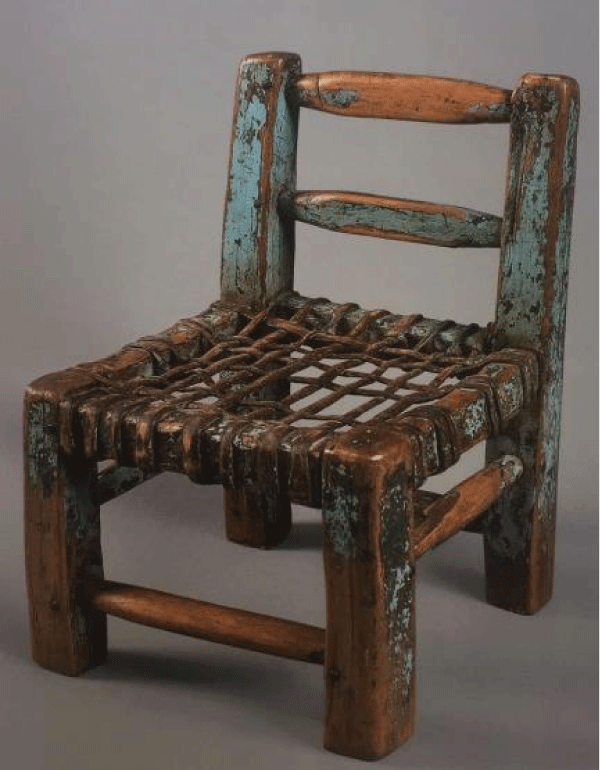
The matera chair was identified as an object representative of the First American Liberal Social Order (1789–1914), corresponding to a pre-modern, proto-rationalist, and vernacular aesthetic. Its formal and functional configuration emerged in the context of the South American Southern Cone, particularly in the Río de la Plata region, as the result of a prolonged process of cultural mestizaje among Indigenous knowledge, colonial practices, and rural Creole ways of life.
The origin of the matera chair cannot be attributed exclusively to a specific ethnic tradition, but it is closely linked to the social and ritual practices associated with the consumption of yerba mate (Ilex paraguariensis), a plant native to the subtropical forests that geographically coincide with the extent of the Guaraní Aquifer and the ancestral territory of the Guaraní people. The Guaraní, original inhabitants of what today comprises northeastern Argentina, southern Brazil, Paraguay, and southeastern Bolivia, were the first to use yerba mate for medicinal, energizing, and ceremonial purposes, calling it ka’a (translated as herb in the Guaraní language). Following colonial contact, this practice was adopted and transformed by Creole communities, becoming established as a central social ritual in rural life along the Río de la Plata.
The matera chair responded functionally to the demands of this ritual: its low height allowed the user to sit close to the ground, near the fire where water was heated in the kettle, while the infusion was shared in a circle. This posture not only facilitated social interaction, but was also adapted to the semi-nomadic way of life of the gaucho, who required objects that were light, resistant, and easily transportable. The chair was manufactured using Creole artisanal techniques, using native woods such as carob and ñandubay, and, in some cases, raw leather — materials available in the immediate environment.
From the perspective of the design values proposed by Llovet [55Llovet J. Ideología y metodología del diseño. Barcelona: Gustavo Gili; 1979.], the following was observed:
-Functional use-value: The chair fulfilled a clearly defined function within the domestic and social rural context. Its design prioritized contextual (not universal) ergonomics, adapting to the height of the fire and to the bodily posture required for the mate ritual. Constructive simplicity, the absence of a backrest (in some cases), and structural lightness responded to practical needs arising from the mobility and rusticity of the gaucho habitat.
-Aesthetic sign-value: The design was characterized by a minimalist geometry, with a predominance of simplified straight lines and an absence of ornamentation. This austere aesthetic, based on economy of means and material honesty, formally anticipated certain principles of the European Modern Movement, though without programmatic intention or modern stylistic awareness. Formal purity derived from practical and cultural conditions (proto-rationalism), not from an explicit aesthetic theory.
-Symbolic use-value: The matera chair acquired a strong identitarian and cultural content. It became a symbol of gaucho culture, rural Argentine life, and communal practices such as the asado and shared mate. Its symbolic meaning was reinforced and disseminated through popular iconography, in particular the illustrations of Florencio Molina Campos (1891–1959) for the almanacs of the Alpargatas company, where it appeared recurrently in scenes of country life. These representations contributed to its consolidation in the collective imaginary as an icon of the country style or Creole-gaucho style.
-Capitalist exchange-value: During the period analyzed (1789–1914), this value was marginal or non-existent. The matera chair was not conceived as a commodity, but as an object for domestic use (not as a product possessing the traits of a commodity), produced through Creole-type artisanal manufacture (DIY) — that is, made by the user himself or by local artisans to satisfy immediate needs. There was no insertion into mass mercantile circuits, nor industrialized (Fordist) productive standardization. Only with the arrival of industrialization at the beginning of the twentieth century did some examples begin to be reproduced in semi-industrialized (manufactured) workshops, marking the beginning of the fragmentation between design, production, and meaning.
Taken together, the first three values — functional, aesthetic, and symbolic — appeared unified, consistent with the pre-modern hypothesis formulated in previous research. This unity reflected a logic of production in which the object was not conceived as a commodity, but as an extension of the user’s cultural and material environment. The matera chair should not be interpreted as a primitive design, but as a historically situated response, deeply articulated with the social, ecological, and symbolic conditions of its time and place.
Figure 1. This design is part of the First American Liberal Social Order. The vernacular design of the matera chair, together with other stools, is an example of Creole DIY manufacture (“Do It Yourself”), in which the gaucho solved problems with the materials and tools available in the area and the place — in this case, the matera chair or low Creole chair (non-modern, proto-rationalist aesthetic). The matera chair is an emblematic object of the material culture of mate in the Río de la Plata region, representative of the First American Liberal Social Order (1789–1914), and a cultural product of Creole DIY manufacture (“Do It Yourself”). In this period, the values (utility, aesthetics, and symbol) tended to be unified. It is important to note that, in the pre-modern matera chair, functional use-value, aesthetic use-value, and symbolic use-value were unified. With the arrival of Modernity and industrial capitalism, these values tend to fragment or become alienated from one another. Source: ArtyHum No. 85, p. 15. Source: https://www.artyhum.com/revista/91/#p=8
Figure 1: This design is part of the First American Liberal Social Order. Source: ArtyHum No. 85, p. 15. Source: https://www.artyhum.com/revista/91/#p=8
Case 2: The B.K.F. Chair (Butterfly or Hardoy)
The B.K.F. chair was analyzed as an icon representative of the Second American Liberal Social Order (1914–1959), a period characterized by the consolidation of the modern aesthetic and Latin American neo-rationalism in design. It was conceived between 1938 and 1940 in Buenos Aires by the Grupo Austral, a collective of architects formed by Antonio Bonet, Juan Kurchan, and Jorge Ferrari-Hardoy, all of them influenced by European rationalist currents and, in particular, by Le Corbusier’s practice in Paris, where Bonet and Kurchan had previously worked.
The piece was publicly presented at the Third Salon of Decorative Artists of Buenos Aires in 1940, marking a milestone in the history of Argentine design for its capacity to synthesize principles of the Modern Movement with local references. Its design was directly inspired by the Tripolina chair, a folding campaign seat of Italian origin, patented in 1877 and used by European military forces. The Tripolina, in turn, descended from Arab and North African models, situating the B.K.F. within a long chain of transnational cultural and technical transfers.
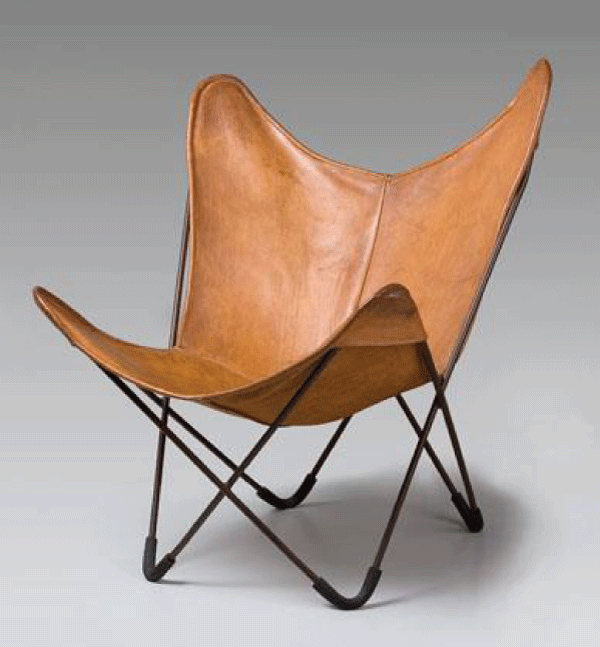
Figure 2. Regarding its origin and historical context, the B.K.F. was designed between 1938 and 1940 in Buenos Aires by the Grupo Austral, composed of the architects Antonio Bonet, Juan Kurchan, and Jorge Ferrari-Hardoy. This design became a symbol of Argentine national design throughout the world. The chair was presented at the Third Salon of Decorative Artists of Buenos Aires in 1940. In the B.K.F. chair, functional use-value, aesthetic use-value, and symbolic use-value, with the arrival of Modernity and industrial capitalism, tend to fragment (become alienated) from one another. Source: B.K.F. Chair. Photograph by Kippelboy; the image corresponds to a JPG file licensed under the “Creative Commons Attribution-Share Alike 3.0 Unported” license. Source: https://commons.wikimedia.org/wiki/File:BKF_Chair.jpg
Figure 2: The image corresponds to a JPG file licensed under the “Creative Commons Attribution-Share Alike 3.0 Unported” license. Source: https://commons.wikimedia.org/wiki/File:BKF_Chair.jpg
The B.K.F. chair was not conceived as a luxury object, but as a functional and economical response to the needs of modern housing in expanding urban contexts. Its structure was composed of solid round iron rods (12.7 mm in diameter), painted with an epoxy coating through high-temperature baking, and a single-piece leather seat, tensioned by means of a simple anchoring system. This configuration allowed for an informal and flexible posture, breaking with the rigidity of traditional seating and adapting to new modes of domestic sociability.
From the perspective of the design values proposed by Llovet [55Llovet J. Ideología y metodología del diseño. Barcelona: Gustavo Gili; 1979.], the following was observed:
-Functional use-value: The chair responded to a logic of technical efficiency and spatial adaptability. Its design allowed for versatile use indoors and outdoors, and its lightness facilitated movement. The metal structure and leather seat were selected not only for their durability, but also for their compatibility with serial production processes. Although fully Fordist industrialization was not achieved in Argentina at that time, the design was conceived from the outset for functional standardization and technical reproducibility, anticipating the logics of modern industrial production.
-Aesthetic sign-value: The piece embodied the fundamental principles of modern rationalism: formal cleanliness, clear geometry, absence of ornamentation, and material honesty. The combination of iron — a material associated with industry and modernity — with leather — a traditional raw material of the Argentine countryside — constituted a symbolic and material synthesis between the industrial and the vernacular. This fusion did not seek folkloric imitation, but a critical reinterpretation of local resources within a universalist aesthetic framework. The resulting form, with its winged silhouette and apparently floating structure, generated a strong visual identity that transcended its utilitarian function.
-Symbolic use-value: The B.K.F. chair rapidly acquired the status of an Argentine national symbol on the international stage. It was exhibited in design museums in Europe and the United States, and became a reference point for modern Latin American design. However, within the context of industrial modernity, its symbolic meaning fragmented. Unlike the matera chair, whose symbolism was rooted in communal practices (mate, the asado), the B.K.F. was associated primarily with the professional identity of the designer, upper-middle-class urban consumption, and, later, with the status of a collector’s object. Its symbolism ceased to be collective and became individual, tied to the aesthetic taste and cultural capital of the user.
-Capitalist exchange-value: This value became the dominant axis of the piece’s historical trajectory. Although the design was patented in Argentina, no international protection was sought, which allowed foreign manufacturers — especially in the United States — to begin reproducing it en masse without authorization or payment of royalties. Knoll Associates, among other companies, marketed versions under the name Butterfly Chair, contributing to its global dissemination. More than 500,000 units are estimated to have been produced legally worldwide, in addition to countless unauthorized copies. This mass production consolidated its status as a global commodity, whose economic value far exceeded its original functional or symbolic value. The chair, initially conceived as a design proposal committed to accessibility, ended up being absorbed by the logic of the capitalist market, where its image was disconnected from its context of origin.
Taken together, the four design values appeared clearly fragmented, consistent with the modern hypothesis formulated in previous research. This fragmentation reflected the logic of capitalist industrial production, in which exchange-value imposes itself as mediator and, in many cases, as the ultimate end of the design process. The B.K.F. chair, therefore, should not be interpreted solely as an aesthetic achievement, but as a material document of the transition from artisanal to industrial design in Latin America, and as a paradigmatic example of how design objects can be decontextualized, commodified, and re-signified within the global capitalist system.
Case 3: The Aro chair by cristian mohaded
The Aro chair, belonging to the Entrevero collection by Argentine designer Cristian Mohaded, was analyzed as a representative example of the Third American Liberal Social Order (1960–2024), a period characterized by a postmodern and eclecticist aesthetic, as well as by post-Fordist and hybrid modes of production. This context was distinguished by the coexistence of industrial, artisanal, and semi-industrial logics, in response to new cultural, ethical, and environmental demands that questioned the universalist and functionalist principles of Modernity.
The piece was situated within a contemporary trend in Latin American design that seeks to critically revisit local cultural heritage without resorting to folkloric or stereotyped reproduction. Rather than imitating traditional forms, the design operated through a symbolic and material reworking of gaucho, Indigenous, and urban references, integrating ancestral knowledge with contemporary technologies. This strategy responded to an explicit intention of decolonial revaluation, understood as the recovery of peripheral practices, materials, and aesthetics in opposition to the Eurocentric canons of modern design.
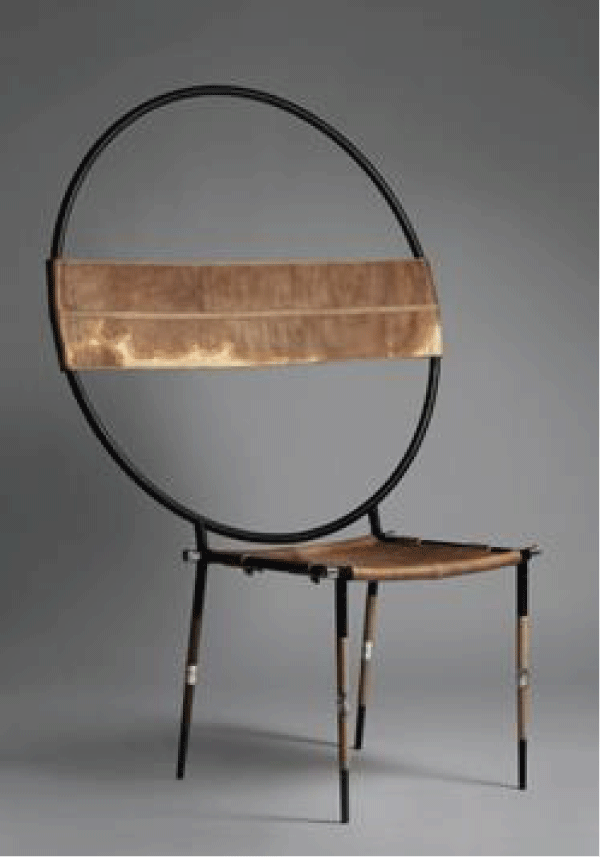
Figure 3. The Aro chair by Cristian Mohaded (from the Entrevero collection), with a postmodern-eclecticist aesthetic, of the postmodern American “gringo” style (1960–2024). It is classified as a piece of eclecticist post-Fordist furniture. This design is situated within the Third American Liberal Social Order, characterized by a critical reinterpretation of vernacular and modern design. Postmodernity in design is distinguished by eclecticism, the mixing of historical styles, irony, and the rejection of the great modernist dogmas. These designs critique the capitalist system from within and seek the integration of the local and the peripheral. Source: ArtyHum No. 84, p. 45. Source: https://www.artyhum.com/revista/84/#p=45
Figure 3: The Aro chair by Cristian Mohaded (from the Entrevero collection), with a postmodern-eclecticist aesthetic, of the postmodern American “gringo” style (1960–2024). Source: ArtyHum No. 84, p. 45. Source: https://www.artyhum.com/revista/84/#p=45
From the perspective of the design values proposed by Llovet [55Llovet J. Ideología y metodología del diseño. Barcelona: Gustavo Gili; 1979.], and expanded with the fifth, emergent value (socio-environmental use-value) introduced in recent research, the following was observed:
-Functional use-value: Functionality was reinterpreted not as a technical imperative, but as one possibility among other dimensions of the object. The structure was composed of linearly welded steel, while the seat was resolved in cattle leather, a traditional material in Argentine furniture production. Unlike modern designs, which prioritized ergonomic efficiency and standardization, the Aro chair did not seek to optimize posture or reduce costs, but rather to articulate functionality with cultural identity and material responsibility. Lightness, stability, and comfort were achieved without sacrificing the formal complexity or the symbolic charge of the object.
-Aesthetic sign-value: The piece integrated a complex, deliberately eclectic aesthetic, characteristic of postmodernism. Notable were artisanal details of high technical complexity, such as the legs covered in punto punzón — a traditional textile technique using interwoven strips of horsehide in a warp-and-weft system — as well as the incorporation of hammered and chiseled nine-hundred-fine silver bracelets, elements evoking both Creole silverwork and the ornamental practices of the Argentine countryside. These components were not added as surface decoration, but as constitutive parts of the formal language, generating an aesthetic that avoided folkloric literalism and opted instead for a refined symbolic abstraction. The combination of industrial steel with organic, artisanal materials produced a visual and tactile contrast that reinforced the design’s hybrid identity.
-Symbolic use-value: The design functioned as a critical rereading of Argentine cultural heritage, articulating diverse historical and geographic references: from the figure of the gaucho and rural practices to Indigenous knowledge and contemporary urban dynamics. Unlike the matera chair, whose symbolism was rooted in a specific communal practice (mate), the Aro chair operated in a more reflexive and self-referential register, typical of designer pieces. Its symbolism was not directed at a homogeneous collective identity, but at a vindication of cultural diversity and material memory. A clear intention was observed to decolonize the design imaginary, incorporating techniques and materials marginalized by the modern narrative, and situating the object in critical dialogue with local history.
-Capitalist exchange-value: The relationship with the market was ambiguous and contradictory. On the one hand, the chair was marketed as a designer object, with limited production and a high price, situating it within the sphere of cultural luxury consumption. On the other hand, its economic value increased not through productive efficiency, but through the incorporation of ethical and ecological attributes, such as the use of raw (untanned) leather, a biodegradable, low-environmental-impact material. This phenomenon reflected a contemporary logic in which sustainability and cultural authenticity become attributes of market value, integrated into strategies of the social economy, fair trade, and responsible design. Thus, exchange-value did not disappear, but was reconfigured to include previously excluded symbolic and ethical dimensions.
-Socio-environmental use-value: This emergent value, proposed as an analytical category for the contemporary period, was explicitly manifested in the Aro chair. The choice of raw leather — which requires no chromium tanning processes and generates no toxic effluents — responded to a commitment to ecological sustainability. In addition, the recovery of artisanal techniques at risk of disappearing (such as punto punzón in leather) contributed to the preservation of intangible heritage and the strengthening of local economies. Finally, the articulation with principles of the circular economy — through the use of renewable, biodegradable materials — and of social justice — through collaboration with artisans and recognition of their knowledge — evidenced an intention to integrate environmental, cultural, and social responsibility into the design process. This fifth value did not replace the previous ones, but mediated and reconfigured them, generating a new logic of valuation proper to contemporary design.
Taken together, the Aro chair exemplified a partial and critical recomposition of design values, mediated by the ethical, ecological, and cultural demands of the twenty-first century. Unlike the pre-modern unity (Case 1) and modern fragmentation (Case 2), this case showed a deliberate and reflexive integration of functionality, aesthetics, symbolism, market, and sustainability. This was not a nostalgic return to the artisanal, but a hybrid synthesis that questioned modern hierarchies and proposed an alternative model of design, in which the local, the peripheral, and the sustainable acquired conceptual and material centrality.
The results of the analysis make it possible to interpret the evolution of chair design in the Argentine Republic as a sequence of paradigmatic transformations analogous to those described by Kuhn [22Kuhn TS. La estructura de las revoluciones científicas. Contín A, translator. Mexico City: Fondo de Cultura Económica; 2006. Original work published 1962.]. Within this framework, the three cases studied — the matera chair, the B.K.F. chair, and the Aro chair — do not constitute mere stylistic variations, but material manifestations of distinct epistemological, productive, and symbolic regimes corresponding to successive phases of the historical development of design under the American Liberal Social Order. This analogy does not imply a mechanical application of the Kuhnian model, but a critical adaptation that recognizes the design object as a historical document capable of registering crises, ruptures, and cultural reconfigurations.
Kuhn characterizes the development of scientific knowledge through a cyclical sequence of non-cumulative stages, in which moments of stability alternate with moments of radical transformation. These stages are: (1) pre-science or the pre-paradigmatic period, (2) normal science (the paradigmatic period), and (3) crisis, extraordinary science, and scientific revolution, which give rise to a new paradigm. This sequence is applied below to the analysis of the three cases, demonstrating that the design of everyday objects can be read as a field of paradigmatic activity analogous to the scientific one.
Beyond describing these three stages, Kuhn (1962/2006)[22Kuhn TS. La estructura de las revoluciones científicas. Contín A, translator. Mexico City: Fondo de Cultura Económica; 2006. Original work published 1962.] also specifies the criteria by which a new paradigm comes to be generally accepted by a community — criteria directly relevant to assessing whether the Aro chair's hybrid-sustainable configuration constitutes an emergent paradigm or merely an anomaly within the industrial one. A new paradigm gains acceptance to the extent that it demonstrates: (a) greater explanatory and predictive power than its predecessor in accounting for anomalies the old paradigm could not resolve; (b) the capacity to resolve those specific anomalies, rather than merely acknowledging them; (c) accumulating empirical evidence — additional cases, replications, or applications — that corroborates its problem-solving capacity beyond the original exemplar; and (d) the endorsement of members of the relevant community with the authority to validate new exemplars, since, as Kuhn observed, paradigm change is frequently resisted by an older generation and consolidated only as a younger generation of practitioners adopts the new framework as self-evident. Applied to the present cases, this framework clarifies why the Aro chair is characterized here as symptomatic of a paradigm in gestation rather than as evidence of a paradigm already consolidated: at the time of writing, the hybrid-sustainable configuration it exemplifies has demonstrated criterion (b) — the capacity to resolve specific anomalies of the industrial paradigm (environmental impact, cultural homogenization, loss of local meaning) at the level of an individual exemplar — but not yet criterion (c), since comparable cases beyond the Entrevero collection remain scarce in the Argentine context, nor criterion (d), since its endorsement so far comes from design critics and academic discourse rather than from a broad community of practicing designers and manufacturers. Its explanatory power, criterion (a), is nonetheless considerable, since it accounts coherently for why neither a nostalgic return to artisanal production nor an uncritical continuation of Fordist industrial logic can resolve the anomalies each generates on its own — a tension already visible, in embryonic form, in the matera chair itself, whose pre-modern unity of values anticipated, without theorizing, several of the criteria that would only later define ecodesign [1010Girod GE, Anderson IF. La Silla Matera: Patrimonio artesanal del etnodiseño ecológico y la cultura del habitar al aire libre. Cuadernos del Centro de Estudios en Diseño y Comunicación. 2026;(335):141‑53. ISSN 1668‑0227.].
-Phase 1: Pre-science or the pre-paradigmatic period: In Kuhn’s terminology, the pre-paradigmatic phase is characterized by the absence of a unifying theoretical and methodological framework. During this period, multiple schools, traditions, and approaches coexist without consensus on legitimate methods, relevant problems, or criteria of validation. The result is a state of fragmentation and competition among incompatible visions, in which no cohesive scientific community exists (which we might term a cohesive community of designers). Although chair design in Latin America did not go through a pre-science phase in the strict sense — since it inherited already-paradigmatic European frameworks — the pre-industrial Río de la Plata context operated, in practice, as a relative pre-paradigmatic space. Before the consolidation of industrial capitalism, no hegemonic design paradigm existed; instead, vernacular, colonial, and artisanal modes of production coexisted, without a unified theory or an institutionalized community of designers. Each workshop, each region, each social group operated with its own codes, materials, and purposes. In this scenario, the matera chair did not emerge as the solution to a puzzle within a paradigm, but as a situated response to specific needs, without universal pretension. Its form was not the result of a design theory, but of the historical convergence of Guaraní Indigenous practices (the mate ritual), colonial carpentry techniques, and the semi-nomadic way of life of the gaucho. Therefore, although it does not fully correspond to the Kuhnian pre-paradigm, this moment reflects a pre-paradigmatic plurality in which the object is defined by its context, not by an abstract model.
-Phase 2: Normal paradigm: According to Kuhn, this is a period of stability in which a community shares a paradigm — a set of theories, methods, standards, and exemplars — and devotes itself to solving the puzzle within that framework (creating designs within the theoretical framework). The objective is not to question the paradigm, but to articulate it, refine it, and extend its domain. In Argentine chair design, this phase is identified with the First American Liberal Social Order (1789–1914), during which a vernacular artisanal paradigm was consolidated. Within this paradigm, there existed an implicit consensus among producers and users as to what constituted a good chair: it had to be low, light, resistant, made of native woods, and adapted to the mate ritual. The matera chair represents the paradigmatic solution par excellence: it coherently resolves the problems specific to its era — how to sit near the fire, how to transport the piece of furniture in a mobile rural context, how to express gaucho identity — without questioning the foundations of the system. This is not a case of disruptive innovation, but of the successful articulation of an existing paradigm. In this period, the values proposed by Llovet [55Llovet J. Ideología y metodología del diseño. Barcelona: Gustavo Gili; 1979.] — functional, aesthetic, and symbolic — appear fully unified, reflecting the integration of form, function, and meaning characteristic of pre-industrial contexts. Capitalist exchange-value is marginal or non-existent, confirming that the object did not function as a commodity, but as an extension of the user’s vital environment. This configuration therefore corresponds to a phase of artisanal normal paradigm, in which design operates as a communal practice, not as a separate technical discipline.
-Phase 3: Crisis and extraordinary paradigmatic revolution: The third phase of the Kuhnian model begins when the dominant paradigm can no longer solve certain puzzles, which are transformed into anomalies. When these anomalies accumulate and undermine confidence in the paradigm, a period of extraordinary paradigm opens, characterized by experimentation, the search for new frameworks, and the fragmentation of the community of designers. If the crisis is not resolved within the old paradigm, a paradigmatic revolution occurs: the total or partial replacement of the old paradigm by a new, incompatible one. In Argentine chair design, this phase manifests in two successive moments.
First, the B.K.F. chair (Case 2) embodies the crisis of the artisanal paradigm and the beginning of an industrial revolution. Designed between 1938 and 1940 by the Grupo Austral, this piece emerges in a context of profound transformation: the expansion of industrial capitalism, accelerated urbanization, and the emergence of an urban middle class with new demands. The B.K.F. chair introduces elements that radically challenge the artisanal paradigm: its solid round-iron structure contrasts with local wood; its production, conceived for standardization, breaks with the logic of the single, unique piece; and its rationalist design imposes itself over historical ornamentation. These characteristics constitute paradigmatic anomalies that cannot be resolved within the artisanal framework (the matera chair). The B.K.F. chair thus operates in a zone of tension, as a transitional object that anticipates the principles of the new industrial paradigm: technical efficiency, the separation of design from manufacturing, and the primacy of capitalist exchange-value. Its global mass production — especially following unauthorized reproduction in the United States — evidences the consolidation of this new industrial paradigm, in which the object becomes a commodity and its meaning fragments. Symbolic value, formerly collective, becomes individualized; aesthetic value is subordinated to the logic of serial production; and functionality is redefined in universal, rather than contextual, terms. The B.K.F. chair, therefore, is not only a successful design, but a material document of the paradigmatic revolution that replaced artisanal logic with industrial logic.
Second, the Aro chair (Case 3) illustrates the beginning of a new crisis, this time of the Fordist industrial paradigm. Within the context of the Third American Liberal Social Order (1960–2024), characterized by postmodernity, post-Fordism, and growing ecological awareness, the industrial model begins to show its limits: cultural homogenization, environmental impact, the loss of local meaning, and user alienation. These tensions generate new anomalies that the industrial paradigm cannot resolve. The Aro chair responds to this crisis through a hybrid strategy that reintegrates previously dissociated elements. Its welded-steel structure — a legacy of industrial logic — is combined with complex artisanal techniques (punto punzón in horsehide, nine-hundred-fine silverwork), recovering local knowledge and revaluing native materials. This fusion is not nostalgic, but critical: it seeks to decolonize the design imaginary by incorporating gaucho and Indigenous references without falling into folklorism. Moreover, the choice of raw (untanned) leather, biodegradable and of low environmental impact, explicitly introduces socio-environmental use-value, proposed as a fifth analytical category. This value does not replace the previous ones, but mediates them, generating a new logic of valuation in which sustainability, social justice, and cultural identity acquire centrality. In Kuhnian terms, the Aro chair signals the beginning of a contemporary extraordinary paradigmatic phase, in which the anomalies of the industrial paradigm (pollution, delocalization, loss of meaning) generate experimentation and the emergence of hybrid practices that could, in the future, crystallize into a new paradigm: the hybrid-sustainable paradigm.
A further clarification is warranted regarding how the general acceptance of a new paradigm is determined in the specific context of chair design, since — unlike in the natural sciences, where acceptance is negotiated within a relatively bounded scientific community — chair design involves at least three distinct, only partially overlapping publics: consumers, design critics and curators, and design historians and educators; and the mechanism of acceptance differs across the three cases in proportion to their scale and mode of production. The matera chair achieved acceptance through sustained vernacular practice rather than formal legitimation: its paradigm was consolidated over generations by anonymous rural users and artisans across provinces such as La Pampa, Buenos Aires, and Entre Ríos, and it was only retrospectively canonized — first by popular iconography (Molina Campos), later by museum collection and academic ethnographic fieldwork — as representative of a proto-rationalist Argentine idiom [1010Girod GE, Anderson IF. La Silla Matera: Patrimonio artesanal del etnodiseño ecológico y la cultura del habitar al aire libre. Cuadernos del Centro de Estudios en Diseño y Comunicación. 2026;(335):141‑53. ISSN 1668‑0227.]. The B.K.F. chair, by contrast, achieved acceptance primarily through market diffusion at industrial scale: more than 500,000 legally produced units, together with countless unauthorized copies, generated the kind of broad consumer familiarity that, in Kuhnian terms, corresponds to a paradigm's uptake by an entire community of practice; its acceptance by design critics and museums followed and consolidated, rather than preceded, this market-driven diffusion. The Aro chair, finally, is a limited, designer-signed piece whose production volume is orders of magnitude smaller than either of the preceding cases; consequently, its acceptance cannot yet be assessed through market diffusion, but only through the legitimation of design critics, curators, and academic discourse. This differentiated picture also carries a risk documented in the companion research on the matera chair itself: as vernacular objects are absorbed into postmodern design markets, their acceptance as “authentic” or “legitimate” can decontextualize and de-identify the artisans who originated them, reducing a living, collective practice to a stylized, individually authored commodity [1010Girod GE, Anderson IF. La Silla Matera: Patrimonio artesanal del etnodiseño ecológico y la cultura del habitar al aire libre. Cuadernos del Centro de Estudios en Diseño y Comunicación. 2026;(335):141‑53. ISSN 1668‑0227.]. General acceptance in chair design is therefore not achieved through a single mechanism, but through the sequential or simultaneous convergence of vernacular practice, market diffusion, and critical-academic legitimation — a convergence that is never ideologically neutral, since each mechanism can also displace or obscure the collective and artisanal origins of the object it legitimizes.
As a final theoretical reflection, this interpretation makes it possible to qualify the linear, progressive vision of design history. Far from being a cumulative evolution, chair design in Argentina presents itself as a series of non-cumulative ruptures, in which each paradigm radically redefines what counts as good design, which materials are legitimate, which forms of knowledge are valued, and what function the object fulfils in society. This approach, inspired by Kuhn but adapted to the field of design, aligns with contemporary currents in material culture studies that reject universalist narratives and emphasize the historicity, contingency, and politics of objects [11Kubler G. The shape of time: Remarks on the history of things. New Haven: Yale University Press; 1961. Available from: https://monoskop.org/images/8/87/Kubler_George_The_Shape_of_Time_Remarks_on_the_History_of_Things.pdf,2222Marx K. El capital: Crítica de la economía política. Vol. 1. Mexico City: Siglo XXI Editores; 2010. Original work published 1867.]. Moreover, the incorporation of the fifth (socio-environmental) value extends Llovet’s [55Llovet J. Ideología y metodología del diseño. Barcelona: Gustavo Gili; 1979.] analytical model to account for the new ethical demands of the twenty-first century, demonstrating that theoretical frameworks must evolve alongside the phenomena they seek to explain.
In sum, the application of the Kuhnian model to chair design proves not only pertinent, but productive: it makes it possible to identify not merely formal changes, but profound transformations in the relationship between society, technology, economy, and culture. The three cases analyzed thus function as sensitive indicators of the paradigmatic revolutions that have run through Argentine history, confirming that the everyday object — far from being neutral — is a symbolic and material battlefield in which worldviews are contested.
The present study made it possible to analyze the evolution of chair design in the Argentine Republic as a sequence of paradigmatic transformations. Through the analysis of three emblematic cases, three distinct historical configurations were identified, all situated within the framework of the American Liberal Social Order, but corresponding to successive aesthetics: non-modern (proto-rationalist), modern (neo-rationalist), and postmodern (eclecticist).
The results confirmed that each case represented a specific phase of the Kuhnian cycle. The matera chair (Case 1) exemplified a phase of artisanal normal science, in which the values proposed by Llovet [55Llovet J. Ideología y metodología del diseño. Barcelona: Gustavo Gili; 1979.] — functional, aesthetic, and symbolic — appeared fully unified, consistent with the pre-modern hypothesis formulated in previous research. During the First American Liberal Social Order (1789–1914), the object functioned as an extension of the user’s cultural and material environment, without subordination to capitalist exchange-value, reflecting a communal, vernacular logic of production.
The B.K.F. chair (Case 2), by contrast, embodied the moment of crisis and paradigmatic revolution. Designed between 1938 and 1940 by the Grupo Austral, this piece introduced anomalies within the artisanal paradigm — an industrial structure, standardized production, disconnection from the rural context — that anticipated the principles of the new industrial paradigm. During the Second American Liberal Social Order (1914–1959), design values fragmented: capitalist exchange-value imposed itself as the organizing axis over the others, while symbolism became individualized and aesthetics were subordinated to the logic of serial production. This case evidenced the transition from artisanal design to industrial design in Latin America, as well as the global commodification of the design object.
Finally, the Aro chair (Case 3) illustrated the beginning of a new crisis of the industrial paradigm and the gestation of a possible emergent paradigm. Within the context of the Third American Liberal Social Order (1960–2024), characterized by post-Fordism and ecological awareness, the design operated through a hybrid strategy that reintegrated previously dissociated elements. The fusion of welded steel with artisanal techniques (punto punzón in horsehide, nine-hundred-fine silverwork) and the incorporation of socio-environmental use-value as a fifth analytical category evidenced a decolonial and sustainable intention. This value did not replace the previous ones, but mediated them, generating a new logic of valuation in which environmental responsibility, social justice, and cultural identity acquired centrality.
Taken together, the study demonstrated that the evolution of chair design in Argentina did not follow a linear progression, but rather a series of non-cumulative ruptures, in which each paradigm was radically redefined. This interpretation, inspired by Kuhn but adapted to the field of design, aligned with contemporary approaches in material culture studies that emphasize the historicity, contingency, and politics of objects.
In sum, the three cases analyzed functioned as sensitive indicators of the paradigmatic revolutions that have run through Argentine history, confirming that the everyday object — far from being neutral — is a material document in which worldviews, modes of production, and social relations are contested.
This approach offers a useful theoretical-methodological tool for analyzing not only furniture design, but also other cultural artefacts in peripheral and postcolonial contexts.
Kubler G. The shape of time: Remarks on the history of things. New Haven: Yale University Press; 1961. Available from: https://monoskop.org/images/8/87/Kubler_George_The_Shape_of_Time_Remarks_on_the_History_of_Things.pdf
Kuhn TS. La estructura de las revoluciones científicas. Contín A, translator. Mexico City: Fondo de Cultura Económica; 2006. Original work published 1962.
Anderson IF. Breve historia occidental del diseño de muebles. Relaciones entre el diseño artesanal e industrial del mueble con la historia de la arquitectura. ArtyHum. 2019;(71):58‑93. Available from: https://www.artyhum.com/revista/71/#p=58
Anderson IF. Breve historia occidental del diseño de muebles (Parte 2). La historia del diseño artesanal e industrial de la silla. ArtyHum. 2020;(74):61‑114. Available from: https://www.artyhum.com/revista/74/#p=62
Llovet J. Ideología y metodología del diseño. Barcelona: Gustavo Gili; 1979.
Anderson IF, Girod GE. La silla de estilo campo Argentina. Cuando la teoría del arte se convierte en un paradigma teórico para explicar la tipología del diseño artesanal de la silla proto‑racionalista de estilo campo (o estilo gaucho) en la República Argentina. ArtyHum. 2022;(85):8‑65. Available from: https://www.artyhum.com/revista/85/#p=8
Anderson IF, Girod GE. Breve historia occidental del diseño de muebles de culto: La silla (Parte 3). Construcción de un marco teórico de la silla como máquina‑herramienta para‑sentarse a través de la premodernidad, modernidad y posmodernidad. ArtyHum. 2024;(90):8‑44. Available from: https://www.artyhum.com/revista/90/#p=8
Anderson IF, Girod GE. Breve historia occidental del diseño de muebles (Parte 4). La silla Indo‑Ibero‑Americana. Ensayo para un marco teórico basado en la dialéctica hegeliana. ArtyHum. 2025;(91):9‑74. Available from: https://www.artyhum.com/revista/91/#p=9
Anderson IF, Girod GE. A Brief Western History of the Chair: The Origins of the European and American Chair. IgMin Research. 2026;4(7):277‑91. doi:10.61927/igmin352
Girod GE, Anderson IF. La Silla Matera: Patrimonio artesanal del etnodiseño ecológico y la cultura del habitar al aire libre. Cuadernos del Centro de Estudios en Diseño y Comunicación. 2026;(335):141‑53. ISSN 1668‑0227.
Anderson IF. Estética y tecnología del paisaje interior doméstico moderno. Argentina: 1880–1980. La Plata: Secretaría de Posgrado, Universidad Nacional de La Plata; 2008. Available from: http://sedici.unlp.edu.ar/handle/10915/36746
Anderson IF. Paisajes de productos industriales del mobiliario doméstico argentino (1880–1990). Arte e Investigación. 2010;(7):9‑14. Available from: http://sedici.unlp.edu.ar/handle/10915/39473
Anderson IF. El coleccionismo burgués y la decoración de interiores. Argentina (1860–1945). Arte e Investigación. 2012;(8):6‑9. Available from: http://sedici.unlp.edu.ar/handle/10915/39691
Anderson IF. La estética burguesa en el diseño de sillas. Arte e Investigación. 2013;(9):20‑25. Available from: http://sedici.unlp.edu.ar/handle/10915/39536
Anderson IF. La Belle Époque argentina. Arte, arquitectura doméstica y diseño de muebles aplicados a la decoración de interiores burguesa (1860–1936) [doctoral thesis]. La Plata: Universidad Nacional de La Plata; 2014. Available from: http://sedici.unlp.edu.ar/handle/10915/35108
Anderson IF. Diseño industrial y artesanía. Una mirada desde la historia del arte. METAL. 2015;1:65‑71. Available from: http://sedici.unlp.edu.ar/handle/10915/49553
Anderson IF. Teoría y crítica del diseño de muebles. Arte e Investigación. 2015;(11):20‑26. Available from: http://sedici.unlp.edu.ar/handle/10915/51554
Anderson IF. La historia del diseño de sillas y otros muebles, reconsiderado. Actas de Diseño. 2018;(25):75‑86. Available from: https://www.academia.edu/41451863
Baudrillard J. Para una crítica de la economía política del signo. Sáenz de Tejada A, translator. Mexico City: Siglo XXI Editores; 1974. Original work published 1972.
Baudrillard J. Le système des objets. Paris: Éditions Gallimard; 1968.
Giddens A. Sociología. Madrid: Alianza Editorial; 1991.
Marx K. El capital: Crítica de la economía política. Vol. 1. Mexico City: Siglo XXI Editores; 2010. Original work published 1867.
Anderson IF, Girod GE. The Latin American Chair. IgMin Res. September 10, 2026; 4(9): 377-390. IgMin ID: igmin362; DOI:10.61927/igmin362; Available at: igmin.link/p362
1Department of Industrial Design, Faculty of Fine Arts, National University of La Plata, La Plata, Argentina
2Area of Objects and Products, Faculty of Design and Communication, University of Palermo, Buenos Aires, Argentina
Address Correspondence: Ibar Federico Anderson, Department of Industrial Design, Faculty of Fine Arts, National University of La Plata, La Plata, Argentina, Email: [email protected]
How to cite this article: Anderson IF, Girod GE. The Latin American Chair. IgMin Res. September 10, 2026; 4(9): 377-390. IgMin ID: igmin362; DOI:10.61927/igmin362; Available at: igmin.link/p362
Figure 1: This design is part of the First American Liberal ...
Figure 2: The image corresponds to a JPG file licensed under...
Figure 3: The Aro chair by Cristian Mohaded (from the Entrev...
Table 1: Comparative material, technical, archival, and pro...
Kubler G. The shape of time: Remarks on the history of things. New Haven: Yale University Press; 1961. Available from: https://monoskop.org/images/8/87/Kubler_George_The_Shape_of_Time_Remarks_on_the_History_of_Things.pdf
Kuhn TS. La estructura de las revoluciones científicas. Contín A, translator. Mexico City: Fondo de Cultura Económica; 2006. Original work published 1962.
Anderson IF. Breve historia occidental del diseño de muebles. Relaciones entre el diseño artesanal e industrial del mueble con la historia de la arquitectura. ArtyHum. 2019;(71):58‑93. Available from: https://www.artyhum.com/revista/71/#p=58
Anderson IF. Breve historia occidental del diseño de muebles (Parte 2). La historia del diseño artesanal e industrial de la silla. ArtyHum. 2020;(74):61‑114. Available from: https://www.artyhum.com/revista/74/#p=62
Llovet J. Ideología y metodología del diseño. Barcelona: Gustavo Gili; 1979.
Anderson IF, Girod GE. La silla de estilo campo Argentina. Cuando la teoría del arte se convierte en un paradigma teórico para explicar la tipología del diseño artesanal de la silla proto‑racionalista de estilo campo (o estilo gaucho) en la República Argentina. ArtyHum. 2022;(85):8‑65. Available from: https://www.artyhum.com/revista/85/#p=8
Anderson IF, Girod GE. Breve historia occidental del diseño de muebles de culto: La silla (Parte 3). Construcción de un marco teórico de la silla como máquina‑herramienta para‑sentarse a través de la premodernidad, modernidad y posmodernidad. ArtyHum. 2024;(90):8‑44. Available from: https://www.artyhum.com/revista/90/#p=8
Anderson IF, Girod GE. Breve historia occidental del diseño de muebles (Parte 4). La silla Indo‑Ibero‑Americana. Ensayo para un marco teórico basado en la dialéctica hegeliana. ArtyHum. 2025;(91):9‑74. Available from: https://www.artyhum.com/revista/91/#p=9
Anderson IF, Girod GE. A Brief Western History of the Chair: The Origins of the European and American Chair. IgMin Research. 2026;4(7):277‑91. doi:10.61927/igmin352
Girod GE, Anderson IF. La Silla Matera: Patrimonio artesanal del etnodiseño ecológico y la cultura del habitar al aire libre. Cuadernos del Centro de Estudios en Diseño y Comunicación. 2026;(335):141‑53. ISSN 1668‑0227.
Anderson IF. Estética y tecnología del paisaje interior doméstico moderno. Argentina: 1880–1980. La Plata: Secretaría de Posgrado, Universidad Nacional de La Plata; 2008. Available from: http://sedici.unlp.edu.ar/handle/10915/36746
Anderson IF. Paisajes de productos industriales del mobiliario doméstico argentino (1880–1990). Arte e Investigación. 2010;(7):9‑14. Available from: http://sedici.unlp.edu.ar/handle/10915/39473
Anderson IF. El coleccionismo burgués y la decoración de interiores. Argentina (1860–1945). Arte e Investigación. 2012;(8):6‑9. Available from: http://sedici.unlp.edu.ar/handle/10915/39691
Anderson IF. La estética burguesa en el diseño de sillas. Arte e Investigación. 2013;(9):20‑25. Available from: http://sedici.unlp.edu.ar/handle/10915/39536
Anderson IF. La Belle Époque argentina. Arte, arquitectura doméstica y diseño de muebles aplicados a la decoración de interiores burguesa (1860–1936) [doctoral thesis]. La Plata: Universidad Nacional de La Plata; 2014. Available from: http://sedici.unlp.edu.ar/handle/10915/35108
Anderson IF. Diseño industrial y artesanía. Una mirada desde la historia del arte. METAL. 2015;1:65‑71. Available from: http://sedici.unlp.edu.ar/handle/10915/49553
Anderson IF. Teoría y crítica del diseño de muebles. Arte e Investigación. 2015;(11):20‑26. Available from: http://sedici.unlp.edu.ar/handle/10915/51554
Anderson IF. La historia del diseño de sillas y otros muebles, reconsiderado. Actas de Diseño. 2018;(25):75‑86. Available from: https://www.academia.edu/41451863
Baudrillard J. Para una crítica de la economía política del signo. Sáenz de Tejada A, translator. Mexico City: Siglo XXI Editores; 1974. Original work published 1972.
Baudrillard J. Le système des objets. Paris: Éditions Gallimard; 1968.
Giddens A. Sociología. Madrid: Alianza Editorial; 1991.
Marx K. El capital: Crítica de la economía política. Vol. 1. Mexico City: Siglo XXI Editores; 2010. Original work published 1867.






 Scan and get link