


Help ?

IGMIN: We're glad you're here. Please click 'create a new query' if you are a new visitor to our website and need further information from us.

If you are already a member of our network and need to keep track of any developments regarding a question you have already submitted, click 'take me to my Query.'

Search

Organised by  IgMin Fevicon

Regional sites

Browse by Subjects

Welcome to IgMin Research – an Open Access journal uniting Biology, Medicine, and Engineering. We’re dedicated to advancing global knowledge and fostering collaboration across scientific fields.

Browse by Sections

At IgMin Research, we bridge the frontiers of Biology, Medicine, and Engineering to foster interdisciplinary innovation. Our expanded scope now embraces a wide spectrum of scientific disciplines, empowering global researchers to explore, contribute, and collaborate through open access.

Special Issues

Our vision is to connect scientists across various fields to enhance shared knowledge growth.

Members

Our vision is to connect scientists across various fields to enhance shared knowledge growth.

Articles

Our vision is to connect scientists across various fields to enhance shared knowledge growth.

Explore Content

Our vision is to connect scientists across various fields to enhance shared knowledge growth.

Identify Us

Our vision is to connect scientists across various fields to enhance shared knowledge growth.

IgMin Corporation

Welcome to IgMin, a leading platform dedicated to enhancing knowledge dissemination and professional growth across multiple fields of science, technology, and the humanities. We believe in the power of open access, collaboration, and innovation. Our goal is to provide individuals and organizations with the tools they need to succeed in the global knowledge economy.

Publications Support
[email protected]
E-Books Support
[email protected]
Webinars & Conferences Support
[email protected]
Content Writing Support
[email protected]
IT Support
[email protected]

Search

Select Language

Explore Section

Content for the explore section slider goes here.

252 of 251
The Latin American Chair
Ibar Federico Anderson and Gaston Eduardo Girod
END
Abstract

Abstract at IgMin Research

Our vision is to connect scientists across various fields to enhance shared knowledge growth.

Engineering Group Research Article Article ID: igmin363

Mineral Hydration as a Source of Accessible Water on Mars to Enable Human Missions at Equatorial Sites

Aerospace Engineering DOI10.61927/igmin363 Affiliation

Affiliation

    Independent Researcher, South Pasadena, CA, USA

21
VIEWS
4
DOWNLOADS
124
Connect with Us

Abstract

Water is a scarce commodity on Mars, yet large amounts of water are needed for crew life support, and in most human mission scenarios, even greater amounts of water are needed to produce propellants for departing Mars for the return trip to Earth. Evidence suggests that significant amounts of water occur as mineral hydration of magnesium or calcium sulfates in the accessible upper layer of Mars regolith at various scattered equatorial locations. Several sulfates occur on Mars with water content 20% to 50% of the sulfate mass. 
Several forms of hydrated sulfates are known to provide a significant share of observed water-equivalent hydrogen in the upper meter of Mars regolith. These include “Gypsum” (CaSO₄⋅2H₂O) containing 20.9% H2O by weight, and “Epsomite” (MgSO4·7H2O) (commonly known as “epsom salts”) containing 51% H2O by weight, as well as hexahydrite (MgSO4·6H2O) and starkeyite (MgSO4·4H2O). 
Scans using the neutron spectrometer from orbit show a remarkable correlation between the occurrence of S and H in the equatorial region, indicating that hydrated sulfates are a primary source of H2O there. Recent higher-resolution scans using the collimated neutron spectrometer show significant pockets of higher H2O content. This implies that even higher local concentrations of H2O almost surely exist within those areas, most likely as hydrated sulfates.
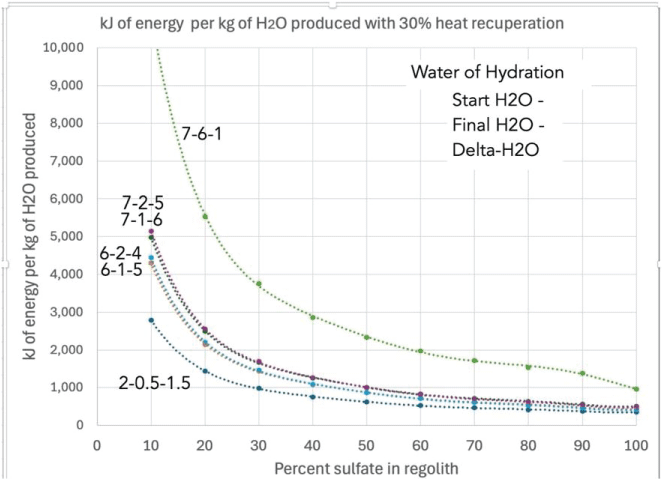
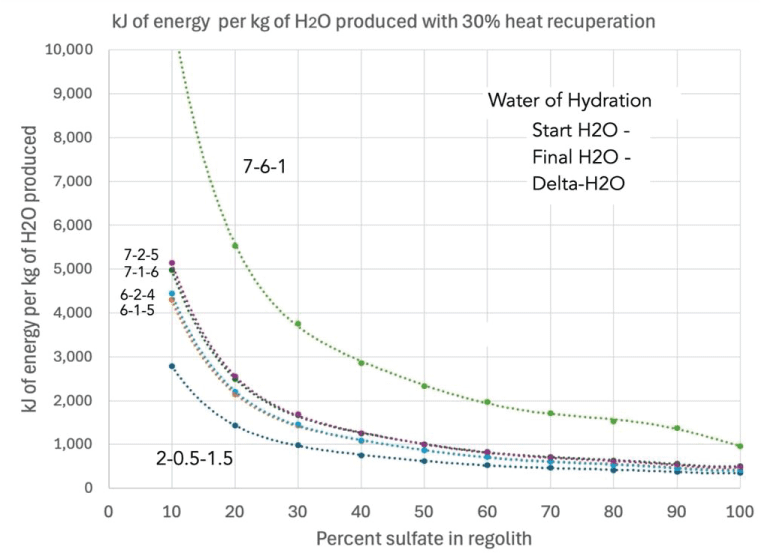
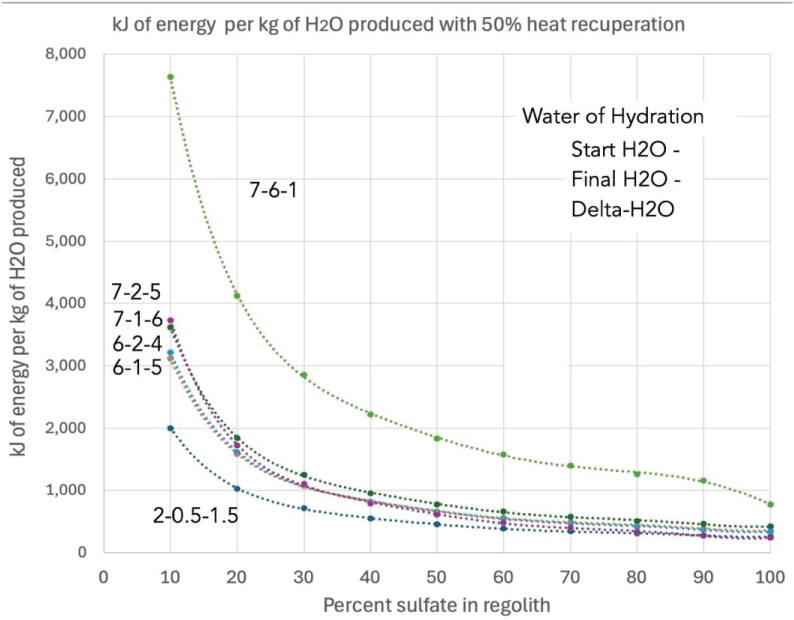
The power requirements to evolve H2O from a range of potential hydrated magnesium sulfates are moderate. We suggest that a human mission to Mars at equatorial latitudes based on hydrated sulfates as a source of water is a potential competitor to a mission at higher latitudes based on putative accessible ice. 

Figures

References

    1. Rapp D, Inglezakis V. Accessible H2O on Mars: a critical review of current knowledge. IgMin Res. 2025 Nov 25;3(11):407‑39. IgMin ID: igmin322. doi: 10.61927/igmin322. Available from: igmin.link/p322
    2. Rapp D. Reliability of water for life support for a near‑term human mission to Mars: requirements, Earth supply, recycling, storage and Mars indigenous water. IgMin Res. 2026;4(7):292‑305. doi: 10.61927/igmin353
    3. Rapp D. Human missions to Mars using the Starship. IgMin Res. 2025 Aug 6;3(8):268‑77. IgMin ID: igmin308. doi: 10.61927/igmin308. Available from: igmin.link/p308
    4. Golombek M, Williams N, Wooster P, McEwen A, Putzig N, Bramson A, et al. SpaceX Starship landing sites on Mars. Presented at: 52nd Lunar Planet Sci Conf; 2021.
    5. Hoffman SJ, Andrews A, Joosten BK, Watts K. A water rich Mars surface mission scenario. 2017 IEEE Aerosp Conf. 2017. Available from: https://ieeexplore.ieee.org/abstract/document/7943911
    6. Heldmann JL, Marinova MM, Lim DSS, et al. Mission architecture using the SpaceX Starship vehicle to enable a sustained human presence on Mars. New Space. 2022 Sep 1;10(3):259‑73. doi: 10.1089/space.2020.0058. Epub 2022 Sep 13. PMID: 36199953; PMCID: PMC9527650
    7. Boynton WV, Feldman WC, Squyres SW, et al. Distribution of hydrogen in the near surface of Mars: evidence for subsurface ice deposits. Science. 2002;297:81‑5.
    8. Feldman WC, Prettyman TH, Maurice S, et al. Global distribution of near‑surface hydrogen on Mars. J Geophys Res. 2004;109:E09006.
    9. Vaniman D, Chipera S, Rampe E, et al. Gypsum on Mars: a detailed view at Gale Crater. Minerals. 2024;14:815. doi: 10.3390/min14080815
    10. Karunatillake S, Wray JJ, Gasnault O, et al. Sulfates hydrating bulk soil in the Martian low and middle latitudes. Geophys Res Lett. 2014;41(22):7987‑96. doi: 10.1002/2014GL061136
    11. Flahaut J, Carter J, Poulet F, et al. Embedded clays and sulfates in Meridiani Planum, Mars. Icarus. 2015;248:269‑88.
    12. Hynek BM, McCollom TM, Szynkiewicz A. Sulfur cycling and mass balance at Meridiani, Mars. Geophys Res Lett. 2019;46. doi: 10.1029/2019GL085115M
    13. David G, Dehouck E, Meslin P‑Y, et al. Evidence for amorphous sulfates as the main carrier of soil hydration in Gale Crater, Mars. Geophys Res Lett. 2022;49:e2022GL098755. doi: 10.1029/2022GL098755
    14. Feldman WC, Mellon MT, Maurice S, et al. Hydrated states of MgSO4 at equatorial latitudes on Mars. Geophys Res Lett. 2004;31:L16702. doi: 10.1029/2004GL020181
    15. Chou I‑M, Seal RR. Magnesium and calcium sulfate stabilities and the water budget of Mars. J Geophys Res Planets. 2007;112:E11. doi: 10.1029/2007JE002898
    16. Vaniman DT, Bish DL, Chipera SJ, et al. Magnesium sulphate salts and the history of water on Mars. Nature. 2004;431(7009):663‑5. doi: 10.1038/nature02973
    17. Clarke J, Willson D, Cooper D. In‑situ resource utilization through water extraction from hydrated minerals – relevance to Mars missions and an Australian analogue. Mars Society Australia. 2008. Available from: https://marssociety.org.au/sites/default/files/library/coober_pedy_ISRU_AMEC.pdf
    18. Abbud‑Madrid A, Beaty DW, Boucher D, et al. Mars water in‑situ resource utilization (ISRU) planning (M‑WIP) study. 2016. Available from: https://www.researchgate.net/publication/301614744_Mars_Water_In-Situ_Resource_Utilization_ISRU_Planning_M-WIP_Study
    19. Kleinhenz J. ISRU soil water extraction: thermal challenges. NASA Tech Rep. 2019. Available from: https://ntrs.nasa.gov/api/citations/20190002020/downloads/20190002020.pdf
    20. Marion GM, Kargel JS. Stability of magnesium sulfate minerals in Martian environments. Lunar Planet Sci Conf XXXVI. 2005. Available from: https://ntrs.nasa.gov/api/citations/20050174605/downloads/20050174605.pdf
    21. Pathare AV, Feldman WC, Prettyman TH, Maurice S. Climatic implications of new global mapping of near‑surface water‑equivalent hydrogen on Mars. Icarus. 2018;301:97‑116. doi: 10.1016/j.icarus.2017.09.031
    22. Malakhov AV, Mitrofanov IG, Golovin DV, et al. High‑resolution map of water in the Martian regolith observed by FREND neutron telescope onboard ExoMars TGO. J Geophys Res Planets. 2022;127(5):e2022JE007258. doi: 10.1029/2022JE007258
    23. Inglezakis VJ. Martian aqua: occurrence of water and appraisal of acquisition technologies. Adv Space Res. 2026;77:635‑70. doi: 10.1016/j.asr.2025.11.002
    24. Bertolini E. In‑situ resource utilization: the extraction of water from Martian gypsum in aid of human colonization of the Red Planet [thesis]. Milano: Politecnico; 2023.
    25. van Susante PJ, Allen J, Eisele T, et al. Research results, prototype development and testing for water extraction from polyhydrated sulphate rock on Mars. AIAA Conf Proc. 2020. doi: 10.2514/6.2020‑4238
    26. Jamanca L, Guevara CG. Water production from hydrated sulfur hydrates on Mars: a geological and technical assessment. 2023. Available from: https://epslibrary.at/items/d91d5cdc-74ea-4e03-a098-09b75c175c29/water-production-from-hydrated-sulfates-on-mars-a-geological-and-technical-assessment
    27. Wang L, Li S, Shi C, et al. Experimental study on desorption and heat storage characteristics of magnesium sulfate hydrate in a moving‑bed heat exchange system. Processes. 2026;14:919. doi: 10.3390/pr14060919
    28. van Essen VM, Zondag HA, Cot Gores J, et al. Characterization of MgSO4 hydrate for thermochemical seasonal heat storage. J Sol Energy Eng. 2009.
    29. Rapp D. Will SpaceX send humans to Mars in 2028? IgMin Res. 2024 Dec 13;2(12):969‑83. IgMin ID: igmin274. doi: 10.61927/igmin274. Available from: igmin.link/p274
    30. Rapp D. Preparing for SpaceX mission to Mars. IgMin Res. 2025 Mar 4;3(3):123‑32. IgMin ID: igmin292. doi: 10.61927/igmin292. Available from: igmin.link/p292
    31. Rapp D. Landing site selection for the first human mission to Mars. IgMin Res. 2026 Feb 9;4(2):66‑75. IgMin ID: igmin333. doi: 10.61927/igmin333. Available from: igmin.link/p333
    32. Kim H, Ng SS, Oh J, et al. Rover‑mounted hydrated mineral detector for Mars exploration: a preliminary report. Planet Sci J. 2022;3:144. doi: 10.3847/PSJ/ac6e5f

Why publish with us?

  • Global Visibility – Indexed in major databases

  • Fast Peer Review – Decision within 14–21 days

  • Open Access – Maximize readership and citation

  • Multidisciplinary Scope – Biology, Medicine and Engineering

  • Editorial Board Excellence – Global experts involved

  • University Library Indexing – Via OCLC

  • Permanent Archiving – CrossRef DOI

  • APC – Affordable APCs with discounts

  • Citation – High Citation Potential

Submit Your Article

Advertisement