


Help ?

IGMIN: We're glad you're here. Please click 'create a new query' if you are a new visitor to our website and need further information from us.

If you are already a member of our network and need to keep track of any developments regarding a question you have already submitted, click 'take me to my Query.'

Search

Organised by  IgMin Fevicon

Regional sites

Browse by Subjects

Welcome to IgMin Research – an Open Access journal uniting Biology, Medicine, and Engineering. We’re dedicated to advancing global knowledge and fostering collaboration across scientific fields.

Browse by Sections

At IgMin Research, we bridge the frontiers of Biology, Medicine, and Engineering to foster interdisciplinary innovation. Our expanded scope now embraces a wide spectrum of scientific disciplines, empowering global researchers to explore, contribute, and collaborate through open access.

Special Issues

We strive to bridge scientific disciplines to stimulate collaborative growth and knowledge sharing.

Members

We strive to bridge scientific disciplines to stimulate collaborative growth and knowledge sharing.

Articles

We strive to bridge scientific disciplines to stimulate collaborative growth and knowledge sharing.

Explore Content

We strive to bridge scientific disciplines to stimulate collaborative growth and knowledge sharing.

Identify Us

We strive to bridge scientific disciplines to stimulate collaborative growth and knowledge sharing.

IgMin Corporation

Welcome to IgMin, a leading platform dedicated to enhancing knowledge dissemination and professional growth across multiple fields of science, technology, and the humanities. We believe in the power of open access, collaboration, and innovation. Our goal is to provide individuals and organizations with the tools they need to succeed in the global knowledge economy.

Publications Support
[email protected]
E-Books Support
[email protected]
Webinars & Conferences Support
[email protected]
Content Writing Support
[email protected]
IT Support
[email protected]

Search

Select Language

Explore Section

Content for the explore section slider goes here.

Abstract

Abstract at IgMin Research

We strive to bridge scientific disciplines to stimulate collaborative growth and knowledge sharing.

Medicine Group Research Article Article ID: igmin364

Clinical and Comorbidity Profile of Metabolic Dysfunction-Associated Steatotic Liver Disease in Tertiary Care Setting: A Retrospective Comparative Study

Hepatology DOI10.61927/igmin364 Affiliation

Affiliation

    1I.M. Sechenov First Moscow State Medical University (Sechenov University), Moscow, Russian Federation

    2Wolaita Sodo University Comprehensive Specialised Hospital, Wolaita Sodo, Ethiopia

    3St.Paul's Hospital Millennium Medical College, Ethiopia

50
VIEWS
10
DOWNLOADS
124
Connect with Us

Abstract

Background: Metabolic dysfunction-associated steatotic liver disease (MASLD) is a multisystem cardiometabolic condition. Because cardiometabolic abnormalities are components of the diagnostic framework, studies describing their prevalence in MASLD must distinguish phenotypic characterization from criterion-independent association testing.
Objective: To compare the clinical, biochemical, and routine-care liver-stiffness profiles of adults with and without MASLD in a tertiary-care setting and to describe how metabolic comorbidity burden varied across imaging-defined steatosis grades.
Methods: This retrospective comparative study included 850 adults. MASLD was operationally defined by both imaging-confirmed hepatic steatosis and at least one documented cardiometabolic risk factor. Between-group comparisons used independent-samples t tests, Mann–Whitney U tests, or chi-square tests, as appropriate. Adjusted odds ratios for comorbidities were treated as exploratory and criterion-dependent because type 2 diabetes mellitus, hypertension, and dyslipidemia contributed to MASLD ascertainment. Across steatosis grades, binary outcomes were evaluated by logistic trend models and continuous outcomes by linear regression with grade coded 1–3.
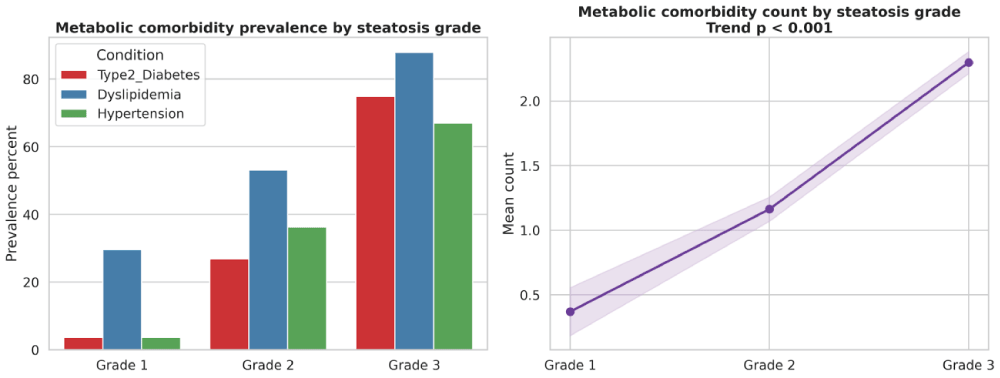
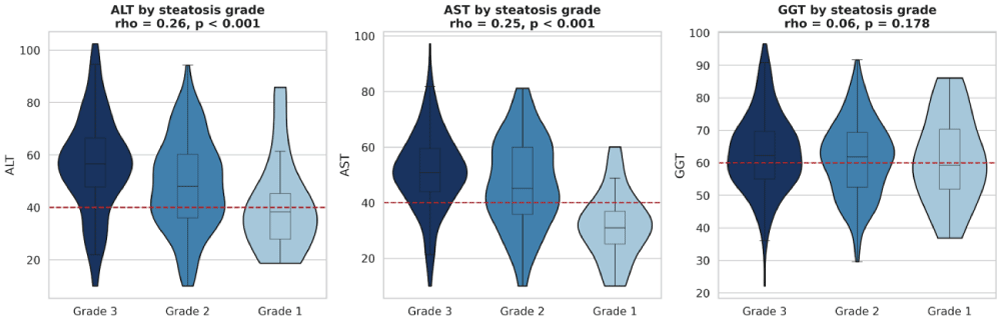
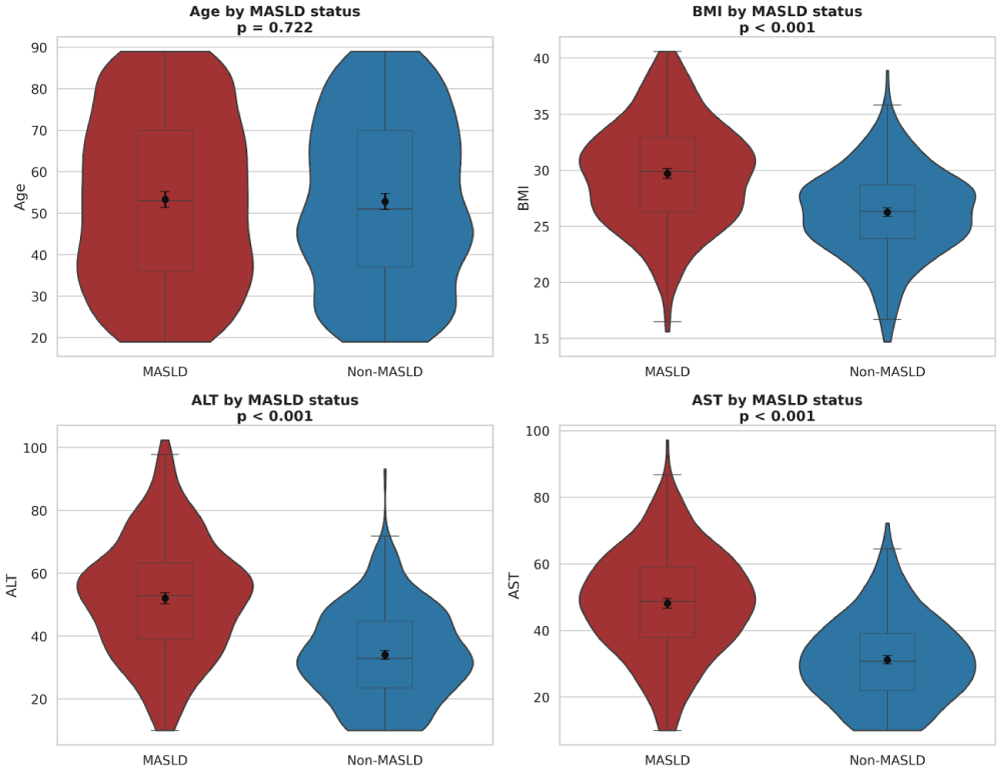
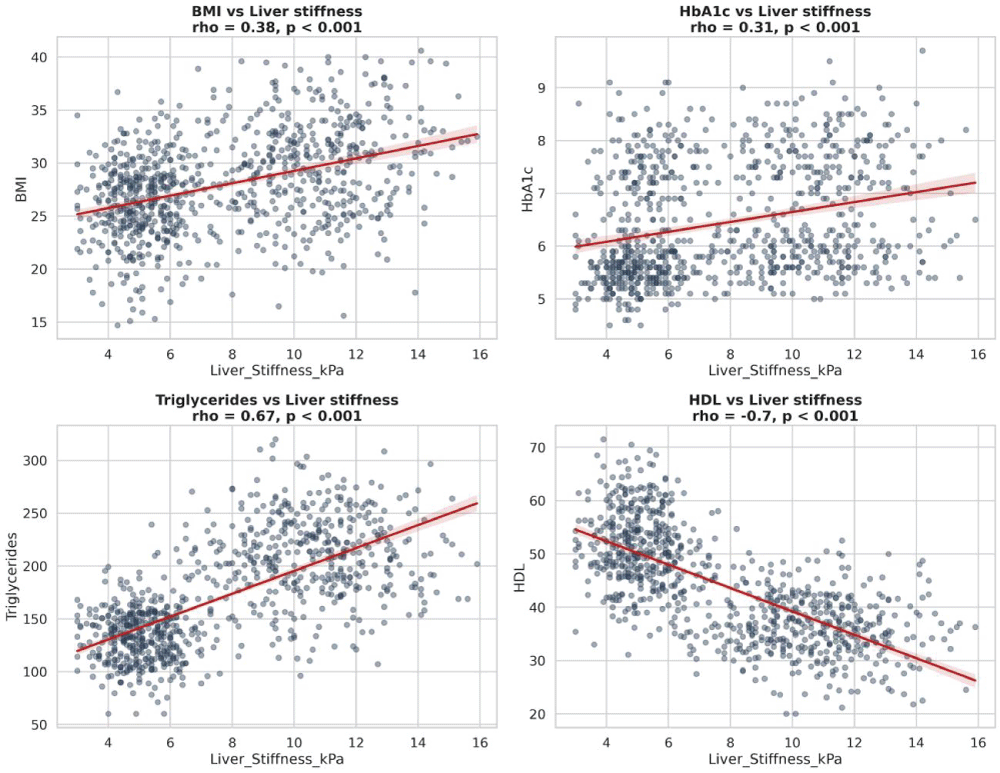
Results: Of 850 patients, 432 (50.8%) met the operational MASLD definition and 418 (49.2%) had no imaging evidence of steatosis. The MASLD group had higher body mass index, aminotransferases, gamma-glutamyl transferase, triglycerides, glycated hemoglobin, and liver stiffness, and lower high-density lipoprotein cholesterol. Type 2 diabetes mellitus and dyslipidemia were more frequent in the MASLD group; however, these comparisons are partly criterion-dependent and should not be interpreted as independent validation of association. Within the MASLD group, increasing steatosis grade was accompanied by higher metabolic comorbidity burden and worsening biochemical and liver-stiffness measurements.
Conclusion: In this tertiary-care cohort, the operational MASLD definition identified patients with an adverse hepatic and cardiometabolic profile. The graded patterns across steatosis severity support integrated metabolic and liver-risk assessment, but the retrospective cross-sectional design, incorporation of cardiometabolic factors into case definition, and non-histologic nature of liver-stiffness measurements limit causal and criterion-independent interpretation.
Figures

References

    1. Eslam M, Newsome PN, Sarin SK, Anstee QM, Targher G, Romero-Gomez M, et al. A new definition for metabolic dysfunction-associated fatty liver disease: An international expert consensus statement. J Hepatol. 2020;73(1):202–209. doi:10.1016/j.jhep.2020.03.039
    2. Younossi ZM, Koenig AB, Abdelatif D, Fazel Y, Henry L, Wymer M. Global epidemiology of nonalcoholic fatty liver disease: Meta-analytic assessment of prevalence, incidence, and outcomes. Hepatology. 2016;64(1):73–84. doi:10.1002/hep.28431
    3. Eslam M, Sanyal AJ, George J. MAFLD: A consensus-driven proposed nomenclature for metabolic associated fatty liver disease. Gastroenterology. 2020;158(7):1999–2014. doi:10.1053/j.gastro.2019.11.312
    4. Tilg H, Effenberger M. From NAFLD to MAFLD: When pathophysiology succeeds. Nat Rev Gastroenterol Hepatol. 2020;17(7):387–388. doi:10.1038/s41575-020-0316-6
    5. Fouad Y, Waked I, Bollipo S, Gomaa A, Ajlouni Y, Attia D. The NAFLD-MAFLD debate: A global perspective. J Hepatol. 2021;74(6):1094–1096. doi:10.1016/j.jhep.2020.12.019
    6. Cusi K, Isaacs S, Barb D, Basu R, Caprio S, Garvey WT, et al. A new era in the management of MAFLD. Nat Rev Gastroenterol Hepatol. 2021;18(3):196–208. doi:10.1038/s41575-020-00396-z
    7. Kaya E, Yilmaz Y. Epidemiology, natural history, and diagnosis of metabolic dysfunction-associated fatty liver disease: a comparative review with nonalcoholic fatty liver disease. Ther Adv Endocrinol Metab. 2022 Dec 10;13:20420188221139650. doi: 10.1177/20420188221139650. PMID: 36533185; PMCID: PMC9747887.
    8. Younossi ZM, Rinella ME, Sanyal AJ, Harrison SA, Brunt EM, Goodman Z, et al. From NAFLD to MAFLD: Implications of a premature change in terminology. Hepatology. 2021;73(3):1194–1198. doi:10.1002/hep.31420
    9. Eslam M, Sarin SK, Wong VW, Fan JG, Kawaguchi T, Ahn SH, et al. The Asian Pacific Association for the Study of the Liver clinical practice guidelines for the diagnosis and management of metabolic associated fatty liver disease. Hepatol Int. 2020;14(6):889–919. doi:10.1007/s12072-020-10094-2
    10. Eslam M, Ahmed A, Després JP, Dixon JB, Foufelle F, Gastaldelli A, et al. Incorporating fatty liver disease in multidisciplinary care and novel clinical trial designs for patients with metabolic diseases. Lancet Gastroenterol Hepatol. 2021;6(9):743–753. doi:10.1016/S2468-1253(21)00132-1
    11. Younossi Z, Anstee QM, Marietti M, Hardy T, Henry L, Eslam M, et al. Global burden of NAFLD and NASH: Trends, predictions, risk factors and prevention. Nat Rev Gastroenterol Hepatol. 2018;15(1):11–20. doi:10.1038/nrgastro.2017.109
    12. Targher G, Corey KE, Byrne CD, Roden M. The complex link between NAFLD and type 2 diabetes mellitus—mechanisms and treatments. Nat Rev Gastroenterol Hepatol. 2021;18(9):599–612. doi:10.1038/s41575-021-00448-y
    13. Targher G, Day CP, Bonora E. Risk of cardiovascular disease in patients with nonalcoholic fatty liver disease. N Engl J Med. 2010;363:1341–50. doi:10.1056/NEJMra0912063
    14. Chalasani N, Younossi Z, Lavine JE, Charlton M, Cusi K, Rinella M, et al. The diagnosis and management of nonalcoholic fatty liver disease: Practice guidance from the American Association for the Study of Liver Diseases. Hepatology. 2018;67(1):328–357. doi:10.1002/hep.29367
    15. Hernaez R, Lazo M, Bonekamp S, Kamel I, Brancati FL, Guallar E, Clark JM. Diagnostic accuracy and reliability of ultrasonography for the detection of fatty liver: A meta-analysis. Hepatology. 2011;54(3):1082–1090. doi:10.1002/hep.24452
    16. Machado MV, Cortez-Pinto H. Non-invasive diagnosis of non-alcoholic fatty liver disease. A critical appraisal. J Hepatol. 2013;58(5):1007–1019. doi:10.1016/j.jhep.2012.11.021
    17. Dulai PS, Singh S, Patel J, Soni M, Prokop LJ, Younossi Z, et al. Increased risk of mortality by fibrosis stage in nonalcoholic fatty liver disease: Systematic review and meta-analysis. Hepatology. 2017;65(5):1557–1565. doi:10.1002/hep.29085
    18. Romero-Gómez M, Zelber-Sagi S, Trenell M, Cusi K, Cortez-Pinto H, Marchesini G. Treatment of MAFLD: Lifestyle and diet modification. J Hepatol. 2021;75(4):1002–1013. doi:10.1016/j.jhep.2021.07.022
    19. Kaya E, Yilmaz Y. Metabolic-associated fatty liver disease (MAFLD): A multisystemic disease beyond the liver. Zhonghua Gan Zang Bing Za Zhi. 2025;33(1):77–87. doi:10.3760/cma.j.cn501113-20250103-00003. PMID: 39929687.
    20. Qu B, Li Z. Exploring non-invasive diagnostics for metabolic dysfunction-associated fatty liver disease. World J Gastroenterol. 2024;30(28):3447–3451. doi:10.3748/wjg.v30.i28.3447. PMID: 39091712; PMCID: PMC11290396.
    21. Imai J, Takashimizu S, Suzuki N, Ohshinden K, Sawamoto K, Mishima Y, et al. Comparative study of MAFLD as a predictor of metabolic disease treatment for NAFLD. Sci Rep. 2024;14(1):13411. doi:10.1038/s41598-024-64301-3. PMID: 38862756; PMCID: PMC11166940.
    22. Fouad Y, Esmat G, Elwakil R, Zakaria S, Yosry A, Waked I, et al. The Egyptian clinical practice guidelines for the diagnosis and management of metabolic associated fatty liver disease. Saudi J Gastroenterol. 2022;28(1):3–20. doi:10.4103/sjg.sjg_357_21. PMID: 35083973; PMCID: PMC8919931.
    23. Lee CH. Metabolic dysfunction-associated fatty liver disease – How relevant is this to primary care physicians and diabetologists? Prim Care Diabetes. 2022;16(2):245–251. doi:10.1016/j.pcd.2022.01.005. PMID: 35086794.
    24. Li Y, Dai C, Ruan Y, Yang H, Zeng H, Huang R, et al. Metabolic dysfunction-associated fatty liver disease and nonalcoholic fatty liver disease from clinical to pathological characteristics: a multi-center cross-sectional study in the real world. Postgrad Med J. 2024;100(1183):319–326. doi:10.1093/postmj/qgae007. PMID: 38272486.
    25. Drapkina, O.; Ivashkin, V.. Risk factors metabolic syndrome and non-alcoholic fatty liver disease in Russian federation in national-wide DIREG-L-01903 STUDY: PP.9.238. Journal of Hypertension 29():p e217-e218, June 2011.
    26. Ivashkin VT, Drapkina OM, Mayev IV, et al. Nonalcoholic fatty liver disease in the Russian Federation: Results of the DIREG 2 study. Ter Arkh. 2015;87(1):34–40. Russian.
    27. Ivashkin VT, Maev IV, Korochanskaya NV, et al. Metabolic syndrome and nonalcoholic fatty liver disease in the Russian Federation: Prevalence and clinical characteristics. Klin Med (Mosk). 2017;95(3):179–186. Russian.
    28. Maev IV, Samsonov AA, Shulpekova YO, et al. Features of nonalcoholic fatty liver disease in different regions of Russia. Ter Arkh. 2018;90(5):30–36. Russian.
    29. Bril F, Cusi K. Management of nonalcoholic fatty liver disease in patients with type 2 diabetes: A call to action. Diabetes Care. 2017;40(3):419–430. doi:10.2337/dc16-1787.
    30. De A, Panigrahi M, Duseja A, Singh SP. Metabolic-dysfunction associated steatotic liver disease (MASLD). Volume 2. Amsterdam: Elsevier; 2025. Chapter 31; p. 861-888. doi: 10.1016/B978-0-443-26711-6.00031-7.
    31. Younossi ZM. Metabolic Dysfunction-Associated Steatohepatitis: From Fibrosis-Based Risk Stratification to Emerging Therapeutic Strategies. Clin Liver Dis. 2026 May;30(2):xix-xx. doi: 10.1016/j.cld.2026.02.001. Epub 2026 Mar 23. PMID: 42142911.
    32. Lazarus JV, Palayew A, Bugianesi E, Shibolet O, Tsochatzis E, Lazarus JA, et al. A cross-sectional study of the public health response to NAFLD: The Global Liver Institute NAFLD Policy Review. J Hepatol. 2022;77(4):1050–1065. doi:10.1016/j.jhep.2022.05.009.
    33. Wong VW, Adams LA, de Lédinghen V, Wong GL, Sookoian S. Noninvasive biomarkers in NAFLD and NASH—current progress and future promise. Nat Rev Gastroenterol Hepatol. 2018;15(8):461–478. doi:10.1038/s41575-018-0014-9.
    34. Younossi ZM, Paik JM, Stepanova M, Ong J, Alqahtani S, Henry L. Clinical profiles and mortality rates are similar for metabolic dysfunction-associated steatotic liver disease and non-alcoholic fatty liver disease. J Hepatol. 2024 May;80(5):647-655. doi: 10.1016/j.jhep.2024.01.014. Epub 2024 Jan 26.
    35. Younossi ZM, de Avila L, Petta S, et al. Diagnostic Accuracy of Noninvasive Tests for Metabolic Dysfunction-associated Steatotic Liver Disease Across Age, Type 2 Diabetes, and Obesity Subgroups: A Multinational Study. Clinical Gastroenterology and Hepatology : the Official Clinical Practice Journal of the American Gastroenterological Association. 2026 Jan:S1542-3565(26)00044-3. DOI: 10.1016/j.cgh.2026.01.016. PMID: 41616900.
    36. Liu Z, Zhang Y, Graham DY, Wang K, Guo S, Wang H, et al. Nonalcoholic fatty liver disease and risk of pancreatitis: A systematic review and meta-analysis. Pancreas. 2020;49(8):1035–1043. doi:10.1097/MPA.0000000000001611.
    37. Miele L, Valenza V, La Torre G, Montalto M, Cammarota G, Ricci R, et al. Increased intestinal permeability and tight junction alterations in nonalcoholic fatty liver disease. Hepatology. 2009;49(6):1877–1887. doi:10.1002/hep.22848.
    38. Chalasani N, Younossi Z, Lavine JE, Diehl AM, Brunt EM, Cusi K, et al. The diagnosis and management of non-alcoholic fatty liver disease: Practice guidance from the American Association for the Study of Liver Diseases. Hepatology. 2018;67(1):328–357. doi:10.1002/hep.29367
    39. Musso G, Gambino R, Cassader M, Pagano G. Meta-analysis: Natural history of non-alcoholic fatty liver disease (NAFLD) and diagnostic accuracy of non-invasive tests for liver disease severity. Annals of Medicine. 2011;43(8):617–649. doi:10.3109/07853890.2010.51862

Why publish with us?

  • Global Visibility – Indexed in major databases

  • Fast Peer Review – Decision within 14–21 days

  • Open Access – Maximize readership and citation

  • Multidisciplinary Scope – Biology, Medicine and Engineering

  • Editorial Board Excellence – Global experts involved

  • University Library Indexing – Via OCLC

  • Permanent Archiving – CrossRef DOI

  • APC – Affordable APCs with discounts

  • Citation – High Citation Potential

Submit Your Article

Advertisement