



Help ?

IGMIN: We're glad you're here. Please click 'create a new query' if you are a new visitor to our website and need further information from us.

If you are already a member of our network and need to keep track of any developments regarding a question you have already submitted, click 'take me to my Query.'

Search

Organised by  IgMin Fevicon

Regional sites

Browse by Subjects

Welcome to IgMin Research – an Open Access journal uniting Biology, Medicine, and Engineering. We’re dedicated to advancing global knowledge and fostering collaboration across scientific fields.

Browse by Sections

At IgMin Research, we bridge the frontiers of Biology, Medicine, and Engineering to foster interdisciplinary innovation. Our expanded scope now embraces a wide spectrum of scientific disciplines, empowering global researchers to explore, contribute, and collaborate through open access.

Special Issues

We aim to connect experts across disciplines to create new pathways for growth.

Members

We aim to connect experts across disciplines to create new pathways for growth.

Articles

We aim to connect experts across disciplines to create new pathways for growth.

Explore Content

We aim to connect experts across disciplines to create new pathways for growth.

Identify Us

We aim to connect experts across disciplines to create new pathways for growth.

IgMin Corporation

Welcome to IgMin, a leading platform dedicated to enhancing knowledge dissemination and professional growth across multiple fields of science, technology, and the humanities. We believe in the power of open access, collaboration, and innovation. Our goal is to provide individuals and organizations with the tools they need to succeed in the global knowledge economy.

Publications Support
[email protected]
E-Books Support
[email protected]
Webinars & Conferences Support
[email protected]
Content Writing Support
[email protected]
IT Support
[email protected]

Search

Select Language

Explore Section

Content for the explore section slider goes here.

Abstract

Abstract at IgMin Research

We aim to connect experts across disciplines to create new pathways for growth.

Medicine Group Research Article Article ID: igmin342

Comparative Study of Glucose Abnormalities Among Senegalese Migrants and Rural Populations

Epidemiology DOI10.61927/igmin342 Affiliation

Affiliation

    1CH St-Charles, Service de Médecine A, 88100 Saint-Die, France

    2Université Cheikh Anta Diop, Département de Géographie, Dakar, Sénégal

    3Université de Lorraine, École de Santé Publique, 54000 Nancy, France

    4Université Cheikh Anta Diop, Faculté de Médecine et Pharmacie, Dakar, Sénégal

87
VIEWS
32
DOWNLOADS
Connect with Us

Abstract

Objective: We compared the prevalence of abnormal glucose status between Senegalese migrants and their relatives staying in their villages in Fuuta (a rural region in the Northern part of Senegal).
Design and methods: We led an exhaustive study on all the Senegalese migrants present in Saint-Die (Vosges, France) (SD) at a 1-year interval. We led a similar study at the same period on their relatives in their villages of Fuuta (F). Study parameters were Weight (W), height, Body Mass Index (BMI), Waist/Hip Ratio (WHR), and Fasting Capillary Glycaemia (FCG) expressed in total blood glucose. We classified patients into normal (N: FCG ≤ 1.00 g/l), Impaired Fasting Glycaemia (IFG: FCG between 1.00 g/l and 1.09 g/l), diabetic (D: FCG > 1.10 g/l when fasting or ≥ 1.80 g/l when not fasting), or abnormal glucose status (IFG + D). SD sample included 74 subjects (58.1% female) of mean age 41.7+/-12.7 years. The sample included 847 subjects (66.9% female) of mean age 37.3+/-17.8 years.
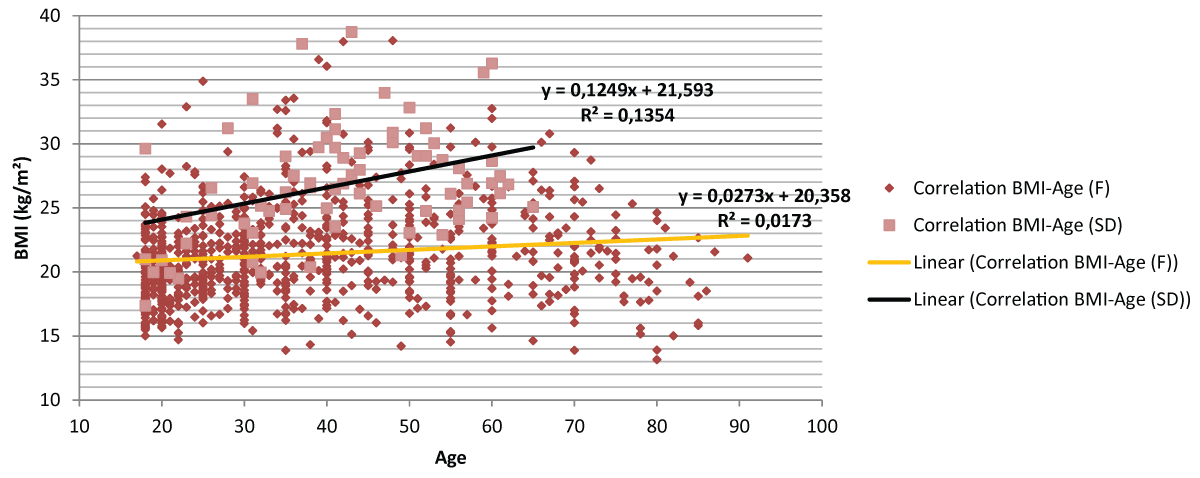
Results: In the SD group, W was 76.8+/-11.4 kg (BMI = 26.80+/-4.30 kg/m2); 57 (77.03%) had normal blood glucose, and 17 (22.97%) had IFG+D, among whom 12 (70.6%) were diabetic. In the F group, W was 60.8+/-10.9 kg (BMI = 21.37+/-3.70 kg/m2); 791 (93.39%) had normal blood glucose, and only 56 (6.61%) had IFG+D, among whom 35 (62.5%) were diabetic. Prevalence of IFG+D between SD and F was significantly different (p < 0.01%). There are still significant differences after standardization on age.
Conclusion: As described in other countries, Senegalese migrants have a much higher risk of developing diabetes mellitus than their relatives remaining in their birth country. The main reason seems to be the nutritional transition (diet and sedentary lifestyle).
Figures

References

    1. Mbanya JCN, Sobngwi E, Assah FK, Enoru ST. Diabetes in sub-Saharan Africa. Lancet. 2010;375:2254-66. PMID: 20609971
    2. Diabetes atlas (4th edn). International Diabetes Federation, 2006.
    3. Sobngwi E, Mauvais-Jarvis F, Vexiau P, Mbanya JCN, Gautier JF. Diabetes in Africans, part 2: ketosis-prone atypical diabetes mellitus. Diabetes Metab. 2002;28:5-12.
    4. Sarr A, Lopez-Sall P, Ndour-Mbaye NM, Diop SN, Sarr GN, Diop O, et al. Frequency of metabolic syndrome in Black Africans, in Senegal. Médecine des Maladies Métaboliques. 2012;6-3:238-43.
    5. Motala AA. Diabetes trends in Africa. Diabetes Metab Res Rev. 2002;18:S14-S20. PMID: 12324980
    6. Fontbonne A, Favier F, Papoz L. Type 2 diabetes in the world: analysis of an epidemic. Journ Annu Diabetol Hotel Dieu. 2003. PMID: 12868301
    7. Osei K, Schuster DP, Amoah AGB, Owusu SK. Diabetes in Africa. Pathogenesis of type 1 and type 2 diabetes in sub-Saharan Africa: implications of transitional populations. J Cardovasc Risk 2003;10:85-96. PMID: 12668905
    8. Fontbonne A, Cournil A, Cames C, Mercier S, N’Diaye-Coly A, Lacroux A, et al. Anthropometric characteristics and cardiometabolic risk factors in a sample of urban-dwelling adults in Senegal. Diabetes Metab. 2011;37:52-58. PMID: 21112227
    9. Osei K, Schuster DE. Metabolic characteristics of African descendants: a comparative study of African-Americans and Ghanaians immigrants using minimal analysis. Diabetologia. 1995;38:1103-1109. PMID: 8591826
    10. Osei K. Metabolic consequences of the West African diaspora: lessons from the thrifty-gene. J Lab Clin Mede. 1999;133:98-111. PMID: 9989761
    11. Okosun IS, Cooper RS, Rotimi CN, Osotimehin B, Forrester T. Association of waist circumference with risk of hypertension and type-2 diabetes in Nigerians, Jamaicans, and African-Americans. Diabetes Care. 1998;11:1836-1842. PMID: 9802730
    12. Haffner SM, Howard G, Mayer E, Bergmann NR, Savage PJ, Rewers M, et al. Insulin sensitivity and acute insulin response in African-Americans, non-Hispanic whites, and Hispanics with NIDDM. The insulin resistance atherosclerosis study. Diabetes. 1997;46:63-69. PMID: 8971083
    13. Sicree RA, Zimmet PZ, Cameron AJ, Magliano DJ, Shaw JE. Diabetes prevalence among migrant populations in Australia: prevalence and risk factor associations. Diabetologia. 2008;51:S427.
    14. Fujimoto WY. The growing prevalence of non-insulin-dependent diabetes in migrant Asian populations and its implications for Asia. Diabetes Res Clin Pract. 1992;15:167-183. PMID: 1563334
    15. Delcourt C, Papoz L. Diabetes and its complications in the French population. Editions Inserm. 1996.
    16. Mbanya JC, Cruickshank JF, Forrester T, Balkau B, Ngogang NY, Riste L, et al. Standardized comparison of glucose tolerance in West-African origin populations of rural and urban Cameroon, Jamaica, and Caribbean migrants to Britain. Diabetes Care. 1999;22:434-440. PMID: 10097925
    17. Henson JJ, Gray LJ, Khunti K, Guru A, Misra A, Davies MJ. The impact of migration on metabolic outcomes and coronary heart disease risk: a comparison of migrant South Asians, Asian Indians and white Europeans. Diabetologia 2010;53:S354.
    18. Ducorps M, Baleynaud S, Mayaudon H, Castagne C, Bauduceau B. A prevalence survey of diabetes in Mauritania. Diabetes Care. 1996;19:761-763. PMID: 8799635
    19. Basdevant A, Laville M, Ziegler O. Practice guideline for the diagnosis, prevention, treatment of obesity in France. Diabetes Metab. 1998;24:10-42. PMID: 9805639
    20. Summer AE, Kushner H, Tulenko TN, Falkner B, Marsch JB. The relationship in African-Americans of sex differences in insulin-mediated suppression of nonesterified fatty acids to sex differences in fasting triglyceride levels. Metabolism. 1997;46:400-405. PMID: 9109843
    21. McLarty DG, Unwin N, Kitange HM, Alberti K. Diabetes mellitus as a cause of death in sub-Saharan Africa: results of a community-based study in Tanzania. The Adult Morbidity and Mortality Project. Diab Med. 1996;13:990-994. PMID: 8946159
    22. Motala Ayesha A, Omar Mohammed AK, Pirie FJ. Diabetes in Africa. Epidemiology of type 1 and type 2 diabetes in Africa. J Cardiovasc Risk. 2003;10:77-83. PMID: 12668904
    23. Brancati FL, Kao WHL, Folsom AR, Watson AR. Incident type 2 diabetes mellitus in African American and white adults: the Atherosclerosis Risk in Communities Study. JAMA. 2000;283:2253-2259. PMID: 10807384
    24. Taylor R, Bennet P, Uili R, Joffres M, Germain R, Levy S, et al. Diabetes in Wallis Polynesian: a comparison of residents of Wallis Islands and first-generation migrants in Noumea, New Caledonia. Diab Res Clin Pract. 1985;1:169-178. PMID: 3836104
    25. Ramachandran A, Snehalatha C, Dharmaraj D, Viswanathan M. Prevalence of glucose intolerance in Asian Indians: urban-rural differences and significance of upper body adiposity. Diabetes Care. 1992;15:1348-1355. PMID: 1425100
    26. Papoz L, Ben Khalifa F, Eschwege E, Ayed HB. Diabetes mellitus in Tunisia: description in urban and rural populations. Int J Epidemiol. 1988;17:419-422. PMID: 3403139
    27. Costagliola D, Delaunay C, Moutet JP, Kankambega P, Demeulemeester R, Donnet JP, et al. The prevalence of diabetes mellitus in the adult population of Guadeloupe as estimated by history or fasting hyperglycemia. Diab Res Clin Pract. 1991;12:209-16.
    28. Connoly V, Unwin N, Sherriff P, Bilous R, Kelly W. Diabetes prevalence and socioeconomic status: a population-based study showing increased prevalence of type 2 diabetes mellitus in deprived areas. J Epid Comm Health. 2000;54:173-177. PMID: 10746110
    29. Gautier JF, Sobngwi E, Vexiau P. How I treat and manage diabetes in black people. 19e Journées de Diabétologie de l’Hôtel-Dieu. 2001.
    30. Buthelezi EP, Van Der Merwe MT, Lönnroth PN, Gray PI, Crowther NJ. Ethnic differences in the responsiveness of adipocyte lipolytic activity to insulin. Obes Res. 2000;8:171-178. PMID: 10757203
    31. Rotimi CN, Dunston GM, Berg K, Akinsete O, Amoah A, Owusu S, et al. In search of susceptibility gene of type 2 diabetes in West Africa: the design and results of the first phase of the AADM study. Ann Epidemiol. 2001;11:51-58. PMID: 11164120
    32. Ricordeau P, Weill A, Vallier N, Fender P, Allemand H. Epidemiology of diabetes in metropolitan France. Diab Metab. 2001;26:11-24. PMID: 11011236
    33. Swinburn BA. The thrifty genotype hypothesis: how does it look after 30 years? Diab Med. 1996;13:695-699. PMID: 8862942
    34. Mejean C, Traissac P, Eymard-Duvernay S, El Ati J, Delpeuch F, Maire B. Influence of socio-economic and lifestyle factors on overweight and nutrition-related diseases among Tunisian migrants versus non-migrant Tunisians and French. BMC Public Health 2007; 7:265. PMCID: PMC2110891
    35. Katte JC, Squires S, Dehayem MY, Balungi PA, Padoa CJ, Sengupta D, et al. Non-autoimmune, insulin-deficient diabetes in children and young adults in Africa: evidence from the Young-Onset Diabetes in sub-Saharan Africa (YODA) cross-sectional study. Lancet Diabetes Endocrinol. 2025;13:745-753. PMID: 40706606
    36. Thieblemont-Dollet S. Actes du Colloque “Lorraine, Terre d’accueil et de brassage des populations”. 2001;7:228-243.
    37. Pedersen MM, Ekstrom CT, Sorensen TI. Emergence of the obesity epidemic preceding the presumed obesogenic transformation of society. Sci Adv. 2023;9:eadge6237. PMID: 37703366

Why publish with us?

  • Global Visibility – Indexed in major databases

  • Fast Peer Review – Decision within 14–21 days

  • Open Access – Maximize readership and citation

  • Multidisciplinary Scope – Biology, Medicine and Engineering

  • Editorial Board Excellence – Global experts involved

  • University Library Indexing – Via OCLC

  • Permanent Archiving – CrossRef DOI

  • APC – Affordable APCs with discounts

  • Citation – High Citation Potential

Submit Your Article

Advertisement