


Help ?

IGMIN: We're glad you're here. Please click 'create a new query' if you are a new visitor to our website and need further information from us.

If you are already a member of our network and need to keep track of any developments regarding a question you have already submitted, click 'take me to my Query.'

Search

Organised by  IgMin Fevicon

Regional sites

Browse by Subjects

Welcome to IgMin Research – an Open Access journal uniting Biology, Medicine, and Engineering. We’re dedicated to advancing global knowledge and fostering collaboration across scientific fields.

Browse by Sections

At IgMin Research, we bridge the frontiers of Biology, Medicine, and Engineering to foster interdisciplinary innovation. Our expanded scope now embraces a wide spectrum of scientific disciplines, empowering global researchers to explore, contribute, and collaborate through open access.

Special Issues

We aim to unite diverse scientific talents to foster dialogue and advance global research.

Members

We aim to unite diverse scientific talents to foster dialogue and advance global research.

Articles

We aim to unite diverse scientific talents to foster dialogue and advance global research.

Explore Content

We aim to unite diverse scientific talents to foster dialogue and advance global research.

Identify Us

We aim to unite diverse scientific talents to foster dialogue and advance global research.

IgMin Corporation

Welcome to IgMin, a leading platform dedicated to enhancing knowledge dissemination and professional growth across multiple fields of science, technology, and the humanities. We believe in the power of open access, collaboration, and innovation. Our goal is to provide individuals and organizations with the tools they need to succeed in the global knowledge economy.

Publications Support
[email protected]
E-Books Support
[email protected]
Webinars & Conferences Support
[email protected]
Content Writing Support
[email protected]
IT Support
[email protected]

Search

Select Language

Explore Section

Content for the explore section slider goes here.

Abstract

Abstract at IgMin Research

We aim to unite diverse scientific talents to foster dialogue and advance global research.

Medicine Group Research Article Article ID: igmin340

Unmyelinated Aortic Baroreceptor Activity is Reduced in a Rabbit Model of Atherosclerosis

Hypertension DOI10.61927/igmin340 Affiliation

Affiliation

    Department of Physiology, Faculty of Biomedical Sciences, University of Otago, PO Box 56, Dunedin 9054, New Zealand

18
VIEWS
10
DOWNLOADS
Connect with Us

Abstract

Aims: Arterial baroreceptors are located in vessels which are subject to atherosclerotic changes. Using a rabbit model, we investigated effects of atherosclerosis on arterial baroreceptors, arterial baroreflex regulation and control of Mean Arterial Pressure (MAP).
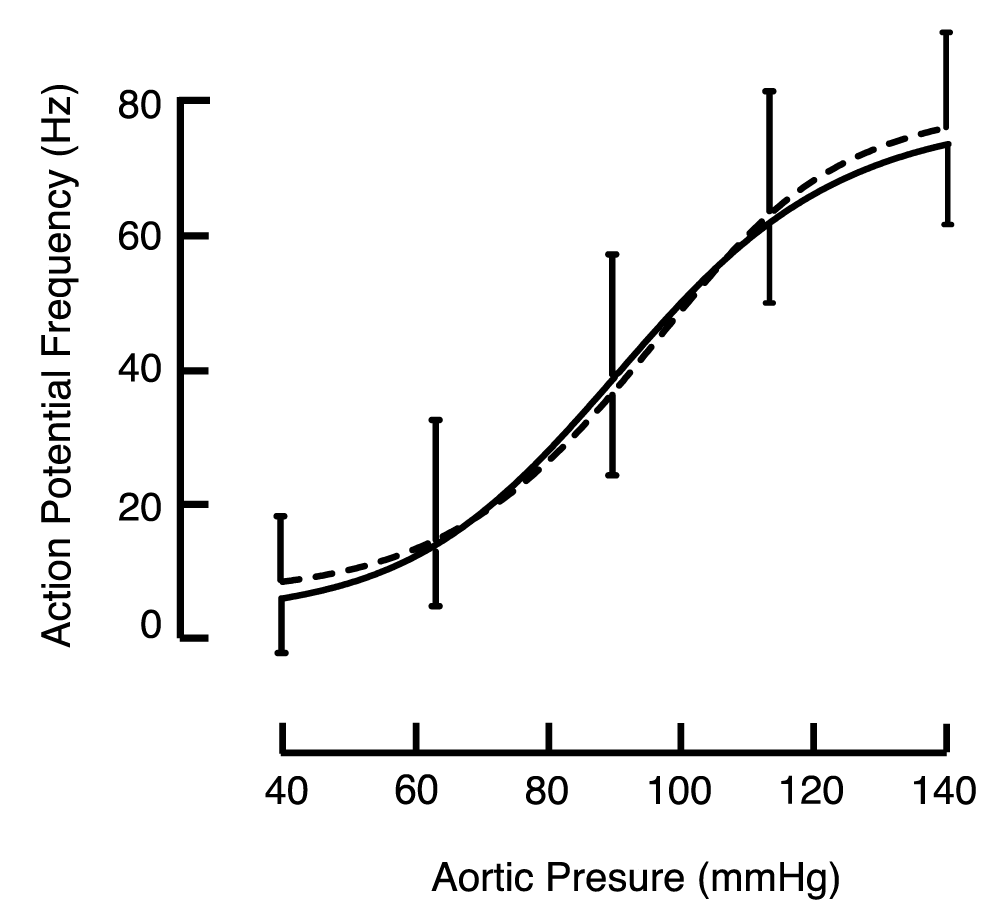
Methods and results: Seven-week-old male New Zealand White rabbits were placed on an atherogenic diet for 14 weeks (treatment). Treatment produced significant atherosclerosis along the aorta, but spared the carotid bifurcation. Treated animals had higher MAP: conscious–(treated: 80.1 [77.3, 82.9] versus control: 70.9 [69.9, 71.9] mmHg; N = 7 and 9 respectively; p = < 0.001) (mean [90% confidence interval]), anaesthetized–(treated: 99.9 [97.2, 102.7] versus control: 95.6 [93.5, 97.7] mmHg, N = 24 for each group; p = 0.050). In anaesthetized animals Pulse Wave Velocity (PWV) along the aorta was higher in treated animals (5.64 [5.54, 5.74] versus 5.07 [4.98, 5.16] m/s in control, N = 24 for each group; p < 0.0001). MAP was ramped (from 40 to 140 mmHg) using inflatable cuffs around the descending aorta and posterior vena cava. Treatment did not affect the activity of individual A-fibre baroreceptors in the ADN. Multifibre records of activity in the left Aortic Depressor Nerve (ADN) and left Carotid Sinus Nerve (CSN), showed that treatment reduced C-fibre baroreceptor activity in the ADN; there was ~16.5% less integrated activity at MAP >100 mmHg in treated animals (4650 [4174, 4988] versus 5570 [5220, 5919] au in control; N = 22 and 20, respectively; p < 0.001). Treatment had no effect on multifibre recordings from the CSN.
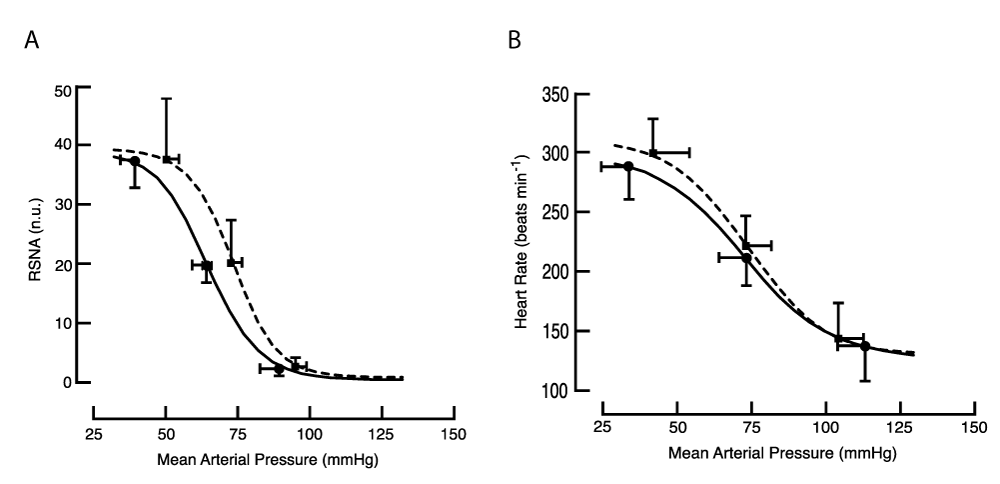
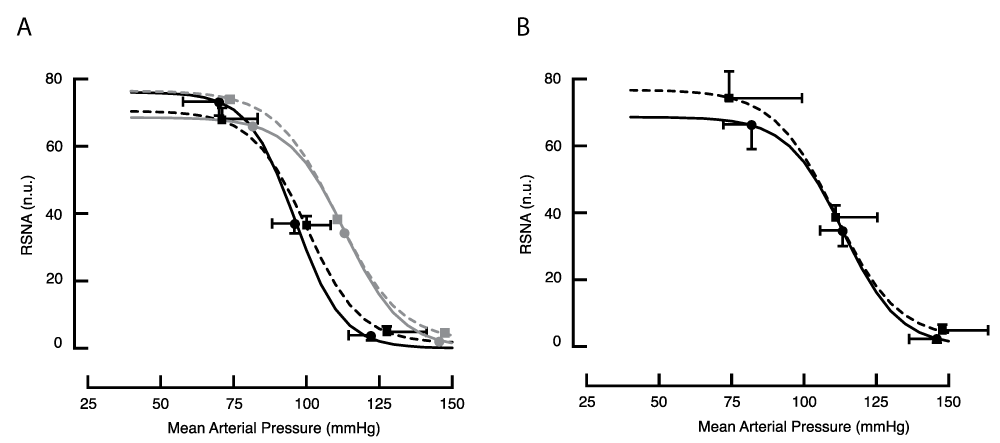
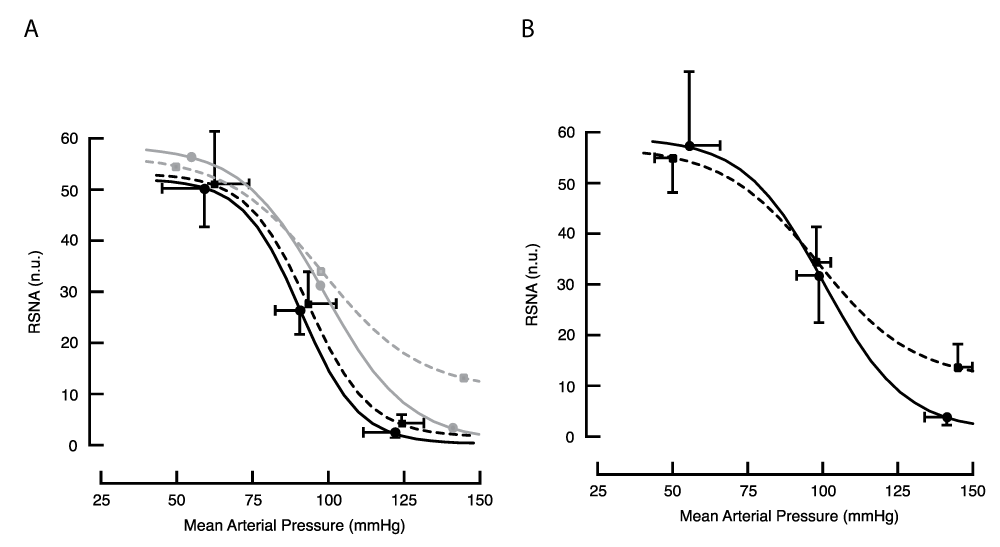
In conscious animals, baroreflex curves describing control of Renal Sympathetic Activity (RSNA) were obtained using i.v. phenylephrine and nitroprusside to modify MAP. Treatment shifted the mid-point of the curve to a higher MAP (72.4 [69.9, 74.8] versus 63.6 [61.3, 65.8] mmHg in control; N = 5 and 8, respectively; p = 0.02. In anaesthetized animals, baroreflex curves for RSNA were obtained using inflatable cuffs to control MAP. When input from the CSN was kept low and steady by common carotid artery occlusion, a high level of MAP was unable to fully inhibit RSNA (12.5 [8.4, 16.6] and 3.9 ([2.6, 5.2] n.u. at saturation in 5 treated and 7 control animals, respectively; p = 0.01).
Conclusion: The loss of aortic C-fibre baroreceptor activity that occurs in this model of atherosclerosis may reset MAP to a higher value, since C-fibre input is likely a controller of MAP.

Figures

References

    1. Incalcaterra E, Accardi G, Balistreri CR, Caimi, G, Candore G, Caruso M, et al. Pro-Inflammatory Genetic Markers of Atherosclerosis. Curr Atheroscler Rep. 2013; 15:329–337. doi: 10.1007/s11883-013-0329-5. PMID: 23591672
    2. Jinnouchi H, Sato Y, Sakamoto A, Cornelissen A, Mori M, Kawakami R, et al. Calcium deposition within coronary atherosclerotic lesions: Implications for plaque stability. Atherosclerosis 2020; 306:85- doi: 10.1016/j.atherosclerosis.2020.05.017. PMID: 32654790.
    3. Poznyak AV, Sadykhov NK, Kartuesov AG, Borisov EE, Melnichenko AA, Grechko AV, et al. Hypertension as a risk factor for atherosclerosis: Cardiovascular risk assessment. Front Cardiovasc Med 2022; 9:959285. doi.org/10.3389/fcvm.2022.959285. PMID: 36072873.
    4. Libby P. The changing landscape of atherosclerosis. Nature 2021; 592:524–533. doi.org/10.1038/s41586-021-03392-8. PMID: 33883728.
    5. Lehmann N, Erbel R, Mahabadi AA, Kälsch H, Möhlenkamp S, Moebus S, et al. Accelerated progression of coronary artery calcification in hypertension, but also prehypertension. J Hypertens 2016; 34:2233–2242. doi: 10.1097/HJH.0000000000001080. PMID: 27512973.
    6. Gonzalez-Guerra A, Roche-Molina M, García-Quintáns N, Sánchez-Ramos C, Martín-Pérez D, Lytvyn M, et al. Sustained Elevated Blood Pressure Accelerates Atherosclerosis Development in a Preclinical Model of Disease. Int J Mol Sci 2021;22:8448. doi: 10.3390/ijms22168448. PMID: 34445154.
    7. Al-Mashhadi AL, Nasr ZP, Mortensen MB, Lewis EA, Camafeita E, Ravlo K, et al. Local Pressure Drives Low-Density Lipoprotein Accumulation and Coronary Atherosclerosis in Hypertensive Minipigs. Am Coll Cardiol 2021;77:575–589. doi: 10.1016/j.jacc.2020.11.059. PMID: 33538256.
    8. Mautner SL, Mautner GC, Hunsberger SA, Roberts WC. Comparison of composition of atherosclerotic plaques in saphenous veins used as aortocoronary bypass conduits with plaques in native coronary arteries in the same men. Am J Cardiol 1992;70:1380–1387. doi: 10.1016/0002-9149(92)90285-7. PMID: 1442604.
    9. Moore GW, Smith RR, Hutchins GM. Pulmonary artery atherosclerosis: correlation with systemic atherosclerosis and hypertensive pulmonary vascular disease. Arch Pathol Lab Med 1982;106:378–380. PMID: 6213213.
    10. Furukawa K, Kawano H, Futakuchi M, Ishijima M, Yamgataga Y, Ueno Y, et al. Pulmonary atherosclerosis in a patient with chronic thromboembolic pulmonary hypertension. Pathol Int 2021;71:164–166. doi:10.1111/pin. 13051. PMID: 33316138.
    11. Prince M, Tafur JD, White CJ. When and how should we revascularize patients with atherosclerotic renal artery stenosis? JACC Cardiovasc Interv 2019;25:505–517. doi: 10.1016/j.jcin.2018.10.023. PMID: 30898248.
    12. Cowley AW Jr. Long-term control of arterial blood pressure. Physiol Rev 1992;72:231–300. doi: 10.1152/physrev. 1992.72.1.231. PMID: 1731371.
    13. Seagard JL, Hopp FA, Drummond HA, Van Wynsberghe DM. Selective contribution of two types of carotid sinus baroreceptors to the control of blood pressure. Circ Res 1993;72:1011–1022. doi: 10.1161/01.res.72.5.1011. PMID: 8477517.
    14. Thrasher TN. Effects of chronic baroreceptor unloading on blood pressure in the dog. Am J Physiol Regul Integr Comp Physiol 2005:288:R863–R871. doi: 10.1152/ajpregu.00489. PMID: 15563576.
    15. Lohmeier TE, Barrett AM, Irwin ED . Prolonged activation of the baroreflex: a viable approach for the treatment of hypertension? Curr Hypertens Rep 2005;7:193–198. doi: 10.1007/s11906-005-0009-0. PMID: 15913493.
    16. Li Z, Mao HZ, Abboud FM, Chapleau MW. Oxygen-derived free radicals contribute to baroreceptor dysfunction in atherosclerotic rabbits. Circ Res 1996;79:802–811. doi: 10.1161/01. res.79.4.802. PMID: 8831504.
    17. Gianaros PJ, Jennings JR, Olafsson GB, Steptoe A, Sutton-Tyrrell K, Muldoon MF, et al. Greater intima-media thickness in the carotid bulb is associated with reduced baroreflex sensitivity. Am J Hypertens 2002;15:486–491. doi: 10.1016/s0895-7061(02)02923-0. PMID: 12074348.
    18. Tsekouras NS, Katsargyris A, Skrapar I, Bastounis EE, Georgopoulos S, Klonar C, et al. The role of carotid plaque echogenicity in baroreflex sensitivity. J Vasc Surg 2011;54:93–99. doi: 10.1016/j.jvs.2010.11.121. PMID: 21458208.
    19. Cox RH, Bagshaw RJ, Detweiler DK. Alterations in carotid sinus reflex control of arterial hemodynamics associated with experimental hyperlipemia in the racing greyhound. Circ Res 1980;46:237–244. doi: 10.1161/01.res.46.2.237. PMID: 7351041.
    20. Morita H, Nishida Y, Motochigawa H, Watanabe Y, Hosomi H. Depressed baroreflex control of renal sympathetic nerve activity in conscious WHHL rabbits. Cardiovasc Res 1988;22:678–685. doi: 10.1093/cvr/22.10.679. PMID: 2476214.
    21. Katsuda S, Hosomi H, Shiomi M, Watanabe Y. Impaired baroreflex control of arterial pressure in WHHL rabbits. J Vet Med Sci 1992; 54:983–987. doi: 10.1292/jvms.54.983. PMID: 1420582.
    22. McCully BH, Brooks VL, Andresen MC. Diet-induced obesity severely impairs myelinated aortic baroreceptor reflex responses. Am J Physiol Heart Circ Physiol 2012;302:H2083–H2091. doi: 10.1152/ajpheart.01200.2011. PMID: 22408022.
    23. Angell-James JE. Arterial baroreceptor activity in rabbits with experimental atherosclerosis. Circ Res 1974;40:27–39. doi: 10.1161/01.res.40.4.27. PMID: 4809347.
    24. Friedewald WT, Levy RI, Fredrickson S. Estimation of the concentration of low-density lipoprotein cholesterol in plasma, without use of the preparative ultracentrifuge. Clin Chem 1972;18:499–502. PMID: 4337382.
    25. Dorward PK, Burke SL, Jänig W, Cassell J. Reflex responses to baroreceptor, chemoreceptor and nociceptor inputs in single renal sympathetic neurones in the rabbit and the effects of anaesthesia on them. J Autonom Nerv Syst 1987;18:39–54. doi: 10.1016/0165-1838(87)90133–0. PMID: 3819315.
    26. Dorward PK, Riedel W, Burke SL, Gipps J, Korner PI. The renal sympathetic baroreflex in the rabbit. Arterial and cardiac baroreceptor influences, resetting, and the effect of anesthesia. Circ Res 1985;57:618–633. doi: 10.1161/01.res.57.4.618. PMID: 4042286.
    27. Burke SL, Head, GA. Method for in vivo calibration of renal sympathetic nerve activity in rabbits. J Neurosci Methods 2003;127:63–74. doi: 10.1016/s0165-0270(03)00121-3. PMID: 12865149.
    28. McDowall LM, Dampney RA. Calculation of threshold and saturation points of sigmoidal baroreflex function curves. Am J Physiol Heart Circ Physiol 2006;291;H2003–2007. doi: 10.1152/ajpheart.00219.2006. PMID: 16714364.
    29. Jones GT, Jiang F, McCormick SP, Dusting GJ. Elastic Lamina Defects Are an Early Feature of Aortic Lesions in the Apolipoprotein E Knockout Mouse. J Vasc Res 2005;42:237–246 doi: 10.1159/000085553. PMID: 15860923.
    30. Aumonier FJ. Histological observations on the distribution of baroreceptors in the carotid and aortic regions of the rabbit, cat and dog. Acta Anat 1972;82:1–16. doi: 10.1159/000143797. PMID: 4669378.
    31. Fan J, Shimoyamada H, Sun H, Marcovina S, Honda K, and Watanabe T. Transgenic rabbits expressing human apolipoprotein(a) develop more extensive atherosclerotic lesions in response to a cholesterol-rich diet. Arterioscler Thromb Vasc Biol 2001;21:88-94. doi:1161/01.atv.21.1.88. PMID: 11145938.
    32. Thoren P, Munch PA, Brown AM. Mechanisms for activation of aortic baroreceptor C-fibres in rabbits and rats. Acta Physiol Scand 1999;166:167–174. doi:10.1046/J.1365-201X.1999.00556.X. PMID: 10468652.
    33. Giannattasio C, Failla M, Emanuelli G, Grappiolo A, Boffi L, Corsi D, et al. Local effects of atherosclerotic plaque on arterial distensibility. Hypertension 2001;38:1177–1180. doi: 10.1161/hy1101.095994. PMID: 11711518.
    34. Makita S, Nakamura S, Hiramori, K. The association of C-reactive protein levels with carotid intima-media complex thickness and plaque formation in the general population. Stroke 2005;36:2138–2142. doi: 10.1161/01.STR.0000181740.74005.ee. PMID: 16151032.
    35. Palombo C, Kozakova M. Arterial stiffness, atherosclerosis and cardiovascular risk: Pathophysiologic mechanisms and emerging clinical indications. Vasc Pharmacol 2016;77:1–7. doi: 10.1016/j.vph.2015.11.083. PMID: 26643779.
    36. Schadt JC, Hasser EM. Hemodynamic effects of acute stressors in the conscious rabbit. Am J Physiol Regul Integr Comp Physiol 1998;274:814–821. doi:10.1152/ajpregu.1998.274.3.R814. PMID: 9530250.
    37. Lim K, Burke SL, Armitage JA, Head GA. Comparison of blood pressure and sympathetic activity of rabbits in their home cage and the laboratory environment. Exp Physiol 2012;97:1263–1271. doi: 10.1113/expphysiol. 2012.064972. PMID: 22613739.
    38. Guyton AC, Coleman TG. Quantitative analysis of the pathophysiology of hypertension 1969;24(5):1–19. PMID: 4306217.
    39. Guyton AC, Coleman TG, Cowley AW, Scheel KW, Manning RD, Norman RA. Arterial pressure regulation: Overriding dominance of the kidneys in long-term regulation and in hypertension. Am J Med 1972;52;584–594. doi:10.1016/0002-9343(72)90050-2. PMID: 4337474.
    40. Esler M. The sympathetic system and hypertension. Am J Hypertens 2000;13:99S–105S. doi: 10.1016/s0895-7061(00)00225-9. PMID: 10921528.
    41. Hall JE. The Kidney, Hypertension, and Obesity. Hypertension 2003;41:625–633. doi: 10.1161/01.HYP.0000052314.95497.78. PMID: 12623970.
    42. Thoren P, Jones JV. Characteristics of aortic baroreceptor C-fibres in the rabbit. Acta Physiol Scand 1977;99:448–456. doi:10.1111/J.1748-1716.1977.TB10397.X. PMID: 855672.
    43. Landgren S. On the excitation mechanism of the carotid baroceptors. Acta Physiol Scand 1952;26:1-34. doi.org/10.1111/j.1748-1716.1952.tb00889.x. PMID: 12985395.
    44. Böck P, Gorgas K. Fine structure of baroreceptor terminals in the carotid sinus of guinea pigs and mice. Cell Tissue Res 1976;170:95–112. doi: 10.1007/BF00220113. PMID: 949737.
    45. Hansson GK, Seifert PS, Olsson G, Bondjers G. Immunohistochemical detection of macrophages and T lymphocytes in atherosclerotic lesions of cholesterol-fed rabbits. Arterioscler Thromb 1991;11:745–750. doi: 10.1161/01. atv.11.3.745. PMID: 2029509.
    46. Pagano PJ, Ito Y, Tornheim K, Gallop PM, Tauber AI, Cohen RA. An NADPH oxidase superoxide-generating system in the rabbit aorta. Am J Physiol Heart Circ Physiol 1995;268:H2274–H2280. doi: 10.1152/ajpheart.1995.268.6.H2274. PMID: 7611477.
    47. Guo GB, Thames MD, Abboud FM. Differential baroreflex control of heart rate and vascular resistance in rabbits. Relative role of carotid, aortic, and cardiopulmonary baroreceptors. Circ Res 1982:50;554–565. doi: 10.1161/01.res.50.4.554. PMID: 6802513.
    48. Thames MD, Ballon BJ. Occlusive summation of carotid and aortic baroreflexes in control of renal nerve activity. Am J Physiol Heart Circ Physiol 1984;246:H851–857. doi:1152/ajpheart.1984.246.6H851. PMID: 6742151.
    49. Hirooka Y, Imaizumi T, Sugimachi M, Takeshita A. Mechanisms involved in aortic baroreceptor excitation during drug-induced aortic pressure elevation in intact rabbits. J Auton Nerv Syst 1992;40:99–106. doi: 10.1016/0165-1838(92)90021-8. PMID: 1464698.
    50. Tanne JH. US guidelines say blood pressure of 120/80 mm Hg is not "normal". Brit Med J 2003;326:1104. doi: 10.1136/bmj. 326.7399.1104-a. PMID: 12763961.

Why publish with us?

  • Global Visibility – Indexed in major databases

  • Fast Peer Review – Decision within 14–21 days

  • Open Access – Maximize readership and citation

  • Multidisciplinary Scope – Biology, Medicine and Engineering

  • Editorial Board Excellence – Global experts involved

  • University Library Indexing – Via OCLC

  • Permanent Archiving – CrossRef DOI

  • APC – Affordable APCs with discounts

  • Citation – High Citation Potential

Submit Your Article

Advertisement