


Help ?

IGMIN: We're glad you're here. Please click 'create a new query' if you are a new visitor to our website and need further information from us.

If you are already a member of our network and need to keep track of any developments regarding a question you have already submitted, click 'take me to my Query.'

Search

Organised by  IgMin Fevicon

Regional sites

Browse by Subjects

Welcome to IgMin Research – an Open Access journal uniting Biology, Medicine, and Engineering. We’re dedicated to advancing global knowledge and fostering collaboration across scientific fields.

Browse by Sections

At IgMin Research, we bridge the frontiers of Biology, Medicine, and Engineering to foster interdisciplinary innovation. Our expanded scope now embraces a wide spectrum of scientific disciplines, empowering global researchers to explore, contribute, and collaborate through open access.

Special Issues

We aim to foster interdisciplinary discussions that contribute to fast-tracking research.

Members

We aim to foster interdisciplinary discussions that contribute to fast-tracking research.

Articles

We aim to foster interdisciplinary discussions that contribute to fast-tracking research.

Explore Content

We aim to foster interdisciplinary discussions that contribute to fast-tracking research.

Identify Us

We aim to foster interdisciplinary discussions that contribute to fast-tracking research.

IgMin Corporation

Welcome to IgMin, a leading platform dedicated to enhancing knowledge dissemination and professional growth across multiple fields of science, technology, and the humanities. We believe in the power of open access, collaboration, and innovation. Our goal is to provide individuals and organizations with the tools they need to succeed in the global knowledge economy.

Publications Support
[email protected]
E-Books Support
[email protected]
Webinars & Conferences Support
[email protected]
Content Writing Support
[email protected]
IT Support
[email protected]

Search

Select Language

Explore Section

Content for the explore section slider goes here.

Table of Contents

Table of Contents at IgMin Research

We aim to foster interdisciplinary discussions that contribute to fast-tracking research.

Article Explorer
Search by
Clear

All Articles
Most Recent Most Viewed Most Downloaded
1 of 255 results
Integrated Health Data System (IHDS): An Evidence-informed Reference Architecture for Interoperable Learning Health Systems

Research Article November 13, 2026

Integrated Health Data System (IHDS): An Evidence-informed Reference Architecture for Interoperable Learning Health Systems

Article Preview Metrics Cite
Published: November 13, 2026 (14d) publication certificate
Integrated Health Data System (IHDS): An Evidence-informed Reference Architecture for Interoperable Learning Health Systems Research Article

Integrated Health Data System (IHDS): An Evidence-informed Reference Architecture for Interoperable Learning Health Systems

MD Nahid Hassan Nishan*

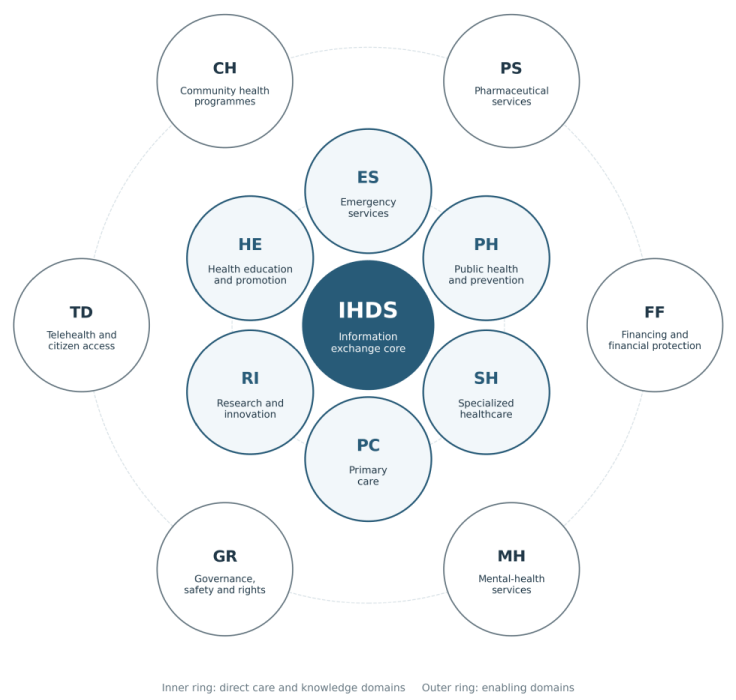
Background: Health systems increasingly rely on digital records, information exchanges, and specialized service platforms, but technical connectivity alone does not ensure coordinated, equitable, and accountable care. This paper proposes the Integrated Health Data System (IHDS), an evidence-informed conceptual reference architecture intended for adaptation across health-system settings. A concentric geometric model is used as a visual language for organizing interdependent capabilities, not as evidence of technical performance.
Methods: A design-science and conceptual framework approach informed a purposive review of WHO and WHO-ITU guidance, OpenHIE and HL7 interoperability specifications, learning-health-system theory, systems thinking, governance scholarship, and emerging-technology evidence. The July 2026 evidence scan was documented by source type, search concepts, selection criteria, and a description of how the evidence informed domain selection. Functions and safeguards were mapped to an exchange-centred design and examined through an internal standards comparison, a hypothetical referral-pathway walkthrough, and explicit appraisal of assumptions and limitations. No prototype or implementation evaluation was undertaken.
Results: IHDS specifies a longitudinal information-exchange core, six direct care and knowledge domains, six enabling domains, including a Pharmaceutical and Life Sciences Ecosystem, five complementary architecture views, cross-cutting interoperability and governance capabilities, an adaptable local-regional-shared-service topology, and a four-stage capability-maturity pathway. Eight testable propositions describe prospective evaluation targets. 
Conclusion: IHDS offers a proposed organizing architecture for interoperable and potentially learning-oriented health systems. Its technical and organizational value remains a hypothesis requiring independent expert assessment, jurisdiction-specific standards mapping, participatory design, and pilot testing before feasibility or outcome claims are warranted.