



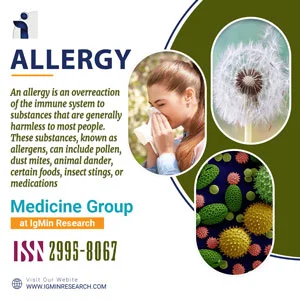
Allergy at IgMin Research | Medicine Group
We aim to facilitate the cross-pollination of ideas across disciplines to boost scientific progress.
About
Allergy is a dynamic and multidisciplinary field that explores the body's hypersensitive immune responses to various substances, known as allergens. These responses can range from mild discomfort to life-threatening reactions. The study of allergies integrates insights from immunology, molecular biology, and clinical medicine to understand the mechanisms that trigger allergic reactions, such as food allergies, drug allergies, and respiratory allergies. Researchers in this area aim to uncover the underlying causes of allergic disorders and develop innovative approaches for diagnosis, prevention, and treatment.
In the broader context of human health, Allergy research addresses the impact of environmental factors, genetic predisposition, and immune system dysregulation on allergic diseases. This field is essential for developing novel therapies, improving diagnostic techniques, and enhancing the quality of life for those affected by allergies. By fostering a deeper understanding of how the immune system interacts with allergens, researchers are paving the way for breakthroughs in allergy management and treatment.

Why publish with us?
Global Visibility – Indexed in major databases
Fast Peer Review – Decision within 14–21 days
Open Access – Maximize readership and citation
Multidisciplinary Scope – Biology, Medicine and Engineering
Editorial Board Excellence – Global experts involved
University Library Indexing – Via OCLC
Permanent Archiving – CrossRef DOI
APC – Affordable APCs with discounts
Citation – High Citation Potential
Which articles are now trending?
Research Articles
- Preparing for SpaceX Mission to Mars
- Current Oscillations and Resonances in Nanocrystals of Narrow-gap Semiconductors
- Malliavin Calculus as Stochastic Backpropagation for Gaussian Latent Models: A Variance-Optimal Hybrid Framework
- Study of the Histological Features of the Stroma of High-Grade Gliomas Depending on the Status of the Mutation in the IDH1 Gene
- Melanocytic Nevi Classification using Transfer Learning
- A Machine Learning-based Method for COVID-19 and Pneumonia Detection